
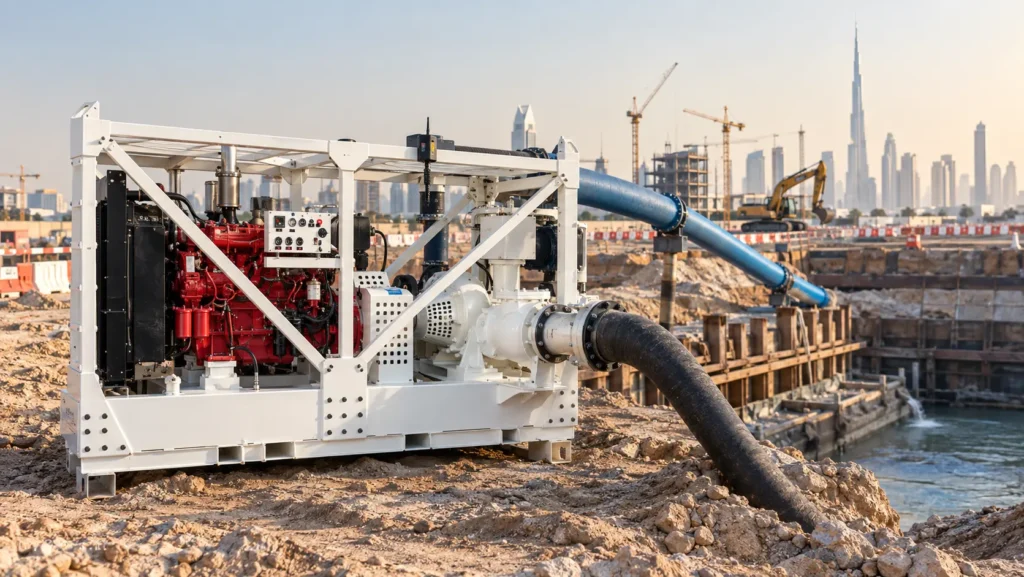
Choosing a dewatering pump suppliers in UAE is not simply a matter of comparing pump prices. For construction, mining, infrastructure, oil and gas, municipal and industrial projects, the supplier must be able to match the pump to the actual hydraulic duty, site conditions, water quality, operating hours, mobility requirements and maintenance strategy.
A pump that looks suitable on a specification sheet can still underperform if the required flow is calculated incorrectly, the total dynamic head is underestimated, suction conditions are ignored, or the pump is not designed for sand, silt or other solids.
For contractors and procurement teams sourcing dewatering pump suppliers in UAE, the right approach is to evaluate the complete pumping solution—not just the pump itself.
This guide explains what to look for when comparing dewatering pump suppliers in Dubai , including diesel dewatering pumps, self-priming pumps, high-flow pumps, submersible systems, wellpoint dewatering systems and industrial water-transfer equipment.
Featured answer: The right dewatering pump suppliers in UAE should be able to demonstrate suitable hydraulic performance, appropriate pump construction, reliable priming, correct driver selection, documented testing, spare-parts availability, technical support and experience with the environmental and operating conditions of the intended project.
Table of Contents
- Why Dewatering Pump Selection Matters
- What a Dewatering Pump Supplier Should Provide
- Understand the Pump Duty Before Comparing Manufacturers
- Flow Rate and Total Dynamic Head
- Suction Lift and Priming
- Water Quality and Solids Handling
- Diesel vs Electric Dewatering Pumps
- Self-Priming vs Submersible Pumps
- When to Use Wellpoint Dewatering Systems
- Pump Selection by Industry
- UAE and GCC Project Considerations
- How to Evaluate a Pump Manufacturer
- Manufacturer vs Local Supplier vs Rental
- Technical Specification Checklist
- Maintenance Requirements
- Common Dewatering Pump Problems
- 2026 Industrial Pump Trends
- 2027–2028 Technology Outlook
- Buying Checklist
- Frequently Asked Questions
- Conclusion
Why Dewatering Pump Selection Matters
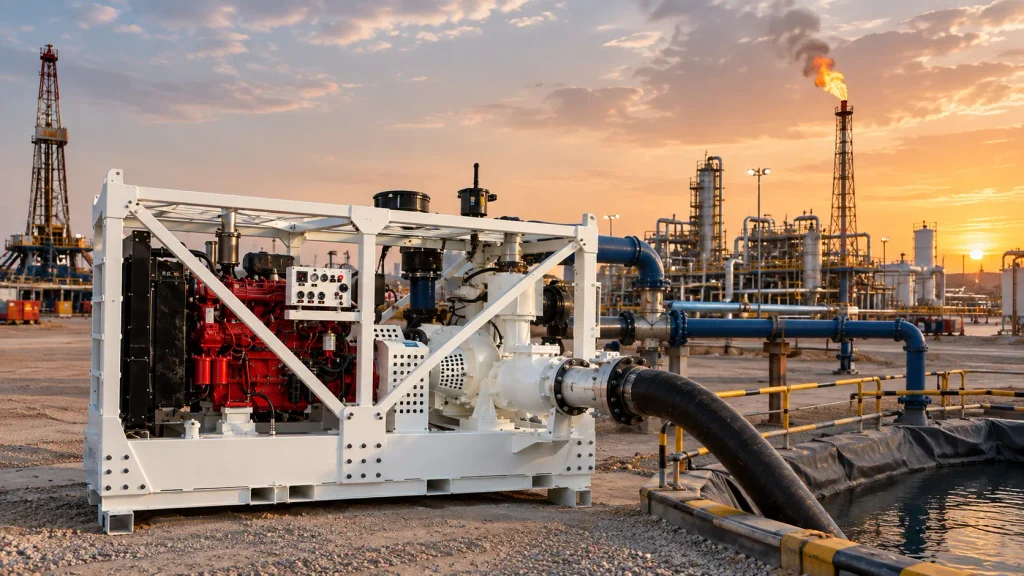
Dewatering is often treated as a temporary site activity, but its effect on a project can be substantial.
Groundwater, rainwater, seepage and process water can accumulate in:
- Building excavations
- Basement structures
- Utility trenches
- Road projects
- Tunnels
- Open-pit mines
- Quarries
- Pipeline corridors
- Industrial foundations
- Municipal drainage areas
- Flooded sites
Effective dewatering helps contractors maintain workable excavation conditions and manage groundwater during construction.
In Dubai, for example, groundwater dewatering at construction sites is subject to municipal permitting requirements, and Dubai Municipality separately identifies requirements for groundwater discharge and discharge into temporary lagoons or other receiving systems.
Abu Dhabi Municipality has also published construction-site dewatering requirements stating that contractors, consultants and developers must obtain relevant approvals and permits and comply with applicable dewatering and discharge requirements.
This means pump selection should form part of the overall water-management plan, not be treated as an isolated equipment purchase.
What Should a Dewatering Pump Supplier Provide?
A professional dewatering pump supplier in Abu Dhabi should be able to provide more than a product brochure.
Before issuing a purchase order, ask for:
- Pump performance curve
- Flow/head operating point
- Pump model and size
- Driver specification
- Engine or motor details
- Priming arrangement
- Suction limitations
- Solids-handling capability
- Material specifications
- Fuel tank capacity where applicable
- Mounting configuration
- Trailer/skid information
- Spare-parts availability
- Recommended maintenance schedule
- Factory test documentation
- Warranty terms
- Technical support
- Delivery documentation
- Installation guidance
For large projects, also request information about:
- Duty and standby configuration
- Emergency backup
- Remote monitoring
- Fuel management
- Noise requirements
- Environmental requirements
- Discharge arrangements
- Site commissioning
- Operator training
A complete pumping package can prevent problems that are not visible when comparing only pump prices.
Understand the Pump Duty Before Comparing Manufacturers
One of the most common procurement mistakes is asking:
“What is the biggest pump you have?”
The better question is:
“What pump can deliver our required flow at our actual system head?”
A proper pump-selection exercise starts with the application.
Key information required
| Parameter | Why it matters |
|---|---|
| Required flow | Determines pumping capacity |
| Static lift | Determines elevation component |
| Discharge distance | Affects friction losses |
| Pipe diameter | Influences hydraulic losses |
| Number of bends | Adds system resistance |
| Valve arrangement | Adds additional losses |
| Suction lift | Affects priming and inlet conditions |
| Water temperature | Can affect materials and seals |
| Solids | Determines pump construction |
| Particle size | Determines solids-handling requirement |
| Operating hours | Influences duty and maintenance |
| Power availability | Helps select diesel/electric |
| Mobility | Determines skid/trailer requirements |
| Environment | Influences materials and protection |
A pump should be selected against its actual operating point, not simply its advertised maximum flow.
Pump-selection guidance from Atlas Copco similarly emphasizes factors such as durability, versatility, transportability and application conditions when selecting dewatering equipment.
Flow Rate and Total Dynamic Head
What is flow rate?
Flow rate is the quantity of water that the pump must move during a specified period.
Common units include:
- m³/hr
- L/min
- L/s
- GPM
For example:
Required flow = 250 m³/hr
does not mean a pump advertised at “250 m³/hr maximum flow” will necessarily deliver 250 m³/hr on site.
The actual flow depends on the system head.
What is total dynamic head?
Total dynamic head, or TDH, includes the elevation difference plus hydraulic losses in the discharge system.
A simplified engineering relationship is:
TDH = Static Head + Friction Head + Minor Losses
Friction losses are influenced by:
- Pipe diameter
- Pipe length
- Flow velocity
- Pipe material
- Bends
- Valves
- Fittings
- Elevation
Therefore, a pump moving water 20 metres vertically through a short pipe has a very different duty from a pump moving water 20 metres vertically through several hundred metres of discharge pipeline.
Pump selection rule
Always select the pump from the performance curve at the required duty point.
Do not select a pump based solely on:
- Maximum flow
- Discharge diameter
- Engine horsepower
- Pump size
- Purchase price
Suction Lift and Priming
Suction conditions become particularly important for surface-mounted self-priming pumps.
A surface pump must establish the hydraulic connection between the pump and the water source before normal pumping begins.
For temporary construction and industrial applications, automatic or vacuum-assisted priming can reduce manual intervention.
Self-priming and automatic self-priming systems are widely used in construction, municipal, industrial and emergency-response applications. Xylem’s Godwin SD series, for example, is positioned for these demanding applications.
When evaluating a supplier, ask:
- What is the maximum recommended suction lift?
- What priming system is used?
- How quickly can the pump establish prime?
- Can the pump tolerate intermittent air entry?
- What happens if the sump level falls?
- What seal arrangement is used?
- What maintenance is required for the priming system?
These questions are often more important than simply comparing pump horsepower.
Water Quality and Solids Handling
Not every dewatering application involves clean water.
Construction and mining sites can contain:
- Sand
- Silt
- Clay
- Gravel
- Mud
- Abrasive particles
- Organic debris
- Sludge
- Process solids
A standard clean-water pump may not be appropriate for heavily contaminated or solids-laden water.
For mining applications, pump selection can involve different configurations for open-pit drainage, underground drainage, stage dewatering, shaft drainage and slurry handling. Xylem’s mining guidance illustrates how pump configuration changes according to the location and characteristics of the water.
Ask the manufacturer about:
- Maximum solids size
- Solids concentration
- Impeller design
- Casing material
- Wear components
- Mechanical seals
- Abrasion resistance
- Spare-part availability
- Expected wear rate
Tip: Never assume that a larger discharge pipe automatically means better solids handling. Verify the manufacturer’s documented solids-passage rating.
Diesel vs Electric Dewatering Pumps
The choice between diesel dewatering pumps and electric pumps should be based on the site rather than on a universal preference.
Diesel pumps
Diesel engine pumps are particularly useful where:
- Grid power is unavailable
- The work area moves frequently
- Emergency pumping is required
- Construction starts before permanent power
- The pump must be trailer-mounted
- Remote mining operations require independent equipment
- Temporary pumping infrastructure must be rapidly deployed
A diesel pump package combines the pump, engine and associated systems into a self-contained unit.
Electric pumps
Electric pumps may suit:
- Fixed installations
- Sites with reliable electrical supply
- Long-duration pumping
- Applications where local exhaust emissions are undesirable
- Locations where noise reduction is important
The current 2026 industry discussion increasingly treats diesel-vs-electric as a site logistics and lifecycle decision, rather than simply a pump-performance decision.
Diesel vs Electric Comparison
| Factor | Diesel | Electric |
|---|---|---|
| External power | Not normally required | Required |
| Mobility | High | Depends on cable/power setup |
| Remote sites | Strong fit | Requires generator/grid |
| Emergency deployment | Practical | Depends on power availability |
| Local exhaust | Yes | No at point of use |
| Refuelling | Required | Not required |
| Noise | Generally higher | Generally lower |
| Long fixed operation | Application-dependent | Often suitable |
| Maintenance | Engine + pump | Motor + pump |
| Site infrastructure | Fuel logistics | Electrical infrastructure |
There is no universal choice. The pump wet end still has to meet the hydraulic duty regardless of the selected driver.
Self-Priming vs Submersible Dewatering Pumps
Both configurations have important applications.
| Factor | Self-Priming Surface Pump | Submersible Pump |
|---|---|---|
| Installation | Above water | Installed in water |
| Access | Easy surface access | Requires lifting/removal |
| Mobility | High | High depending on system |
| Priming | Automatic systems available | Not normally required |
| Flood response | Very useful | Very useful |
| Deep groundwater | May require different system | Often suitable |
| Wellpoint applications | Common with suitable system | Application-specific |
| Maintenance access | Convenient | More involved |
| Solids handling | Model-dependent | Model-dependent |
Atlas Copco’s UAE range includes both self-priming and submersible dewatering equipment, reflecting the fact that different site conditions call for different configurations.
When Should You Use a Wellpoint Dewatering System?
Wellpoint systems are used to lower groundwater around excavations.
They can be appropriate for:
- Deep excavations
- Trenches
- Foundations
- Utility corridors
- Underground structures
- Groundwater control projects
A wellpoint system typically includes:
- Wellpoints
- Header pipe
- Suction connections
- Pump
- Vacuum/priming system
- Discharge arrangement
The pump should be selected according to the hydraulic and vacuum requirements of the complete wellpoint system.
Saudi road-code documentation published by the Road General Authority describes wellpoint systems for certain dewatering works and specifies requirements including backup equipment, suitable vacuum-assisted pumps and groundwater monitoring.
This is a good example of why procurement teams should assess the complete dewatering system, rather than simply buying a pump.
Pump Selection by Industry
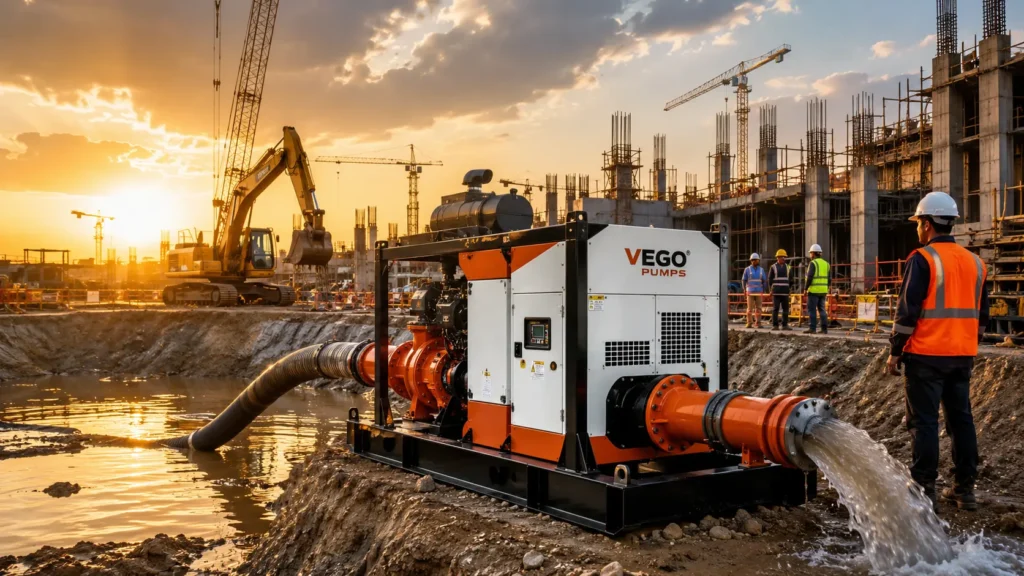
Construction
Typical requirements:
- Fast deployment
- Variable water inflow
- Trailer/skid mounting
- Self-priming operation
- High-flow pumping
- Emergency backup
Applications include:
- Foundations
- Basements
- Excavations
- Tunnels
- Trenches
- Infrastructure construction
Construction-site dewatering also needs to account for groundwater, stormwater, sediment and discharge management.
Mining
Mining applications can demand:
- High flow
- High head
- Abrasion resistance
- Solids handling
- Long operating hours
- Portable systems
- Backup capacity
Open-pit and underground mining can require different pump configurations, including surface, submersible, multistage and slurry systems.
Oil & Gas
Projects may require:
- Reliable drainage
- Pipeline trench dewatering
- Excavation dewatering
- Sump pumping
- Hazardous-area considerations
- High-pressure water transfer
- Documentation and certification
The pump package must be evaluated against the project’s specific safety classification and site requirements.
Municipal and Flood Control
Flood-control applications prioritize:
- High flow
- Rapid deployment
- Reliable starting
- Emergency response
- Trailer mobility
- Long operating cycles
A flood water pump should be selected according to the actual floodwater conditions, debris level, required discharge route and duty point.
Marine and Coastal Projects
Marine environments may introduce:
- Saline water
- Corrosion
- Sand
- Sediment
- Restricted access
- Continuous-duty requirements
Material selection and corrosion protection therefore become important procurement criteria.
UAE and GCC Project Considerations
The UAE is not simply one generic pumping environment.
Site conditions can differ between:
- Dubai
- Abu Dhabi
- Sharjah
- Ras Al Khaimah
- Fujairah
- Al Ain
Before purchasing a pump, confirm:
- Required permits
- Discharge location
- Environmental requirements
- Site power
- Access restrictions
- Noise requirements
- Fuel storage requirements
- Working temperature
- Salinity
- Water quality
- Required documentation
Dubai Municipality explicitly provides a service for obtaining or renewing a permit for groundwater dewatering at construction sites.
Abu Dhabi’s published construction dewatering circular similarly requires applicable approvals and permits for dewatering and discharge activities.
Saudi Arabia also regulates protection of water resources and environmental requirements associated with dewatering and groundwater management.
For procurement teams, this means technical compliance and discharge planning should be discussed before equipment arrives on site.
How to Evaluate a Dewatering Pump Manufacturer
Before selecting a manufacturer, review these ten areas.
1. Manufacturing capability
Ask:
- Is the pump manufactured in-house?
- Where are machining and fabrication performed?
- Is final assembly controlled by the manufacturer?
- Are pumps factory tested?
2. Hydraulic documentation
Request:
- Pump curve
- Flow/head data
- Efficiency data where available
- Duty-point information
- Engine/motor data
3. Materials
Confirm:
- Casing material
- Impeller material
- Shaft material
- Seal construction
- Wear components
4. Priming system
Understand:
- Vacuum pump
- Automatic priming
- Priming tank
- Dry-run capability
- Air handling
5. Mobility
Consider:
- Trailer mount
- Skid mount
- Lifting points
- Forklift access
- Transport dimensions
6. Serviceability
Look for:
- Accessible wear parts
- Standard components
- Service access
- Local technical support
- Spare-part availability
7. Engine support
For diesel units, check:
- Engine manufacturer
- Local service availability
- Filter availability
- Fuel consumption
- Service intervals
8. Documentation
Request:
- Technical datasheet
- Performance curve
- Test certificate
- Installation instructions
- Operation manual
- Spare-parts list
9. Customization
Industrial projects may require:
- Different engine options
- Special materials
- Skid dimensions
- Trailer configurations
- High-head versions
- Special discharge arrangements
10. After-sales support
A low purchase price becomes less attractive if critical parts or technical assistance are difficult to obtain.
Manufacturer vs Local Supplier vs Rental
| Procurement route | Typical advantage | Key question |
|---|---|---|
| Manufacturer | Direct technical communication | Can they support your region? |
| Local supplier | Local availability | What is their stock and service capability? |
| Rental company | Lower initial commitment | What equipment and backup are included? |
| Distributor | Regional support | How strong is manufacturer access? |
| Project contractor | Complete service | Who owns technical responsibility? |
The correct commercial model depends on project duration, capital budget, equipment utilization and operational risk.
For a short project, rental may be commercially appropriate.
For repeated projects, purchasing may make more sense.
For long-term contractors, a combination of owned equipment plus emergency rental backup can also be considered.
Dewatering Pump Selection Guide
| Application | Typical pump consideration | Key parameters |
|---|---|---|
| Foundation excavation | Self-priming/submersible | Flow, head, solids |
| Deep excavation | Wellpoint/deep-well system | Drawdown, groundwater inflow |
| Mine pit | Heavy-duty/high-head | Flow, head, abrasion |
| Quarry | Solids-capable pump | Abrasion, solids |
| Flood response | High-flow mobile pump | Flow, deployment time |
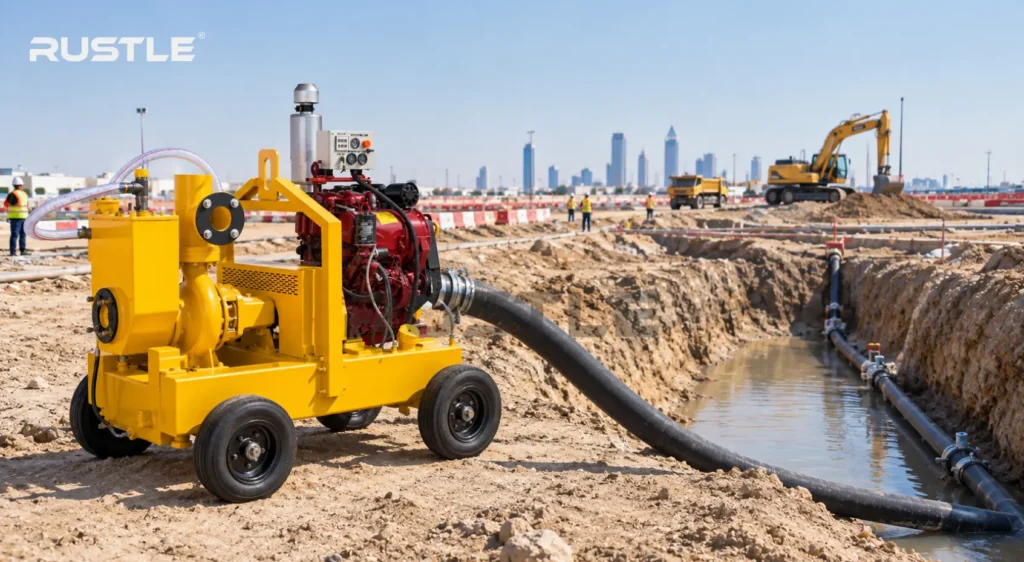
| Pipeline trench | Diesel self-priming | Mobility, suction, flow |
| Municipal drainage | High-flow pump | Flow, head, debris |
| Industrial sump | Self-priming/submersible | Solids, temperature |
| Sewage/sludge | Solid-handling pump | Particle size, viscosity |
| Marine work | Corrosion-resistant configuration | Salinity, materials |
Flow Rate Guide
The following is a selection framework, not a pump-sizing specification:
| Project requirement | Pump-selection focus |
|---|---|
| Low-volume drainage | Compact dewatering pump |
| Medium excavation | 4–6 inch class, subject to duty |
| Large excavation | 6–12 inch class, subject to duty |
| Major flood control | High-flow pump system |
| Mine drainage | High-flow/high-head configuration |
| Long-distance transfer | Head and friction become critical |
| Wellpoint system | Vacuum and groundwater drawdown |
| Heavy solids | Solid-handling/slurry configuration |
The final pump should always be selected from the manufacturer’s performance curve.
Advantages of Heavy-Duty Dewatering Pumps
A properly specified heavy-duty pump can provide:
- High water-removal capacity
- Rapid deployment
- Continuous operation
- Reduced manual priming
- Improved mobility
- Easier maintenance
- Better solids tolerance
- Flexible installation
- Emergency response capability
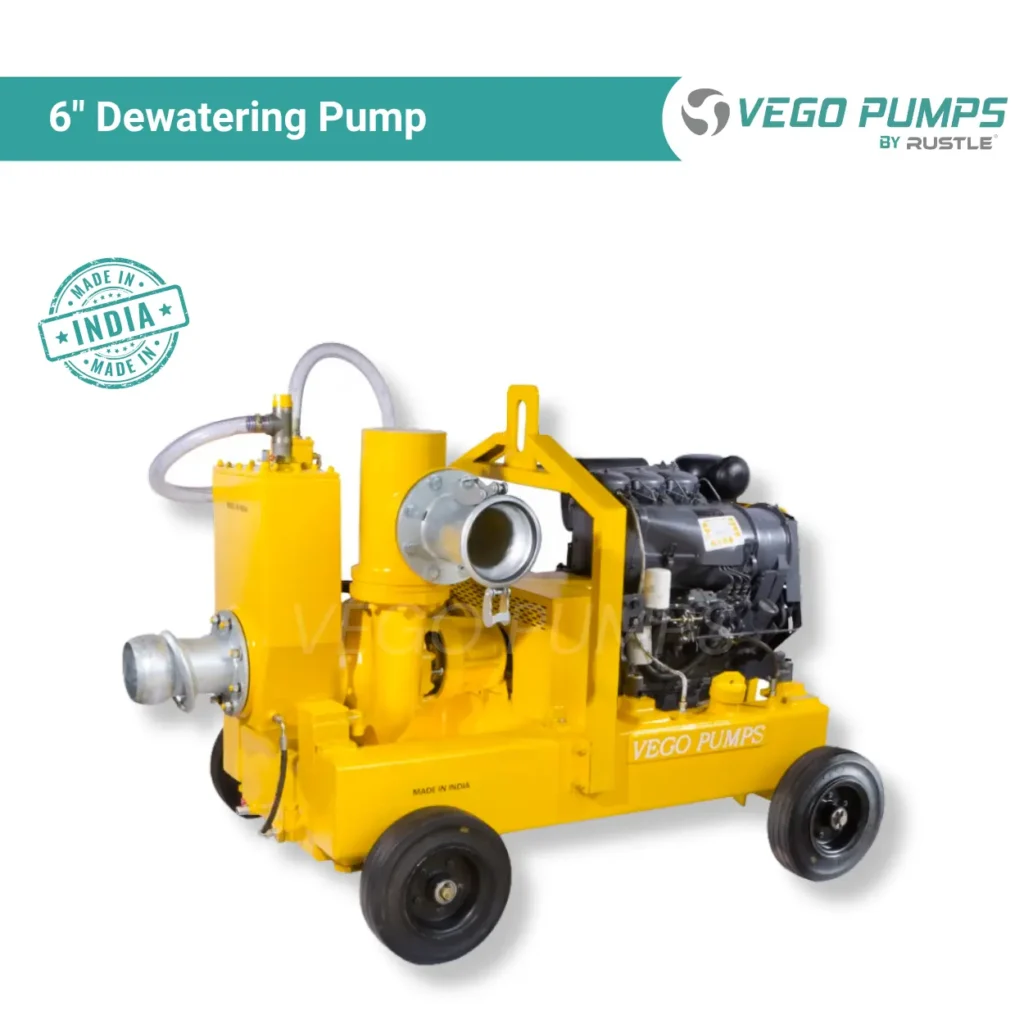
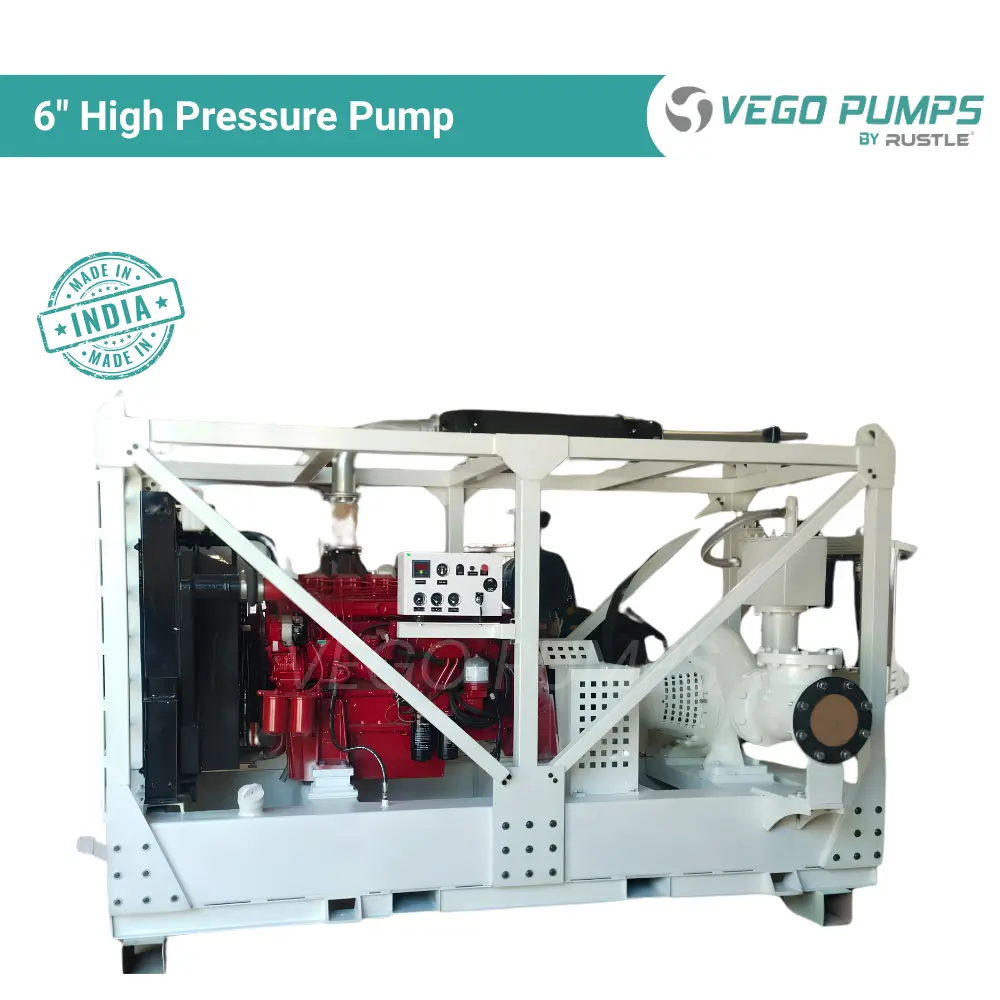
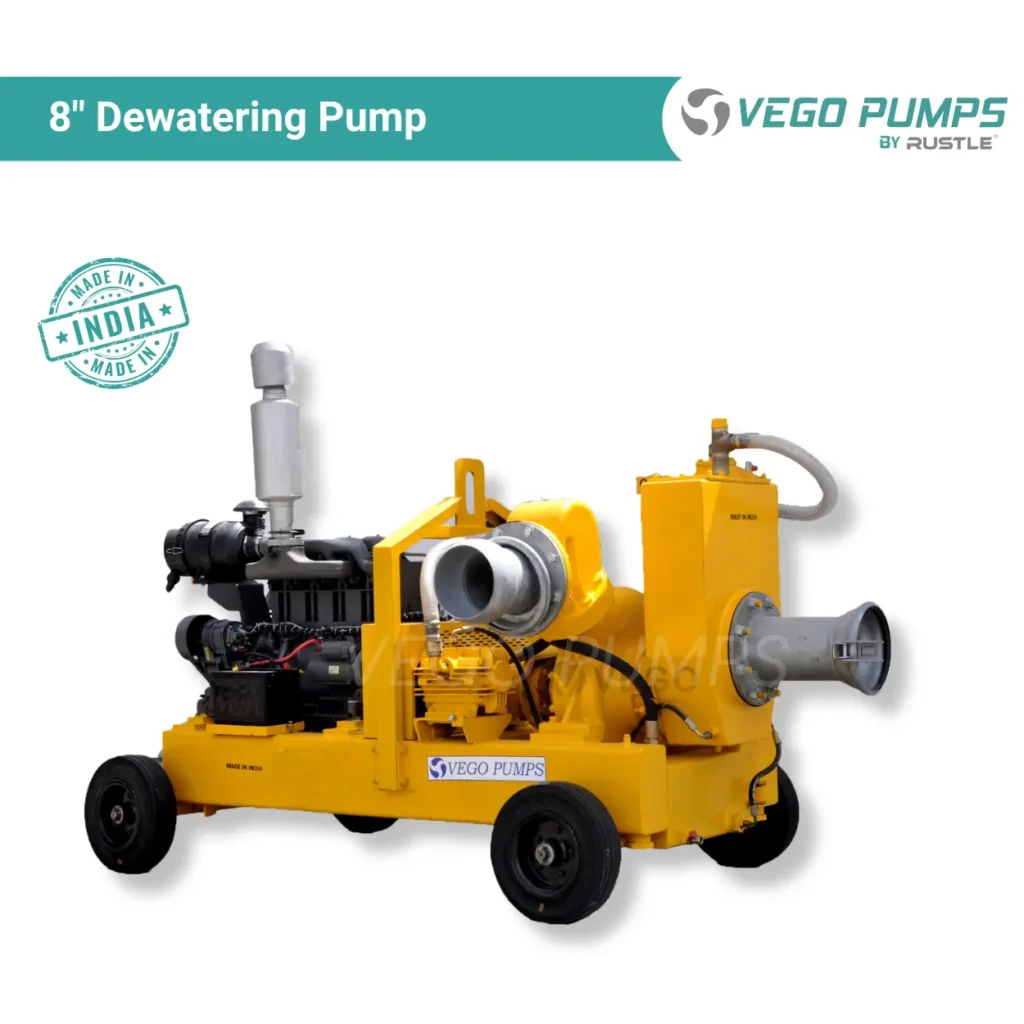
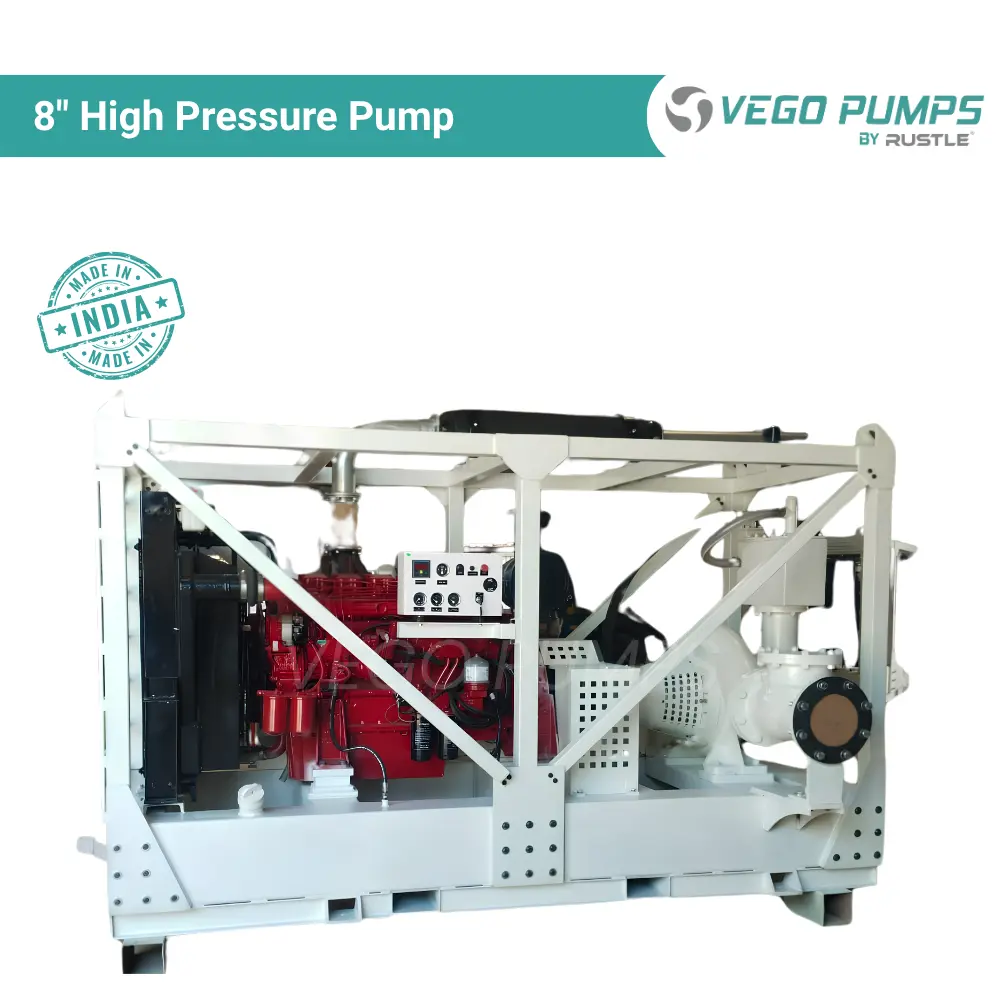
VEGO’s published range includes auto-priming diesel dewatering pumps, high-capacity models, high-head models and solid-handling configurations.
Diesel vs Electric: Lifecycle Considerations
Do not compare only:
Purchase Price A vs Purchase Price B
Instead consider:
Total Cost of Ownership = Capital Cost + Energy/Fuel + Maintenance + Spares + Transport + Downtime + Service
For a remote construction site, diesel may reduce dependency on electrical infrastructure.
For a fixed site with reliable power, electric operation may offer different operating economics.
The important point is to calculate the complete project cost.
Maintenance Checklist
| Check | Typical action |
|---|---|
| Engine oil | Inspect according to engine schedule |
| Fuel system | Check contamination/leaks |
| Mechanical seals | Inspect for leakage |
| Bearings | Check condition/lubrication |
| Impeller | Inspect for wear |
| Casing | Inspect erosion/damage |
| Suction hose | Check collapse/damage |
| Discharge hose | Check wear/leaks |
| Strainer | Clean regularly |
| Vacuum system | Check operation |
| Fasteners | Inspect/tighten |
| Trailer/skid | Inspect structure |
| Instrumentation | Verify gauges/sensors |
| Pump performance | Compare actual flow/head |
| Spare parts | Maintain critical stock |
Maintenance frequency should reflect operating hours, water quality, solids concentration and actual wear. Current industry guidance similarly recommends inspecting seals, bearings, impellers, hoses, strainers, fasteners and the driver system according to operating conditions rather than relying on a single universal interval.
Common Dewatering Problems and Solutions
| Problem | Possible cause | Recommended investigation |
|---|---|---|
| Pump not priming | Air leak/suction issue | Check suction line and priming system |
| Low flow | Excessive head | Review pump curve and discharge line |
| High vibration | Bearing/imbalance issue | Inspect rotating assembly |
| Frequent seal failure | Abrasive water/misalignment | Review water and installation |
| Impeller wear | Sand/abrasives | Review materials and solids |
| Engine overload | Incorrect operating point | Check pump duty |
| Excessive fuel use | Poor operating point | Review flow/head and engine loading |
| Pump loses prime | Air ingress/low water level | Check suction and water level |
| Hose collapse | Incorrect suction hose | Use suitable reinforced hose |
| Repeated blockage | Debris/solids | Review solids passage and strainer |
Common Procurement Mistakes
1. Selecting by pipe size alone
A 6-inch pump is not automatically correct because the project has a 6-inch pipeline.
2. Selecting by maximum flow
Maximum flow is not necessarily the operating flow.
3. Ignoring total dynamic head
Long pipelines can introduce significant friction losses.
4. Ignoring solids
Dirty water requires appropriate pump construction.
5. Forgetting standby capacity
Critical dewatering systems may need backup equipment.
6. Ignoring spare parts
Ask what parts will be available during the project.
7. Comparing only purchase price
Consider lifecycle cost and downtime.
8. Choosing the driver first
First establish the hydraulic duty. Then select diesel or electric drive.
9. Ignoring discharge requirements
The water has to go somewhere legally and safely.
10. Treating the pump as a standalone component
The pump, suction system, discharge pipeline, power source and controls work as one hydraulic system.
2026 Industrial Pump Trends
1. IoT Pump Monitoring
Connected pump systems are becoming more relevant for critical applications.
Potential monitoring parameters include:
- Runtime
- Engine status
- Flow
- Pressure
- Fuel level
- Vibration
- Temperature
- Fault conditions
- Service intervals
Atlas Copco currently highlights digital connectivity and QR-based access to pump information within its dewatering portfolio.
2. Remote Pump Monitoring
Remote monitoring can help project teams identify:
- Unexpected shutdowns
- Abnormal operating conditions
- Maintenance requirements
- Fuel issues
- Runtime
- Equipment utilization
This becomes especially useful when contractors operate multiple pumps across different sites.
3. Predictive Maintenance
Instead of servicing equipment only according to a calendar, condition-monitoring systems can increasingly use operating data to identify maintenance needs.
Potential inputs include:
- Vibration
- Temperature
- Pressure
- Runtime
- Flow
- Engine parameters
The objective is not simply to collect data—it is to reduce unexpected downtime.
4. Energy Efficiency
Pump efficiency is becoming increasingly important because energy or fuel can represent a significant portion of lifecycle cost.
Variable-speed operation, better hydraulic design and improved system sizing are among the areas being discussed across the industrial pump sector in 2026.
5. Modular Pump Packages
Contractors increasingly benefit from equipment that can be configured for:
- Trailer mounting
- Skid mounting
- Different drivers
- Different materials
- Different discharge arrangements
- Changing project requirements
This improves equipment flexibility across project fleets.
2027 Predictions for Dewatering Equipment
Looking toward 2027, several developments are likely to become more commercially important:
Digital fleet management
Contractors operating multiple pumps may manage equipment through centralized dashboards.
Condition-based servicing
Maintenance decisions can increasingly use actual equipment data rather than fixed schedules alone.
Remote diagnostics
Service teams may diagnose basic pump and engine conditions without immediately sending technicians to every site.
Improved fuel management
For diesel pump fleets, runtime and fuel monitoring can help identify excessive consumption and improve planning.
Hybrid project strategies
Sites may combine:
- Electric pumps for routine duties
- Diesel pumps for backup
- Portable pumps for emergency response
2028 Pump Technology Outlook
By 2028, smart pumping is likely to become increasingly integrated with broader project-management systems.
Potential developments include:
- AI-assisted fault detection
- Digital pump twins
- Automated duty-point monitoring
- Predictive spare-parts planning
- Automated fleet maintenance schedules
- Remote start/stop controls where appropriate
- More detailed energy monitoring
- Carbon reporting for equipment fleets
- Connected rental fleets
The important point for procurement teams is that digital capability should solve a real operational problem.
A sensor is useful when it provides actionable information—not simply because the equipment has an app.
Sustainability and Carbon Reduction
Pump sustainability is broader than electric motors.
Consider:
- Hydraulic efficiency
- Engine efficiency
- Pump operating point
- Fuel consumption
- Equipment utilization
- Preventive maintenance
- Leakage
- Equipment lifetime
- Repairability
- Spare-parts availability
- Reuse across projects
A correctly sized pump can avoid unnecessary energy or fuel consumption caused by operating far from the required duty point.
How to Choose a Dewatering Pump Supplier in UAE: 12-Step Checklist
Before placing an order, ask:
- What flow is required?
- What is the total dynamic head?
- What is the suction lift?
- What is the discharge distance?
- What is the pipe diameter?
- What solids are present?
- What is the largest particle size?
- How many hours per day will the pump operate?
- Is electrical power available?
- Does the pump need to be mobile?
- What permits/discharge requirements apply?
- What happens if the duty pump stops?
Then request the supplier’s recommended pump model and performance curve.
What Makes a Manufacturer Different From a Reseller?
A manufacturer may provide direct access to:
- Engineering
- Manufacturing
- Customization
- Factory testing
- Product documentation
- Spare-parts planning
- Technical support
A distributor or reseller may provide:
- Local stock
- Regional logistics
- Local service
- Multiple brands
- Faster availability
Neither business model automatically guarantees suitability.
For the buyer, the important question is:
Who will take technical responsibility for matching the equipment to the project?
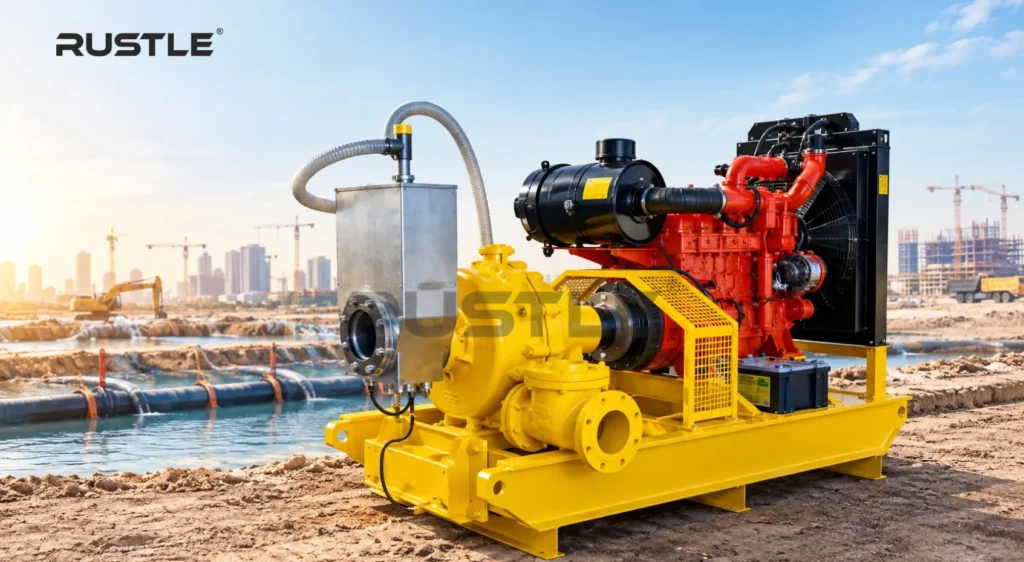
VEGO Pumps by Rustle
VEGO Pumps by Rustle is manufactured by Rustle Dynamics in Coimbatore, India.
The company’s published VEGO range includes:
- 6-inch dewatering pumps
- 8-inch dewatering pumps
- High-pressure pumps
- Solid-handling pumps
- Submersible pumps
- Pump spares
The manufacturer describes its products as serving construction, infrastructure, oil and gas, utilities and other industrial applications, with international supply including Middle Eastern markets.
For buyers evaluating an industrial pump manufacturer in India, the relevant procurement questions remain the same:
- What is the required duty?
- What pump configuration is suitable?
- What documentation is available?
- What materials are used?
- What spare parts are available?
- What customization is possible?
- What export support is available?
- What technical assistance is provided?
Buying Guide for UAE Contractors and Procurement Managers
Before requesting a quotation, prepare a basic pump-duty sheet.
Project information
Project location:
Dubai / Abu Dhabi / Sharjah / Saudi Arabia / Qatar / Oman / Kuwait / Bahrain / Africa / India
Application:
Excavation / mine / trench / flood control / industrial / municipal
Required flow:
_____ m³/hr
Static lift:
_____ m
Discharge distance:
_____ m
Pipe diameter:
_____ inch
Suction lift:
_____ m
Water condition:
Clean / muddy / abrasive / sewage / slurry
Solids:
_____ mm maximum
Operating hours:
_____ hours/day
Power:
Diesel / Electric / Hybrid
Mounting:
Trailer / Skid / Fixed
Required quantity:
Duty _____ / Standby _____
Providing this information allows a manufacturer to recommend equipment based on the actual application rather than making a generic product recommendation.
People Also Ask: Dewatering Pump Questions
1. What is a dewatering pump used for?
A dewatering pump removes accumulated groundwater, rainwater, seepage, floodwater or other unwanted water from excavations, trenches, mines, construction sites and industrial areas.
2. How do I choose a dewatering pump?
Start with required flow and total dynamic head. Then evaluate suction lift, water quality, solids, operating hours, power availability, mobility and maintenance requirements.
3. What size dewatering pump do I need?
Pump size should be determined from the required duty point rather than excavation size alone. Review the manufacturer’s pump curve at the required flow and head.
4. What is a self-priming dewatering pump?
A self-priming pump is designed to remove air from the suction system and establish pumping without repeated manual priming.
5. Are diesel dewatering pumps suitable for construction?
Yes. Diesel-driven pumps can be useful on construction sites where grid power is unavailable, temporary or unreliable, particularly when mobility and rapid deployment are important.
6. Are electric pumps better than diesel pumps?
The selection depends on the project. Electric pumps can suit sites with reliable electrical infrastructure, while diesel units can provide independent power and mobility.
7. Can dewatering pumps handle sand?
Some pumps are specifically designed for solids-laden or abrasive water. The manufacturer’s solids-passage rating, materials and impeller design should be checked before selection.
8. What is total dynamic head?
Total dynamic head represents the elevation and hydraulic resistance that the pump must overcome to deliver the required flow.
9. What is a wellpoint dewatering system?
A wellpoint system uses a series of closely spaced groundwater extraction points connected to a header and suitable pump system to lower the groundwater level around an excavation.
10. Should I buy or rent a dewatering pump?
The decision depends on project duration, utilization, capital budget, service requirements and the availability of suitable rental equipment.
11. How often should a dewatering pump be serviced?
Maintenance intervals depend on pump design, operating hours, water quality, solids and driver requirements. Follow the manufacturer’s recommended service schedule and inspect equipment based on actual operating conditions.
12. What should I ask a dewatering pump supplier?
Ask for the pump curve, duty point, materials, priming arrangement, driver details, solids capability, maintenance requirements, spare-parts availability, warranty and technical documentation.
13. Do UAE construction projects require dewatering permits?
Requirements depend on the project location and discharge arrangement. Dubai Municipality provides a specific groundwater-dewatering permit service, while Abu Dhabi has published construction dewatering requirements covering approvals, permits and discharge compliance.
14. Can one pump handle every dewatering application?
No. Construction, mining, flood control, wellpoint, slurry and industrial water-transfer applications can require significantly different hydraulic and mechanical characteristics.
15. What is the most important information when requesting a pump quotation?
Provide the required flow, total dynamic head, suction lift, discharge distance, pipe diameter, water condition, solids content, operating hours and available power.
Expert Advice
Do not buy a dewatering pump by horsepower, pipe diameter or maximum flow alone. Buy against the actual duty point and the conditions under which the equipment must operate.
For critical applications, also consider the consequences of pump failure.
If a pump stops and the result is simply slower drainage, the backup strategy may be different from a site where failure could flood an excavation, interrupt mining operations or affect critical infrastructure.
Conclusion
Choosing among dewatering pump suppliers in UAE requires more than comparing quotations.
The right procurement process begins with the hydraulic duty and then evaluates:
- Flow
- Total dynamic head
- Suction conditions
- Water quality
- Solids
- Pump construction
- Priming system
- Driver
- Mobility
- Maintenance
- Spare parts
- Technical support
- Documentation
- Discharge requirements
- Total lifecycle cost
For construction, mining, infrastructure, oil and gas, municipal and industrial applications, the pump should be treated as part of a complete water-management system.
The 2026 market is also moving toward greater connectivity, condition monitoring, serviceability and equipment-data visibility. Digital monitoring, remote diagnostics and predictive maintenance are likely to become increasingly relevant as contractors manage larger equipment fleets.
Need a Dewatering Pump for Your Project?
VEGO Pumps by Rustle supplies industrial pumping equipment manufactured in Coimbatore, India, for demanding construction, mining, infrastructure and industrial applications.
Need help selecting a pump?
Send your project requirements:
- Required flow
- Head
- Suction lift
- Pipe size
- Water condition
- Solids size
- Operating hours
- Diesel/electric preference
- Trailer/skid requirement
- Quantity required
Request a Quote | Speak with Our Engineers | Ask for the Catalogue | WhatsApp Sales
For enquiries, contact the VEGO/Rustle sales team and provide the project duty so the appropriate pump configuration can be evaluated.
That was amazing