Flooding can turn a functioning construction site, industrial facility, mine, road project, basement, or municipal area into a critical emergency within hours.
The challenge is not simply to “pump the water out.” Emergency dewatering requires the right combination of pump capacity, total head, suction conditions, solids handling, power source, mobility, pipework and operating reliability.
For contractors and project managers in Saudi Arabia, UAE, Qatar, Oman, Kuwait, Bahrain, Africa and India, this becomes particularly important because floodwater can contain sand, silt, stones, debris, sewage contamination and other suspended materials. A pump that works well with clean water may perform poorly when the water becomes heavily contaminated or the site conditions change.
This guide explains how to select and operate flood water removal pumps for emergency dewatering, including pump types, sizing, installation, maintenance, common mistakes and the technologies expected to influence emergency pumping through 2027 and 2028.
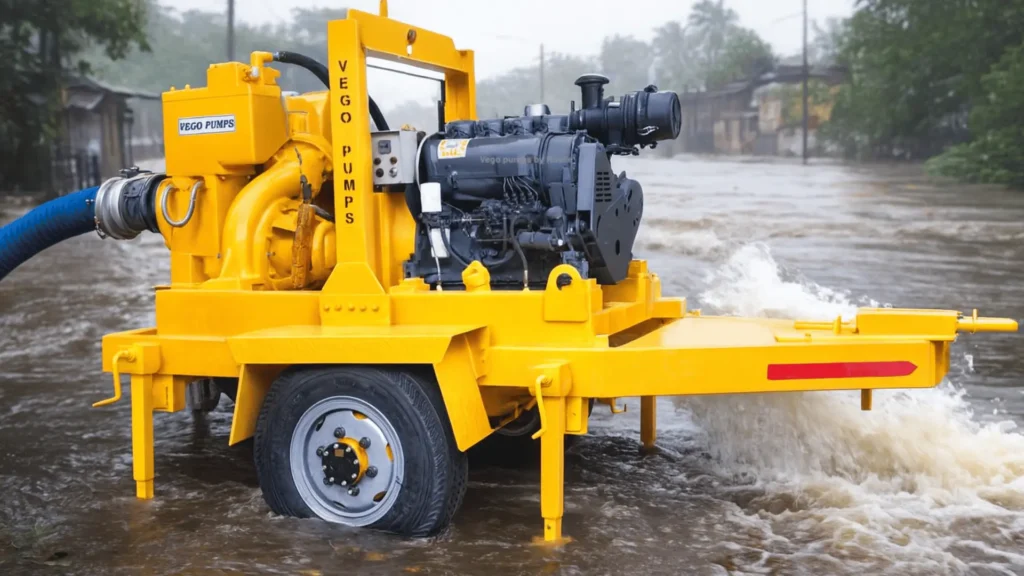
What Is a Flood Water Removal Pump?
A flood water removal pump is a pumping system designed to rapidly remove accumulated water from areas affected by heavy rainfall, stormwater, groundwater ingress, drainage-system overload, burst pipelines or other flooding events.
Depending on the application, the system may use:
- Self-priming centrifugal pumps
- Diesel-driven dewatering pumps
- Electric dewatering pumps
- Submersible pumps
- Solid-handling pumps
- High-capacity mobile pump sets
- Trailer-mounted or skid-mounted pump units
- Automatic priming systems
- Temporary bypass pumping systems
The correct choice depends on the water condition and the hydraulic duty rather than simply selecting the pump with the largest flow rating.
Modern dewatering manufacturers increasingly position their equipment around rapid deployment, solids handling, automatic priming, continuous operation and easy maintenance. For example, current industrial pump ranges from major manufacturers specifically address construction dewatering, mining, flood control and municipal applications.
Why Emergency Flood Dewatering Requires the Right Pump
The right flood water removal pumps must be selected according to the volume of incoming water, total pumping head, water quality, solids content and available power source.
Water can:
- Stop construction activities
- Flood foundations and excavations
- Destabilize soil
- Damage electrical equipment
- Contaminate industrial areas
- Delay concrete and civil works
- Interrupt mining operations
- Damage stored materials
- Restrict access roads
- Overload drainage systems
- Increase safety risks
The objective of emergency dewatering is therefore not merely water removal. It is rapid restoration of a safe and workable operating environment.
For an excavation, for example, the pump must remove incoming water faster than water is entering the excavation.
A useful engineering principle is:
Required pumping capacity > peak water inflow
But capacity alone is not enough. The pump must also overcome the complete hydraulic head created by:
- Static lift
- Discharge elevation
- Pipe friction
- Fittings and valves
- Discharge distance
- Back pressure
- Changes in site conditions
This is why pump selection should always begin with the actual duty point.
Flood Water Removal Pump Types
There is no single pump type suitable for every flood emergency.(flood water removal pumps)
1. Self-Priming Centrifugal Dewatering Pumps
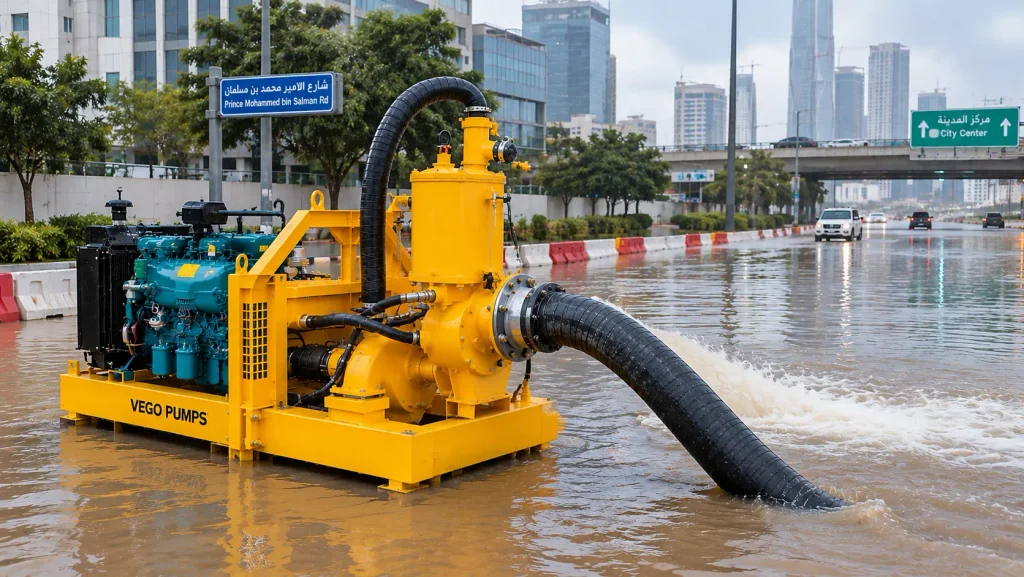
Self-priming centrifugal pumps are widely used for construction dewatering, mining, drainage and emergency floodwater removal.
Their main advantage is that the pump can be positioned above the water level while the suction pipe reaches into the flooded area.
This makes them particularly useful for:
- Construction excavations
- Foundation pits
- Trenches
- Road projects
- Mining sites
- Temporary drainage
- Sewer bypass
- Flood control
- Wellpoint systems
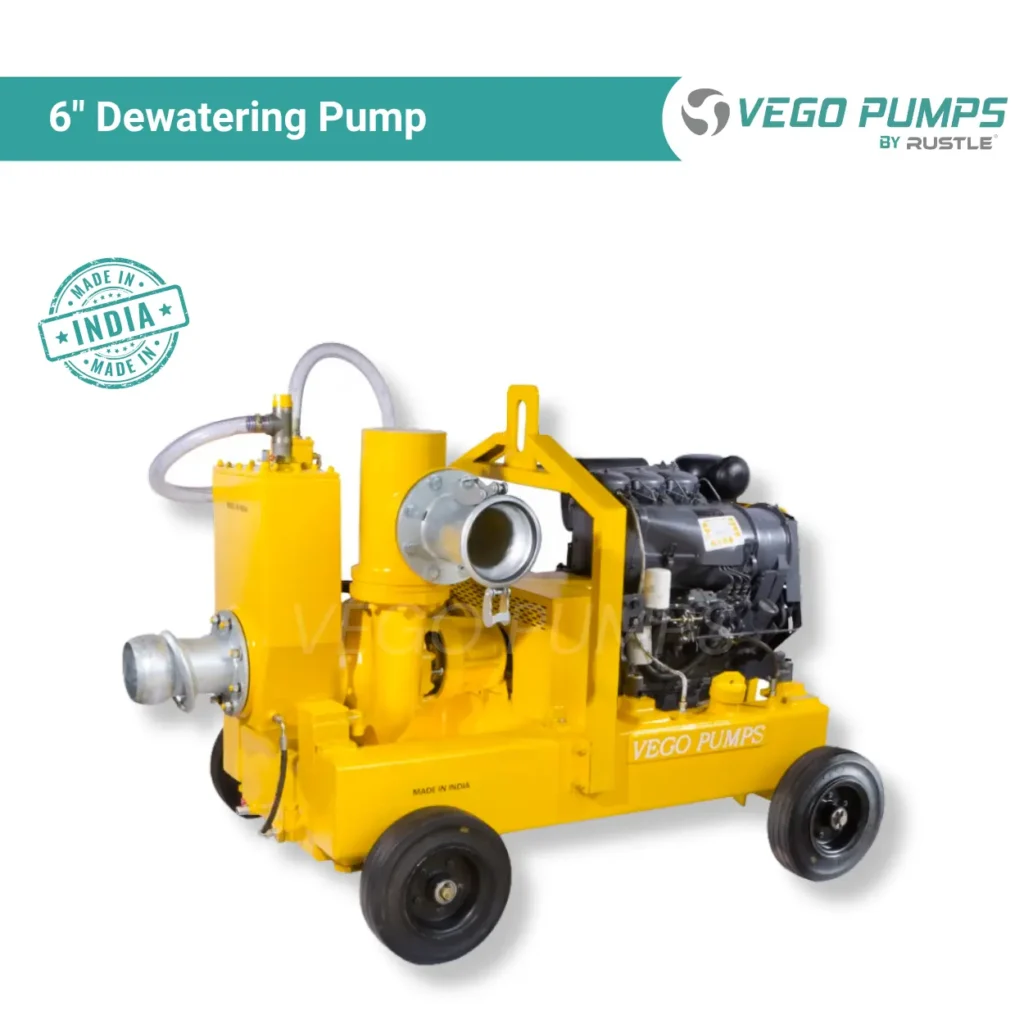
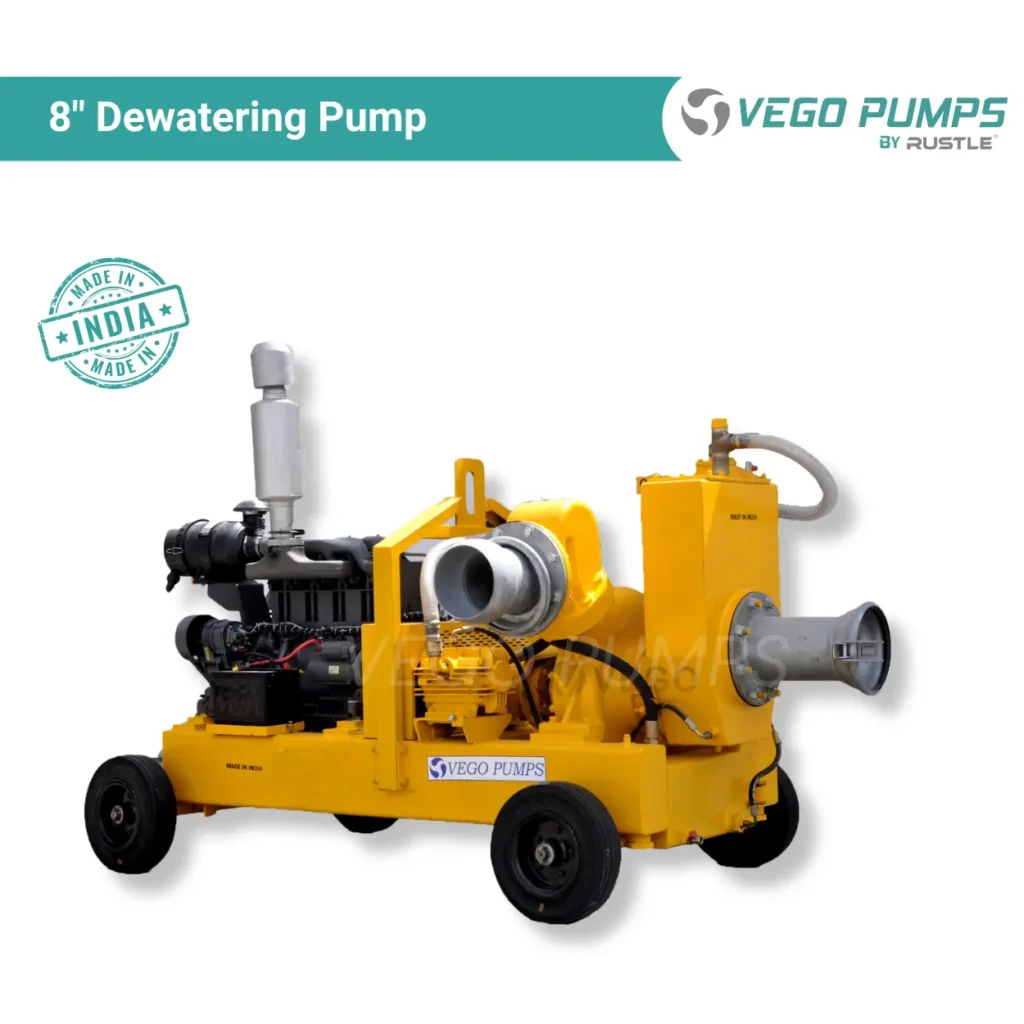
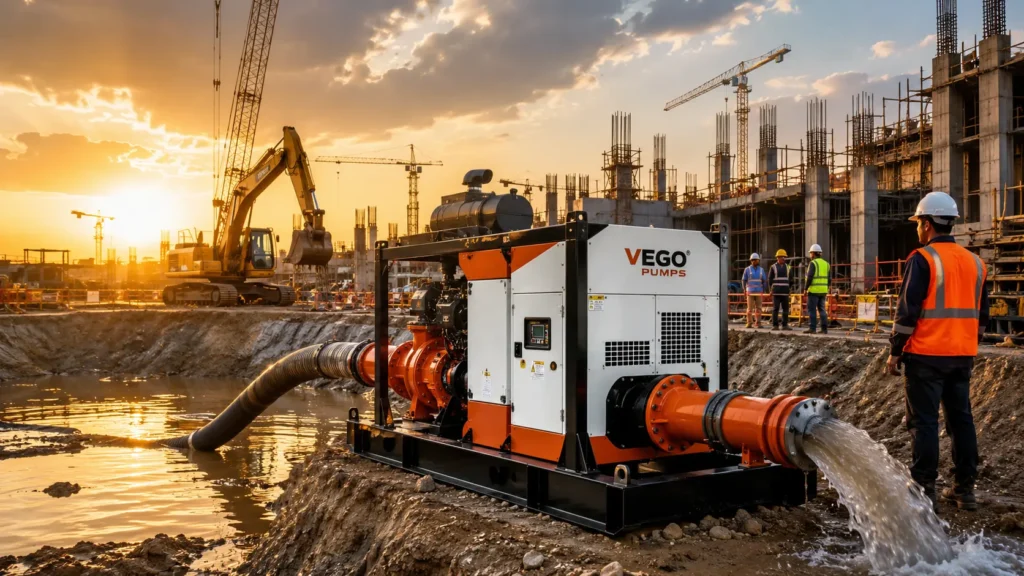
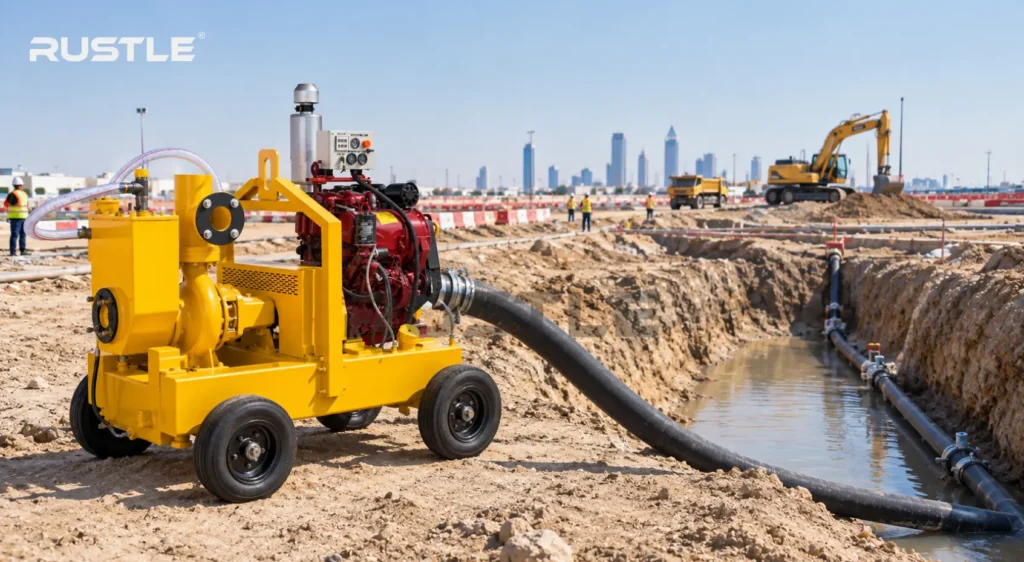
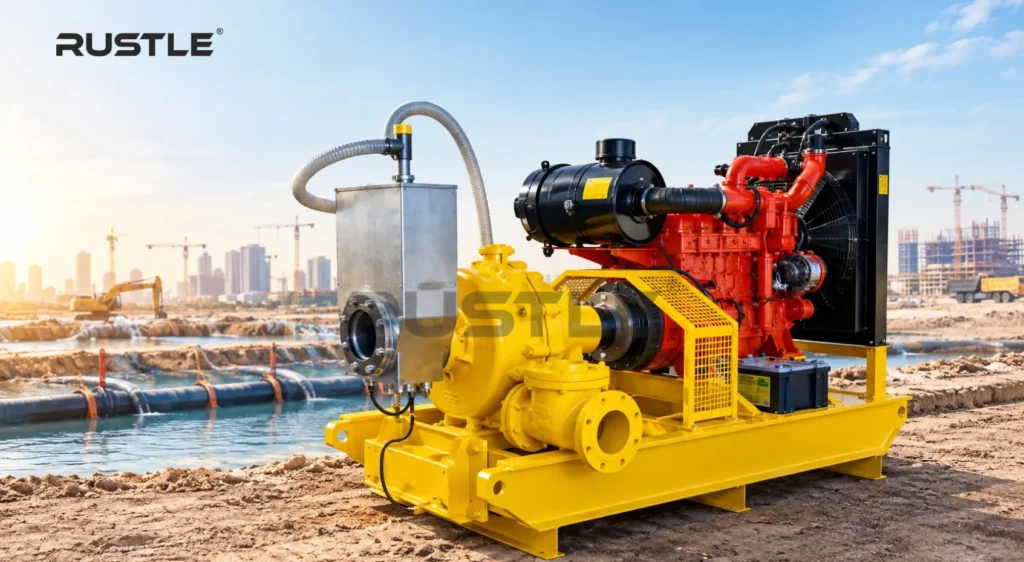
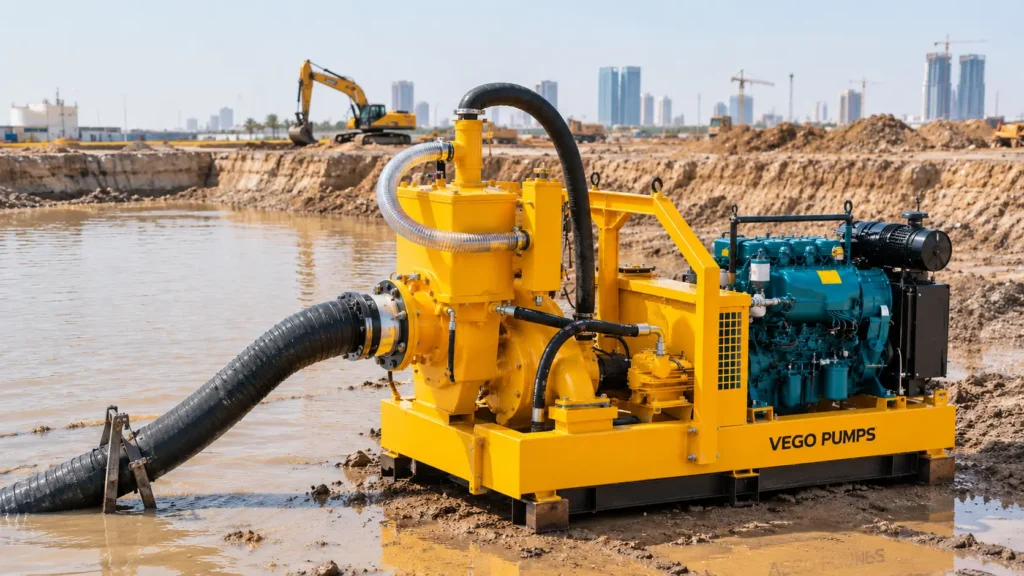
VEGO’s auto-priming dewatering range is designed for high-volume applications and can be configured with diesel engines or electric motors. The 6-inch and 8-inch ranges are available in trailer and skid configurations.
For construction and infrastructure projects, flood water removal pumps with self-priming capability can provide a practical solution where the pump must remain above the flooded area.
Why self-priming matters during emergencies
A flood response team may not have time to repeatedly dismantle and manually prime a pump.
An automatic or self-priming arrangement can significantly simplify deployment.
However, engineers must still verify:
- Maximum suction lift
- Suction pipe diameter
- Suction pipe length
- Air leakage
- Pump priming system
- Foot-valve requirements, if applicable
- Water temperature
- Solids concentration
- NPSH conditions
2. Diesel-Driven Flood Water Pumps
Diesel-powered pump sets are particularly useful when grid electricity is unavailable or unreliable.
This is common in:
- Remote construction projects
- Mining operations
- Emergency flood zones
- Infrastructure projects
- Rural areas
- Temporary drainage works
- Remote industrial facilities
A diesel pump can operate independently of the electrical grid, making it valuable as an emergency backup.
For GCC and African projects, where pumping equipment may be deployed to remote project locations, mobility and fuel autonomy can be just as important as pump efficiency.
VEGO’s diesel dewatering units can be supplied with trailer or skid mounting and extended fuel-tank configurations for prolonged operation.
Diesel-powered flood water removal pumps are particularly useful for emergency applications where electrical power is unavailable or unreliable, especially at remote construction and mining sites.
Diesel pump advantages
- Independent operation
- Suitable for remote sites
- Rapid deployment
- High-capacity options
- Trailer-mounted configurations
- Useful for emergency standby
- Suitable for long-duration field operation
Limitations
Diesel systems require:
- Fuel availability
- Engine maintenance
- Lubrication checks
- Exhaust management
- Battery maintenance
- Periodic servicing
Where reliable electrical power is available, electric pumping can be more economical for long-duration operation.
3. Electric Dewatering Pumps
Electric pumps are an excellent option when a reliable electrical supply is available.
Advantages include:
- Lower routine engine maintenance
- No diesel fuel storage
- Lower local exhaust emissions
- Straightforward starting
- Potentially lower operating cost
- Compatibility with automation and monitoring systems
Electric submersible pumps are particularly useful when the pump needs to be placed directly into the flooded area.
However, electrical safety becomes critical during flood conditions.
Electrical equipment, cables, control panels and generators must be selected and installed appropriately for the environment.
Never treat a flooded work area as an ordinary pumping location.
4. Submersible Flood Water Pumps
A submersible pump operates while immersed in the water.
This configuration is useful when:
- Floodwater depth is changing rapidly
- Suction lift is difficult
- There is insufficient space for a surface pump
- Water must be removed from low points
- Rapid deployment is required
VEGO’s SD submersible range uses investment-cast stainless-steel construction and is available in 50 Hz and 60 Hz configurations. The range includes portable models intended for demanding dewatering conditions.
Submersible pumps are often attractive for emergency response because the pump can be lowered directly into the flooded area.
The drawback is that access to the pump for inspection or maintenance can be more difficult during an active flood.
5. Solid-Handling Pumps
Not all floodwater is clean.
Stormwater can carry:
- Sand
- Gravel
- Silt
- Stones
- Leaves
- Plastic debris
- Mud
- Sewage
- Organic matter
When solids become significant, a standard clean-water pump may not be the right choice.
A solid-handling pump is designed with larger internal passages and an impeller arrangement suitable for solids-laden liquids.
VEGO’s solid-handling range is intended for demanding applications including sludge, sewage, bypass pumping and large wellpoint applications. Certain models are designed to handle solids up to 100 mm.
Important engineering rule
Never select a pump solely from the flow requirement when the water contains significant solids.
Check the manufacturer’s specified maximum solid size and confirm that the pump construction and impeller are appropriate for the actual fluid.
Flood Water Removal Pump Comparison
| Pump Type | Best Application | Main Advantage | Main Consideration |
|---|---|---|---|
| Self-priming centrifugal | Excavations, drainage, floodwater | Fast deployment and surface operation | Suction conditions |
| Diesel dewatering pump | Remote emergency sites | Independent power | Fuel and engine maintenance |
| Electric pump | Sites with stable power | Efficient continuous operation | Electrical infrastructure |
| Submersible pump | Deep or rapidly changing floodwater | Direct immersion | Cable/electrical safety |
| Solid-handling pump | Muddy or debris-laden water | Better solids tolerance | Wear and correct sizing |
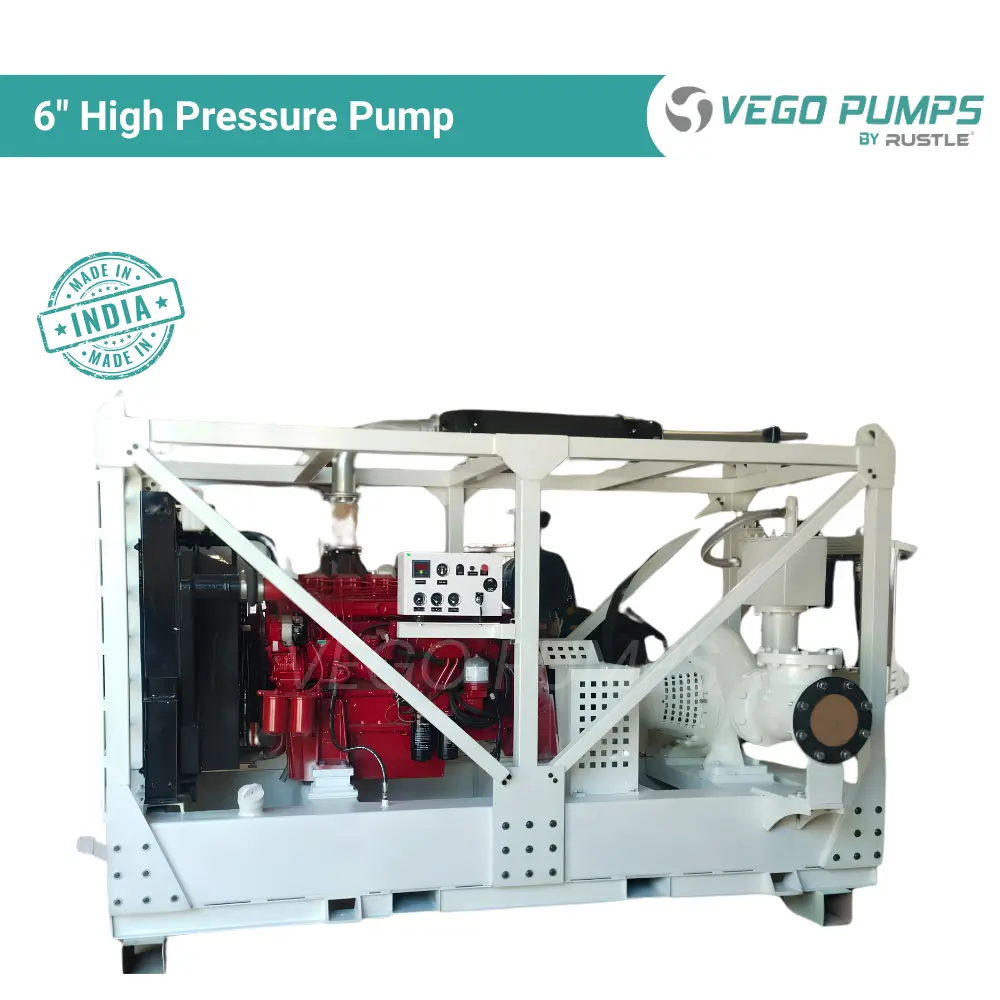
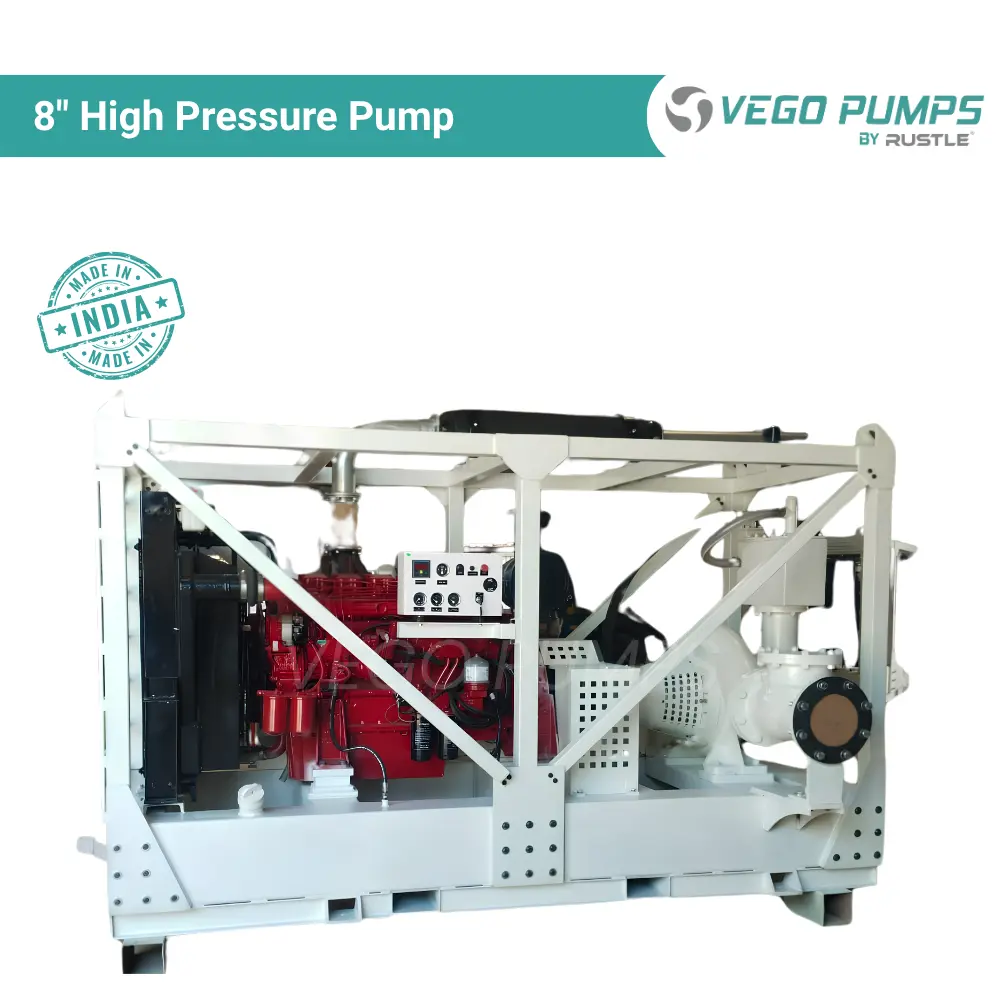
| High-pressure pump | Long discharge distances/high elevation | Higher pressure capability | Hydraulic duty selection |
How to Size a Flood Water Removal Pump
Pump sizing is one of the most important stages of emergency dewatering.
A common mistake is to select a pump based only on pipe diameter.
For example:
“We need an 8-inch pump because the discharge pipe is 8 inches.”
That is not enough information.
The pump must be selected from the required flow and total dynamic head.
Step 1: Estimate Water Inflow
Determine how much water is entering the area.
Sources may include:
- Rainfall
- Groundwater
- River or drainage overflow
- Broken pipelines
- Process water
- Surface runoff
- Seepage
- Tidal or marine influence
For rainfall, a simplified estimate can begin with:
Water volume = rainfall depth × catchment area
For more complex projects, engineers should consider runoff coefficients, soil conditions and peak rainfall intensity.
Step 2: Determine Required Flow
The pump should remove water at a rate greater than the incoming flow.
For emergency applications, engineers may include a reasonable design margin rather than selecting a pump that operates permanently at its absolute maximum capacity.
For example:
If estimated inflow is 300 m³/hr, selecting equipment capable of approximately 300 m³/hr at zero head is meaningless.
The relevant question is:
What flow does the pump actually deliver at the required total dynamic head?
Step 3: Calculate Total Dynamic Head
Total dynamic head can be considered as:
TDH = Static Head + Friction Loss + Fitting Losses + Required Discharge Pressure
Static head includes the vertical elevation between the water surface and discharge point.
Friction losses depend on:
- Pipe diameter
- Pipe length
- Flow velocity
- Pipe material
- Number of bends
- Valves
- Connections
This is why two sites using the same pump may achieve completely different flow rates.
Step 4: Check Suction Conditions
For surface-mounted pumps, suction conditions can determine whether the system performs reliably.
Consider:
- Vertical suction lift
- Suction hose diameter
- Suction hose length
- Air leaks
- Water level fluctuation
- Strainer condition
- Pump elevation
- Water temperature
- Atmospheric pressure
Avoid unnecessarily long suction lines.
Whenever possible, use a short, correctly sized suction line with minimal bends.
Example Emergency Dewatering Scenario
Imagine a construction excavation in the GCC after an intense rainfall event.
Assume:
- Excavation volume: 2,000 m³
- Estimated incoming water: 250 m³/hr
- Required discharge elevation: 12 m
- Discharge pipeline: 150 m
- Multiple bends and fittings
- Water contains moderate sediment
A pump should not be selected simply because its catalogue says “500 m³/hr maximum.”
The engineer needs the pump curve to determine the actual flow at the complete operating head.
A practical selection process would be:
- Estimate peak inflow.
- Establish required recovery time.
- Calculate static head.
- Calculate pipe friction.
- Add fitting losses.
- Determine total dynamic head.
- Check solids concentration.
- Select pump type.
- Select diesel or electric drive.
- Confirm the duty point against the performance curve.
What Pump Capacity Is Suitable for Flood Water Removal?
There is no universal answer.
Typical emergency pumping requirements can range from relatively small basement drainage duties to hundreds or thousands of cubic metres per hour for major infrastructure, mining and municipal applications.
For example, current mobile flood-control pump systems in the market include capacities of several hundred cubic metres per hour, while larger industrial dewatering systems can provide substantially higher flows.
The correct pump is determined by the required duty point, not by maximum catalogue capacity.
Where Are Flood Water Removal Pumps Used?
Construction Sites
Flooding can affect:
- Foundations
- Basement excavations
- Tunnels
- Trenches
- Retaining-wall works
- Road construction
- Bridge projects
Construction dewatering is particularly important because uncontrolled water can affect soil stability and delay subsequent work.
Mining
Mining operations may experience water ingress from:
- Rainfall
- Groundwater
- Underground seepage
- Surface runoff
- Pit-wall drainage
High-volume dewatering pumps are commonly used to keep mine working areas operational.
Wear resistance is also important where water contains abrasive particles.
Municipal Flood Response
Municipal emergency teams may use mobile pumps to remove water from:
- Roads
- Underpasses
- Basements
- Drainage channels
- Public facilities
- Industrial areas
Saudi Arabia is actively expanding stormwater infrastructure; more than 200,000 linear metres of stormwater drainage networks were completed during the first half of 2026.
Dubai is similarly investing heavily in long-term stormwater resilience, including the Dh500 million Al Quoz drainage upgrade and the wider Tasreef programme.
These investments reduce flood risk, but mobile emergency pumping remains important when rainfall exceeds drainage capacity or temporary construction conditions create localized flooding.
Flood Dewatering in Saudi Arabia, UAE and the GCC
The GCC has traditionally been associated with arid conditions, but low annual rainfall does not mean flooding is impossible.
Short-duration heavy rainfall can overwhelm drainage systems and create significant surface runoff.
This creates demand for:
- Emergency flood pumps
- Construction dewatering
- Mobile pumping units
- Stormwater management
- Temporary bypass pumping
- Excavation drainage
- Infrastructure resilience
Saudi Arabia’s Vision 2030 continues to drive investment and development across infrastructure and economic sectors.
For contractors working on major infrastructure projects, having emergency pumping equipment available before a severe weather event can be considerably more practical than sourcing equipment after flooding has already occurred.
Flood Dewatering in India
India presents a different but equally important flood challenge.
The monsoon season can create sudden flooding across:
- Construction projects
- Urban areas
- Industrial facilities
- Mines
- Roads
- Rail projects
- Tunnels
- Agricultural and irrigation infrastructure
The Indian dewatering pump market is also expected to expand substantially through the coming years, with electric systems representing a significant segment while hydraulic systems are among the faster-growing categories.
For Indian contractors, the ideal emergency pumping fleet may therefore combine:
- Electric submersible pumps
- Diesel surface pumps
- Self-priming centrifugal pumps
- Solid-handling pumps
- Backup units
Key Features to Look for in an Emergency Flood Pump
When comparing suppliers, look beyond the headline flow rate.
1. Automatic or Self-Priming Capability
Useful when the pump sits above the water source.
2. Solids Handling
Check the actual maximum solid size.
3. Continuous-Duty Capability
Emergency flooding may require prolonged operation.
4. Easy Maintenance
Access to:
- Impeller
- Mechanical seal
- Bearings
- Vacuum system
- Engine
- Lubrication points
can directly affect downtime.
5. Mobile Mounting
Trailer or skid mounting can simplify emergency deployment.
6. Suitable Materials
Consider cast iron, stainless steel, hardened components or wear-resistant coatings depending on water quality.
7. Reliable Priming System
A pump that is difficult to prime is a poor emergency pump.
8. Fuel Autonomy
For diesel equipment, tank capacity matters when operators need continuous unattended or low-intervention operation.
Diesel vs Electric Flood Water Pumps
| Factor | Diesel | Electric |
|---|---|---|
| Remote operation | Excellent | Requires power |
| Emergency deployment | Excellent | Good if power exists |
| Fuel requirement | Yes | No diesel |
| Local exhaust | Yes | None at pump |
| Engine maintenance | Higher | Lower |
| Long-duration operating cost | Site dependent | Often attractive |
| Remote mining | Excellent | Depends on infrastructure |
| Automation | Possible | Excellent |
| Backup emergency use | Excellent | Good with generator |
Engineer’s recommendation
Do not treat diesel versus electric as a universal winner.
For a remote Saudi mine with no reliable electrical infrastructure, diesel may be the obvious solution.
For a permanent industrial plant with stable electrical power, an electric pump may make more economic sense.
For emergency response teams, maintaining a combination of technologies can provide greater resilience.
Common Mistakes When Removing Floodwater
Mistake 1: Selecting by Pipe Size Alone
An 8-inch pipe does not automatically mean an 8-inch pump will meet the required flow.
Mistake 2: Ignoring Total Head
Maximum flow published in a catalogue is normally not the flow at your actual operating point.
Mistake 3: Underestimating Solids
Mud, sand and debris can cause rapid wear or blockage.
Mistake 4: Using an Undersized Suction Line
A restrictive suction system can severely affect pump performance.
Mistake 5: Excessive Suction Lift
Surface-mounted pumps have practical suction limitations.
Mistake 6: No Emergency Backup
If flooding is critical, relying on one pump can create a single point of failure.
Mistake 7: Ignoring Discharge Routing
A high-capacity pump is useless if the discharge line cannot safely carry the water.
Mistake 8: Poor Maintenance Before the Rainy Season
A pump stored for months is not necessarily ready for emergency service.
Mistake 9: Buying Only on Price
The cheapest pump can become the most expensive option if it causes project downtime.
Emergency Flood Pump Maintenance Checklist
Before an expected high-risk weather period, inspect:
Pump
- Impeller condition
- Casing
- Mechanical seal
- Bearings
- Shaft
- Fasteners
- Gaskets
- Wear components
Priming System
- Vacuum pump
- Vacuum hoses
- Priming tank
- Valves
- Connections
Diesel Engine
- Engine oil
- Coolant
- Fuel quality
- Fuel filter
- Air filter
- Battery
- Belts
- Hoses
Electrical Equipment
- Cables
- Control panel
- Earthing
- Protection devices
- Connections
- Insulation condition
Pipework
- Suction hose
- Discharge hose
- Couplings
- Clamps
- Valves
- Strainers
- Flexible connections
Final Test
Run the pump before the emergency.
A pump that starts during a controlled test is far more valuable than a pump that looks ready on paper.
2026 Trends in Emergency Dewatering Pumps
Emergency dewatering is becoming more engineering-focused.
Several trends are particularly relevant in 2026.
1. More Focus on Rapid Deployment
Contractors increasingly want pumping equipment that can be transported, connected and started quickly.
Trailer-mounted and skid-mounted packages support this requirement.
2. Better Solids Handling
Floodwater is rarely perfectly clean.
Pump manufacturers are therefore emphasizing wear resistance, open or semi-open impellers and larger passage designs for demanding applications. Current industry offerings show continued development toward improved wear resistance and solids handling.
3. Remote Monitoring and Connected Equipment
IoT-enabled pumping is becoming more relevant for projects with multiple remote pump stations.
Useful monitoring parameters can include:
- Pump status
- Runtime
- Engine condition
- Water level
- Flow
- Pressure
- Fuel level
- Maintenance alerts
- Location
The value is not the “smart” label itself.
The value is knowing that a pump has stopped before a flooded excavation becomes a major problem.
4. Energy Efficiency
Long-duration pumping makes energy consumption a significant operating-cost factor.
Manufacturers and buyers are increasingly evaluating:
- Pump hydraulic efficiency
- Engine efficiency
- Motor efficiency
- Variable-speed operation
- Fuel consumption
- Lifecycle cost
What to Expect in 2027–2028
The next phase of emergency dewatering will likely focus less on simply increasing pump capacity and more on creating resilient pumping systems.
Predictive Maintenance
Sensors and operating data can help identify abnormal vibration, temperature, pressure or runtime conditions before failure.
Remote Fleet Management
Large contractors operating pumps across several projects will increasingly benefit from centralized equipment monitoring.
Hybrid Power Strategies
Sites may combine:
- Grid electricity
- Diesel generators
- Battery systems
- Solar-assisted power
- Variable-speed electric drives
depending on project requirements.
Smarter Flood Response
Future emergency systems are likely to combine:
Weather data → water-level monitoring → pump activation → remote alert → maintenance notification
This does not eliminate the need for experienced engineers.
It gives engineers better information to make faster decisions.
How to Choose a Flood Water Removal Pump: Buyer’s Checklist
Before requesting a quotation, prepare these details:
| Parameter | Information Required |
|---|---|
| Application | Flood, excavation, mine, municipal, industrial |
| Water type | Clear, muddy, sewage, slurry |
| Required flow | m³/hr |
| Static lift | metres |
| Total discharge length | metres |
| Pipe diameter | inches/mm |
| Solids | Approximate size and concentration |
| Suction lift | metres |
| Operating hours | Intermittent/continuous |
| Power | Diesel/electric |
| Installation | Skid/trailer/submersible |
| Environment | Indoor/outdoor/remote |
| Required mobility | Fixed/mobile |
| Country | For electrical/export requirements |
| Backup requirement | Yes/No |
Providing this information allows a pump manufacturer to recommend equipment based on engineering duty rather than guesswork.
VEGO Pumps for Flood Water Removal and Emergency Dewatering
VEGO Pumps by Rustle manufactures industrial pumping equipment in Coimbatore, India, for demanding applications across construction, mining, infrastructure, municipal and industrial sectors. Rustle’s current portfolio includes dewatering, high-pressure, solid-handling and submersible pump solutions.
For flood and emergency dewatering, relevant VEGO solutions include:
VEGO 6-Inch Dewatering Pumps
The VEGO 6-inch auto-priming range is designed for general dewatering, wellpoint applications and sewer bypass duties. Published specifications include up to 320 m³/hr flow and up to 38 m head, depending on the selected configuration.
VEGO 8-Inch Dewatering Pumps
The 8-inch range is intended for high-volume dewatering and can be configured for diesel or electric drive, trailer or skid mounting and project-specific requirements.
VEGO Submersible Pumps
The SD series provides a compact option where direct immersion is preferred, with stainless-steel construction and 50 Hz/60 Hz availability.
VEGO Solid-Handling Pumps
Where floodwater contains significant solids, mud, sewage or debris, a dedicated solid-handling configuration can be more appropriate than a standard dewatering pump.
The important point is that the pump should be selected according to flow, head, solids, suction conditions and operating environment rather than simply selecting the biggest pump available.
Frequently Asked Questions
1. What is the best pump for flood water removal?
The best pump depends on water volume, total head, solids content, suction conditions and available power. Self-priming centrifugal pumps are commonly suitable for surface floodwater and construction dewatering, while submersible pumps are useful where direct immersion is preferred.
2. Can a dewatering pump remove muddy floodwater?
Yes, provided the pump is designed for the solids content and particle size present in the water. For heavily contaminated or solids-laden water, a solid-handling pump may be more appropriate.
3. Is a diesel pump better than an electric flood pump?
Not universally. Diesel pumps are advantageous where grid power is unavailable, while electric pumps can be attractive for sites with reliable electricity and long operating periods.
4. How do I calculate the required flood pump capacity?
Estimate the peak water inflow, determine the desired pumping time and select a pump that provides the required flow at the complete total dynamic head.
5. What is total dynamic head?
Total dynamic head is the combined hydraulic resistance the pump must overcome, including static elevation, pipe friction, fittings and discharge pressure.
6. Can self-priming pumps run dry?
Some specially designed industrial self-priming pump systems can tolerate dry-running conditions for specified periods, but the manufacturer’s operating instructions must always be followed.
7. What size flood water pump do I need?
Pump size cannot be determined from pipe diameter alone. Required flow, head, suction lift, solids and operating conditions must be considered.
8. Are submersible pumps suitable for emergency flooding?
Yes. Submersible pumps are often useful for rapidly removing water from low points and flooded areas where surface suction arrangements are difficult.
9. What pump is suitable for floodwater containing sand?
A pump designed for solids-laden water with appropriate wear-resistant components should be considered. Sand can accelerate impeller, casing and seal wear.
10. Can flood pumps be used for construction excavation dewatering?
Yes. Dewatering pumps are widely used to control groundwater and accumulated rainwater in excavations, trenches, foundations and infrastructure projects.
Featured Snippet Answer
What is the best pump for emergency flood water removal?
The best flood water removal pump depends on required flow, total head, water depth, solids content and available power. Self-priming centrifugal pumps are suitable for many construction and flood-control applications, while submersible pumps work well for direct immersion. Diesel pumps are useful for remote sites without reliable electricity, and solid-handling pumps should be considered when floodwater contains significant mud, sand or debris.
Conclusion: Be Ready Before the Flood Arrives
Emergency dewatering is not the time to discover that a pump is undersized, the suction line is too restrictive, the discharge route cannot handle the flow or the engine has not been serviced.
The most reliable approach is to treat flood pumping as an engineered system.
Start with:
Water inflow → Required flow → Total head → Solids → Suction conditions → Pump type → Power source → Pipework → Backup → Maintenance
For construction contractors, mining operators, infrastructure companies, municipalities and industrial facilities, having the right pump available before an emergency can significantly reduce downtime and protect critical assets.
VEGO Pumps by Rustle provides industrial dewatering solutions for construction, mining, infrastructure, municipal and flood-control applications, with diesel, electric, self-priming, submersible and solid-handling options available depending on project requirements.
Need a flood water removal pump for your project?
Share your required flow rate, head, suction lift, discharge distance, water condition and solids information with the VEGO engineering team.
VEGO Pumps by Rustle — engineered for demanding dewatering applications.
Request a technical quotation and pump recommendation today.
Phone: +91 99942 04834
Email: sales@vegopumps.com
Email: sales@rustledynamics.com