
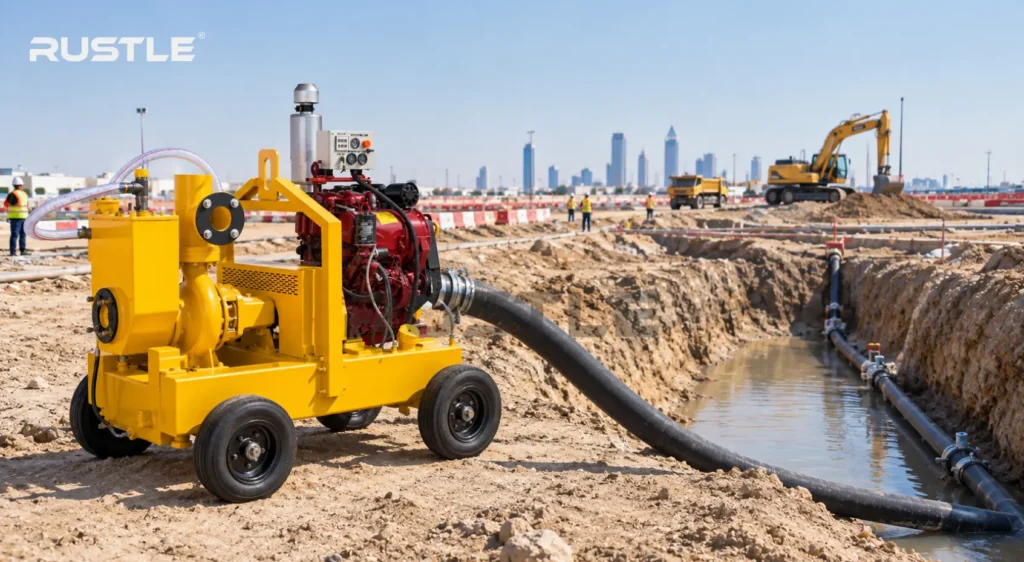
Construction projects rarely fail because there is simply “too much water.” They fail when water is not controlled at the right time, at the required flow rate, and against the actual site conditions.
Groundwater entering an excavation, stormwater collecting in a foundation pit, seepage around a trench, or water accumulating during tunnelling can quickly affect excavation stability, worker safety, concrete work, equipment access and project schedules. That is why selecting the right industrial dewatering pumps for construction projects should be treated as an engineering decision rather than simply purchasing the pump with the largest discharge size.
For contractors, civil engineers, project managers and procurement teams working across Saudi Arabia, UAE, Qatar, Oman, Kuwait, Bahrain, Africa and India, pump selection becomes even more important because projects can involve deep excavations, high ambient temperatures, sandy soils, variable groundwater conditions, long discharge pipelines and demanding operating schedules.
The right dewatering system should provide adequate flow, sufficient head, reliable priming, appropriate solids-handling capability, easy maintenance and a practical power source for the site.
This guide explains how to evaluate construction dewatering pumps, where different pump types fit, what specifications matter and what mistakes buyers should avoid.
What Is a Construction Dewatering Pump?
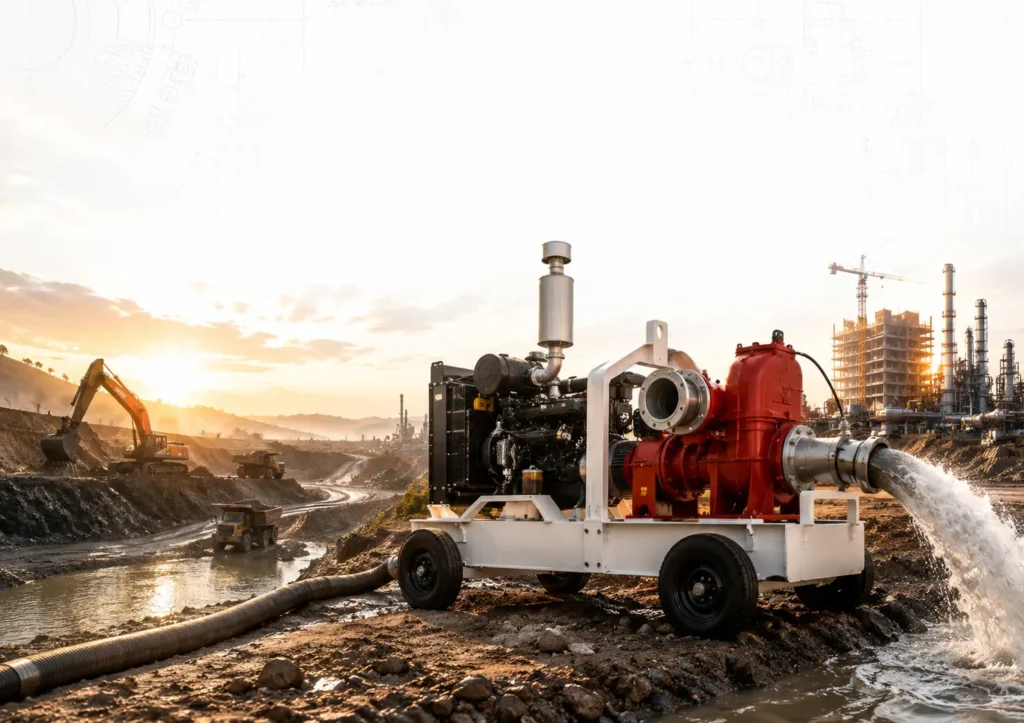
A construction dewatering pump is equipment used to remove unwanted water from an excavation, trench, foundation, tunnel, mine, construction site or other work area.
The objective is not simply to move water from one location to another. A properly designed dewatering system must control water continuously enough to maintain suitable working conditions.
Typical applications include:
- Foundation excavation
- Basement construction
- Road and bridge construction
- Tunnelling
- Trench drainage
- Wellpoint dewatering
- Groundwater lowering
- Sewer bypass pumping
- Floodwater removal
- Mining and quarry dewatering
- Industrial drainage
- Emergency water removal
The pump must be selected according to the actual hydraulic conditions rather than discharge pipe diameter alone.
Why Dewatering Is Critical for Construction Projects
Water can create several problems at a construction site.
1. Excavation instability
Groundwater can weaken soil and increase the risk of sidewall instability, erosion and difficult excavation conditions.
2. Delayed construction
If an excavation cannot remain sufficiently dry, activities such as foundation preparation, reinforcement installation, concrete placement and equipment movement may be delayed.
3. Equipment problems
Standing water can restrict access and expose construction equipment, electrical systems and materials to unnecessary water damage.
4. Worker safety
A controlled work area is essential for safe excavation and site operations.
5. Increased project costs
Poorly selected pumps may require additional units, excessive fuel, frequent maintenance or emergency replacement.
For large projects, dewatering should therefore be considered as part of the overall construction methodology, not as an afterthought.
How to Choose the Best Industrial Dewatering Pump
There is no single “best” pump for every construction site.
The correct pump depends on at least seven major factors:
- Required flow rate
- Total dynamic head
- Suction lift
- Water characteristics
- Solids content
- Power availability
- Operating environment
A professional pump selection should begin with the required duty point.
Flow Rate
Flow rate is usually expressed in:
- m³/hr
- L/min
- L/s
- GPM
The required flow depends on groundwater inflow, rainfall, excavation size, seepage and the required drawdown rate.
Buying a pump purely because it has a large outlet can be a mistake. A larger discharge connection does not automatically mean the pump will deliver the required flow at the required head.
Total Dynamic Head
Head is the total resistance the pump must overcome.
It can include:
- Static elevation
- Friction losses
- Pipe fittings
- Valves
- Discharge restrictions
- Pressure requirements
A pump producing high flow at low head may be unsuitable if the discharge pipeline is long or the elevation difference is significant.
This is why the pump curve should always be evaluated at the actual operating point.
Suction Lift
For surface-mounted pumps, suction conditions are particularly important.
Long suction lines, excessive bends, poor pipe sizing or excessive vertical lift can affect pump performance and priming.
For deep excavations, engineers may consider different arrangements such as submersible pumps, wellpoint systems or staged pumping.
Water Quality
Not all construction water is clean water.
A site may contain:
- Sand
- Silt
- Mud
- Small stones
- Sludge
- Sewage
- Organic material
- Abrasive particles
If solids are present, pump selection must consider passage size, impeller design, wear resistance and maintenance accessibility.
Major Types of Dewatering Pumps for Construction
1. Auto-Priming Diesel Dewatering Pumps
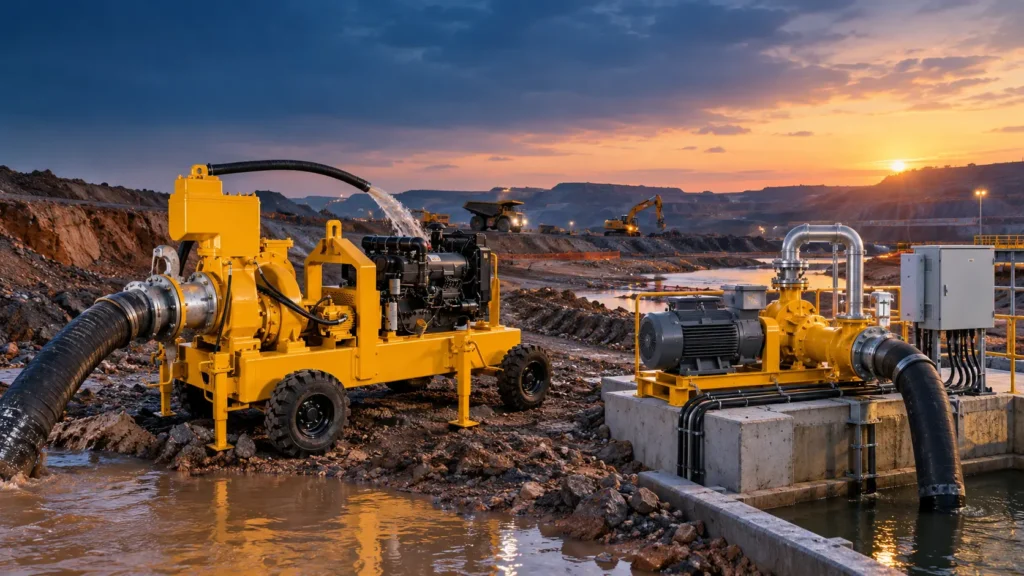
Auto-priming diesel pumps are widely suited to construction sites where reliable surface pumping and independent power are required.
They can be particularly useful where:
- Grid electricity is unavailable
- Pumps must operate continuously
- Equipment needs to be moved between locations
- High-volume water removal is required
- Emergency pumping capability is important
VEGO’s diesel-driven dewatering systems are designed around automatic priming and are available in trailer and skid-mounted configurations. The published 6-inch model, for example, is specified up to 320 m³/hr and 38 m maximum head, while the 8-inch model is specified up to 640 m³/hr and 42 m maximum head. Actual performance should always be selected from the pump curve and project duty point rather than the maximum headline value.
2. Electric Submersible Dewatering Pumps
Submersible pumps operate directly inside the water.
They can be useful for:
- Deep pits
- Sumps
- Trenches
- Flooded excavations
- Restricted-access areas
- Applications with available electrical power
The main advantage is that the pump does not require a conventional surface suction arrangement.
VEGO also offers submersible pumps designed for demanding field conditions, including stainless-steel construction options and 50 Hz/60 Hz models.
3. Wellpoint Dewatering Systems
Wellpoint systems are commonly used when groundwater must be lowered around an excavation rather than simply pumping accumulated surface water.
A wellpoint arrangement can include:
- Wellpoints
- Header pipes
- Couplings
- Vacuum-assisted pumping
- Surface dewatering pumps
Wellpoint systems are particularly relevant to sandy or permeable ground conditions and deep excavations.
4. Solid Handling Pumps
When the water contains significant quantities of solids, a standard clear-water pump may not be the right choice.
Solid-handling pumps are designed with larger internal passages to reduce blockage risk.
VEGO’s 6-inch solid-handling pump is specified for liquids containing solids up to 100 mm and is positioned for applications including sewage, sludge, construction and bypass pumping.
5. High-Head Dewatering Pumps
Some projects require water to be transported over long distances or lifted through significant elevations.
In such situations, a conventional high-flow, low-head pump may not be suitable.
High-head pumps are designed for applications where pressure and total head are more demanding.
VEGO’s published 6-inch high-pressure model has a maximum specified head of 75 m and the 8-inch model up to 90 m, with actual operating performance dependent on the system duty point.
Industrial Dewatering Pump Comparison
| Pump Type | Best Application | Main Advantage | Main Consideration |
|---|---|---|---|
| Auto-priming diesel | Large construction sites | Independent power and high-volume pumping | Fuel and engine maintenance |
| Electric submersible | Sumps, pits, trenches | Compact and direct pumping | Requires suitable electrical supply |
| Wellpoint system | Groundwater lowering | Controls groundwater around excavation | Requires proper system design |
| Solid-handling pump | Mud, sludge and solids | Reduced blockage risk | More demanding wear conditions |
| High-head pump | Long discharge / high elevation | Handles higher system head | Flow reduces as head increases |
Why Diesel Dewatering Pumps Remain Important in GCC Construction
The Gulf construction environment creates several practical challenges.
Large projects can operate away from permanent infrastructure, while temporary works may require equipment to operate continuously.
Diesel-driven dewatering pumps can therefore provide an important advantage where electrical infrastructure is not yet available.
This is particularly relevant to:
- Remote infrastructure projects
- Large excavation sites
- Road projects
- Mining operations
- Emergency flood response
- Temporary bypass systems
- Large civil construction projects
The Saudi Arabian pump market is also being influenced by continued infrastructure, industrial and water-sector investment. Current industry research identifies construction, oil and gas, mining and water-related applications among the important demand areas for dewatering equipment.
Dewatering in Saudi Arabia, UAE and the GCC
Dewatering requirements vary significantly between projects.
In Saudi Arabia, large infrastructure, construction, industrial and water projects create demand for robust pumping equipment. Current market research also identifies groundwater management and construction activity as important drivers for dewatering pump demand.
In the UAE, construction projects may encounter groundwater, excavation drainage and site water management challenges. Pump selection must account for excavation depth, water conditions, access and discharge requirements.
Across Qatar, Oman, Kuwait and Bahrain, project conditions can similarly vary according to soil, groundwater, excavation geometry and infrastructure availability.
The same engineering principle applies across the GCC:
Select the pump based on the duty point and site conditions—not simply the pipe diameter.
Important Pump Specifications Buyers Should Compare
When comparing industrial dewatering pumps, procurement teams should request the following information.
Hydraulic Performance
- Maximum flow
- Rated flow
- Maximum head
- Rated head
- Pump curve
- Suction lift
- Efficiency
Mechanical Construction
- Casing material
- Impeller material
- Shaft material
- Mechanical seal design
- Bearing arrangement
- Wear-resistant components
Power System
- Diesel engine make
- Engine power
- Electric motor power
- Operating speed
- Fuel capacity
- Electrical voltage and frequency
Installation
- Skid mounted
- Trailer mounted
- Pontoon mounted
- Portable arrangement
- Discharge connection
- Suction connection
Serviceability
- Seal accessibility
- Impeller inspection
- Oil and lubrication requirements
- Spare parts availability
- Maintenance intervals
- Technical support
What Makes a Good Construction Dewatering Pump?
From an engineering perspective, a good construction dewatering pump should balance performance, reliability and lifecycle cost.
Look for:
Reliable priming
Frequent manual priming is inefficient on demanding construction sites. Automatic priming can simplify operation.
Dry-run capability
Some dewatering applications can experience intermittent water inflow. Pump design must therefore be evaluated for its ability to tolerate the expected operating conditions.
Wear resistance
If the water contains sand or abrasive particles, material selection becomes increasingly important.
Easy maintenance
Construction equipment is often maintained under difficult site conditions. Components that can be inspected and serviced quickly can reduce downtime.
Appropriate mounting
Trailer-mounted pumps can be useful where equipment is frequently relocated. Skid-mounted units may be preferred for more permanent temporary installations.
Practical Applications of Industrial Dewatering Pumps
Foundation Dewatering
Foundation pits can accumulate groundwater and rainwater. A properly designed pumping arrangement helps maintain suitable working conditions.
Basement Construction
Deep basement excavations may require continuous water management during excavation and structural work.
Road and Bridge Construction
Trenches, culverts, bridge foundations and low-lying work areas can require temporary pumping.
Tunnel Construction
Tunnel projects may encounter significant water inflows. Pump selection must consider high head, solids and continuous operation.
Mining
Mine water can contain abrasive particles and solids. Pump construction and wear resistance are therefore critical.
Sewer Bypass
During sewer maintenance and rehabilitation, bypass pumps may need to transfer large volumes of wastewater without interruption.
Flood Control
Large portable diesel pumps can provide rapid response where fixed drainage infrastructure is insufficient.
How to Calculate Your Dewatering Pump Requirement
A preliminary engineering assessment should consider:
Required Flow ≈ Expected Water Inflow + Rainfall Contribution + Safety Margin
The system head should then be estimated from:
Total Dynamic Head = Static Head + Friction Losses + Minor Losses + Required Discharge Pressure
These calculations are only preliminary. Actual pump selection should be confirmed using the pump manufacturer’s performance curve and the project’s hydraulic conditions.
Example
Suppose a contractor needs to remove approximately 300 m³/hr from an excavation and discharge it through a pipeline to a location 20 m higher.
The engineer should not automatically select a 300 m³/hr pump with a 20 m maximum head.
Pipeline friction, fittings and other losses must be added.
If the calculated system head becomes 30 m, the pump must be capable of delivering approximately 300 m³/hr at 30 m—not merely 300 m³/hr at zero or very low head.
This distinction is one of the most common areas where pump selection goes wrong.
Maintenance Tips for Construction Dewatering Pumps
Even a well-designed pump will underperform if maintenance is neglected.
Daily Checks
Inspect:
- Engine oil
- Coolant
- Fuel
- Oil levels
- Suction hose
- Discharge hose
- Couplings
- Leaks
- Abnormal vibration
- Unusual noise
Periodic Checks
Inspect:
- Mechanical seals
- Bearings
- Impeller
- Wear components
- Vacuum pump
- Priming system
- Electrical connections
- Engine belts and filters
Keep the Suction System Clean
Blocked strainers or suction lines can severely affect pump performance.
Monitor Performance
A gradual reduction in flow may indicate:
- Wear
- Blockage
- Air leakage
- Impeller damage
- Increased system resistance
- Priming problems
Monitoring performance can identify problems before they become major failures.
2026–2028 Trends in Construction Dewatering
The next phase of dewatering equipment development is likely to focus less on simply increasing pump size and more on improving system efficiency, monitoring and lifecycle performance.
1. Smarter Monitoring
Remote monitoring and connected equipment are becoming increasingly relevant to industrial pumping.
Potential capabilities include:
- Runtime monitoring
- Fuel monitoring
- Pressure monitoring
- Flow monitoring
- Engine diagnostics
- Fault alerts
- Preventive maintenance notifications
2. Energy Efficiency
Energy and fuel costs remain important lifecycle considerations.
For electric systems, pump efficiency and motor efficiency directly influence operating costs. For diesel systems, engine efficiency, correct sizing and operating point selection can reduce unnecessary fuel consumption.
3. Hybrid Power Systems
Hybrid arrangements combining diesel, electric and battery technologies are likely to become more practical as temporary power infrastructure evolves.
4. Modular Dewatering Systems
Contractors increasingly benefit from systems that can be rapidly mobilised, relocated and reconfigured.
Trailer-mounted, skid-mounted and modular pumping systems fit this requirement.
5. Data-Driven Maintenance
Instead of servicing equipment only after a fixed number of operating hours, future systems will increasingly use operating data to identify maintenance requirements.
6. Greater Focus on Total Cost of Ownership
Procurement teams are moving beyond purchase price.
The real cost of a pump can include:
Purchase + Fuel/Electricity + Maintenance + Spare Parts + Downtime + Transport + Replacement
A slightly higher initial investment can be economical if it significantly reduces operating and maintenance costs.
Common Dewatering Pump Selection Mistakes
Mistake 1: Selecting by outlet size alone
An 8-inch pump is not automatically better than a 6-inch pump.
Mistake 2: Ignoring total head
A pump must deliver the required flow at the actual system head.
Mistake 3: Ignoring solids
Mud and abrasive particles can cause premature wear or blockage.
Mistake 4: Using undersized hoses
A pump may be capable of high flow, but an unsuitable pipe arrangement can create excessive friction losses.
Mistake 5: Ignoring suction conditions
Poor suction design can cause air leakage, loss of performance and priming problems.
Mistake 6: Buying only on price
The cheapest pump may become the most expensive option if it requires frequent repairs or causes project delays.
Mistake 7: No spare-parts strategy
Critical construction projects should have a plan for wear parts, seals and other service components.
Mistake 8: No emergency capacity
Projects with serious water-ingress risks should consider standby pumping capacity.
Construction Dewatering Pump Buying Checklist
Before issuing a purchase order, ask your supplier:
- What is the required flow rate?
- What is the total dynamic head?
- What is the suction lift?
- What type of water will be pumped?
- How much solid content is expected?
- What is the required operating duration?
- Is diesel or electrical power available?
- Is automatic priming required?
- Is the pump trailer or skid mounted?
- What hose and pipe sizes are recommended?
- What is the pump’s performance curve?
- What maintenance is required?
- Are spare parts readily available?
- Is technical support available?
- Can the pump be customised for the application?
A professional manufacturer should be able to help evaluate these parameters before recommending a pump.
Why Consider VEGO Pumps for Construction Dewatering?
VEGO Pumps by Rustle is an Indian manufacturer and exporter of dewatering, high-pressure, solid-handling and submersible pumping equipment.
VEGO’s published product range includes 6-inch and 8-inch auto-priming dewatering pumps, high-pressure pumps and solid-handling pump configurations.
The company’s published 6-inch and 8-inch dewatering models are designed for applications including wellpoint dewatering, straight dewatering and sewer bypass. The manufacturer also offers diesel or electric drive options and trailer or skid-mounted configurations.
VEGO’s 6-inch dewatering model is specified at up to 320 m³/hr and 38 m maximum head, while its 8-inch model is specified at up to 640 m³/hr and 42 m maximum head. These figures represent maximum published specifications; project selection should always be based on the required duty point and performance curve.
For applications involving difficult solids, VEGO also provides solid-handling configurations, while its high-pressure range is designed for applications requiring higher discharge pressure.
Choosing Between a 6-Inch and 8-Inch Dewatering Pump
For contractors comparing pump sizes, the decision should be based on required flow, head and system conditions.
| Factor | 6-Inch Dewatering Pump | 8-Inch Dewatering Pump |
|---|---|---|
| Typical role | General construction dewatering | Higher-volume dewatering |
| Published maximum flow | Up to 320 m³/hr | Up to 640 m³/hr |
| Published maximum head | Up to 38 m | Up to 42 m |
| Mobility | Trailer/skid options | Trailer/skid options |
| Wellpoint use | Yes | Yes |
| Sewer bypass | Suitable applications | Suitable applications |
| Best selection method | Duty-point analysis | Duty-point analysis |
The important point is that larger is not always better. A properly matched 6-inch pump can outperform an oversized pump operating far away from its efficient duty point.
Expert Tip: Select the System, Not Just the Pump
One of the most useful lessons in construction dewatering is that the pump is only one component of the system.
A complete dewatering solution can include:
Pump + Engine/Motor + Suction Arrangement + Wellpoints/Sump + Discharge Pipeline + Valves + Couplings + Monitoring + Standby Capacity
If any one component is poorly selected, the overall system can underperform.
This is why contractors should provide the pump manufacturer with as much project information as possible before purchasing.
Frequently Asked Questions
1. What is the best industrial dewatering pump for construction?
The best pump depends on flow, head, suction lift, water quality, solids content, power availability and operating conditions. There is no universal pump that is best for every construction project.
2. Are diesel dewatering pumps suitable for construction sites?
Yes. Diesel-driven pumps are particularly useful for high-volume pumping, remote sites and projects where grid electricity is unavailable or unreliable.
3. What is an auto-priming dewatering pump?
An auto-priming pump is designed to remove air from the suction system and establish pumping without requiring repeated manual priming.
4. What size dewatering pump do I need?
Pump size should be selected using the required flow rate and total dynamic head. Pipe diameter alone should not determine pump size.
5. What is the difference between a dewatering pump and a solid-handling pump?
A standard dewatering pump is generally intended for water with limited solids, while a solid-handling pump is designed with larger passages and components suitable for liquids containing larger solids.
6. Can a dewatering pump run continuously?
Some industrial dewatering pumps are designed for extended operation, but continuous operation must remain within the manufacturer’s specified operating conditions and maintenance requirements.
7. Are diesel pumps better than electric pumps?
Neither is universally better. Diesel pumps provide independence from grid power, while electric pumps can offer advantages where reliable electrical power is available. Selection should be based on the site and lifecycle requirements.
8. When should I use a wellpoint dewatering system?
Wellpoint systems are commonly considered when groundwater must be lowered around an excavation, particularly where ground conditions and excavation geometry make distributed groundwater control appropriate.
9. What information should I provide to a pump manufacturer?
Provide required flow, total head, suction lift, water characteristics, solids content, discharge distance, elevation, operating hours, power availability and installation arrangement.
10. How often should construction dewatering pumps be maintained?
Maintenance frequency depends on pump type, operating hours, water conditions and manufacturer recommendations. Daily inspections should be combined with scheduled servicing.
11. Can dewatering pumps be used for sewer bypass applications?
Yes. Pumps specifically configured for wastewater and solids-handling applications can be used for appropriate bypass duties.
12. Are VEGO Pumps available for GCC projects?
VEGO Pumps by Rustle exports industrial pumping equipment from India and targets markets including the Middle East, Africa and India.
13. Can VEGO dewatering pumps be customised?
VEGO publishes options including diesel or electric drive, trailer or skid mounting, alternative materials and other engineered configurations.
14. What is more important: flow or head?
Both are essential. The correct pump must deliver the required flow at the required total dynamic head.
15. How can I select the right pump for my project?
Start with the duty point: required flow and total dynamic head. Then evaluate suction conditions, solids, power, installation, operating hours and maintenance requirements.
Conclusion: Choose the Right Dewatering Pump Before Water Becomes a Project Problem
Construction dewatering is not simply about removing water. It is about controlling groundwater, rainwater, seepage and site drainage in a way that protects productivity, safety, equipment and project schedules.
The right industrial dewatering pump for construction projects should be selected based on actual hydraulic requirements, not just pump size or purchase price.
For projects in Saudi Arabia, UAE, Qatar, Oman, Kuwait, Bahrain, Africa and India, contractors and engineers should evaluate:
- Flow rate
- Total dynamic head
- Suction lift
- Water and solids characteristics
- Diesel or electric power
- Pump construction
- Priming system
- Mounting arrangement
- Maintenance requirements
- Spare-parts availability
- Total cost of ownership
VEGO Pumps by Rustle provides engineered dewatering solutions including auto-priming diesel pumps, high-pressure pumps, solid-handling pumps and submersible pumps for demanding industrial and construction applications.
Planning a construction dewatering project? Don’t select a pump based on outlet size alone. Share your required flow, pumping head, excavation depth and application with VEGO Pumps and get a pump recommendation matched to your actual site conditions.
Contact VEGO Pumps by Rustle for construction dewatering pump requirements, technical assistance and project-specific solutions.
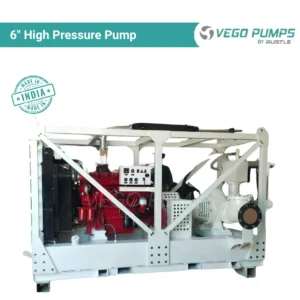
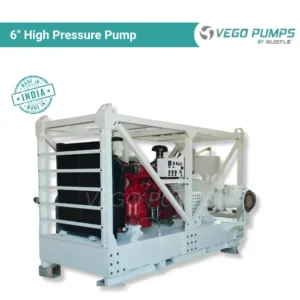
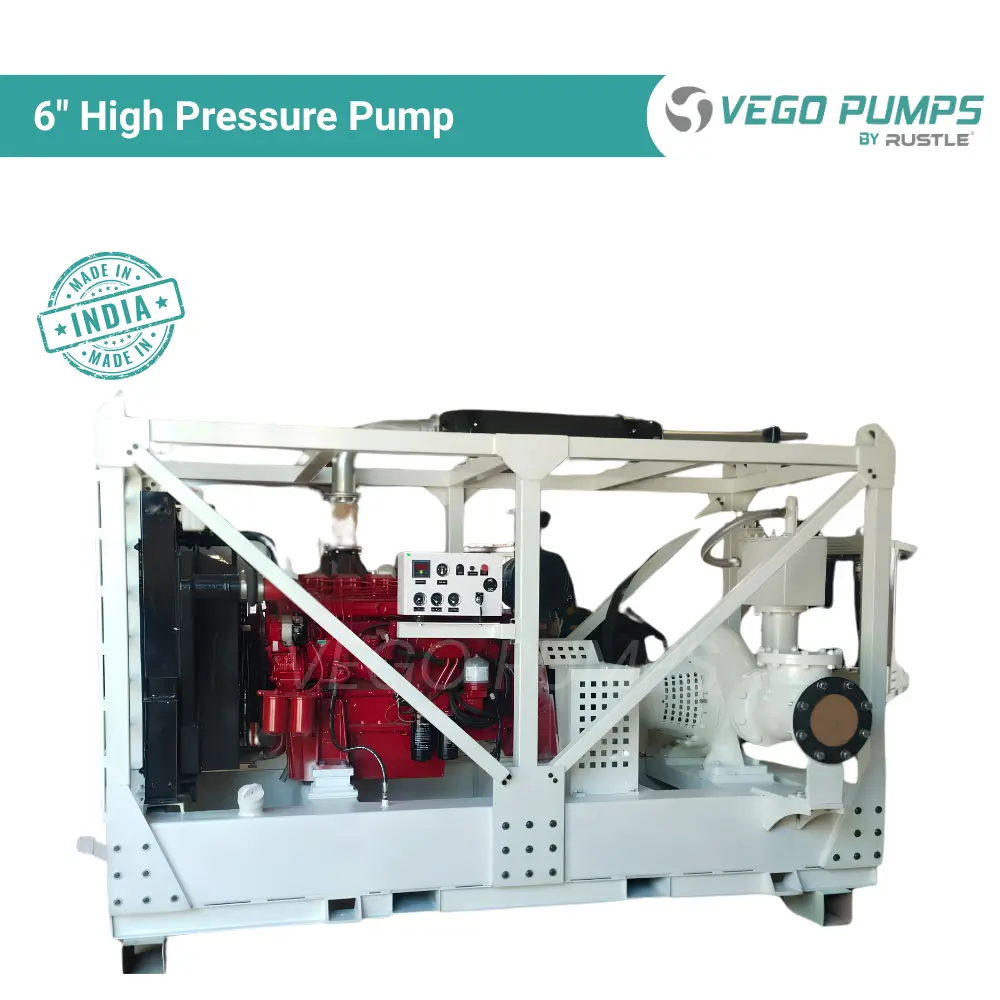
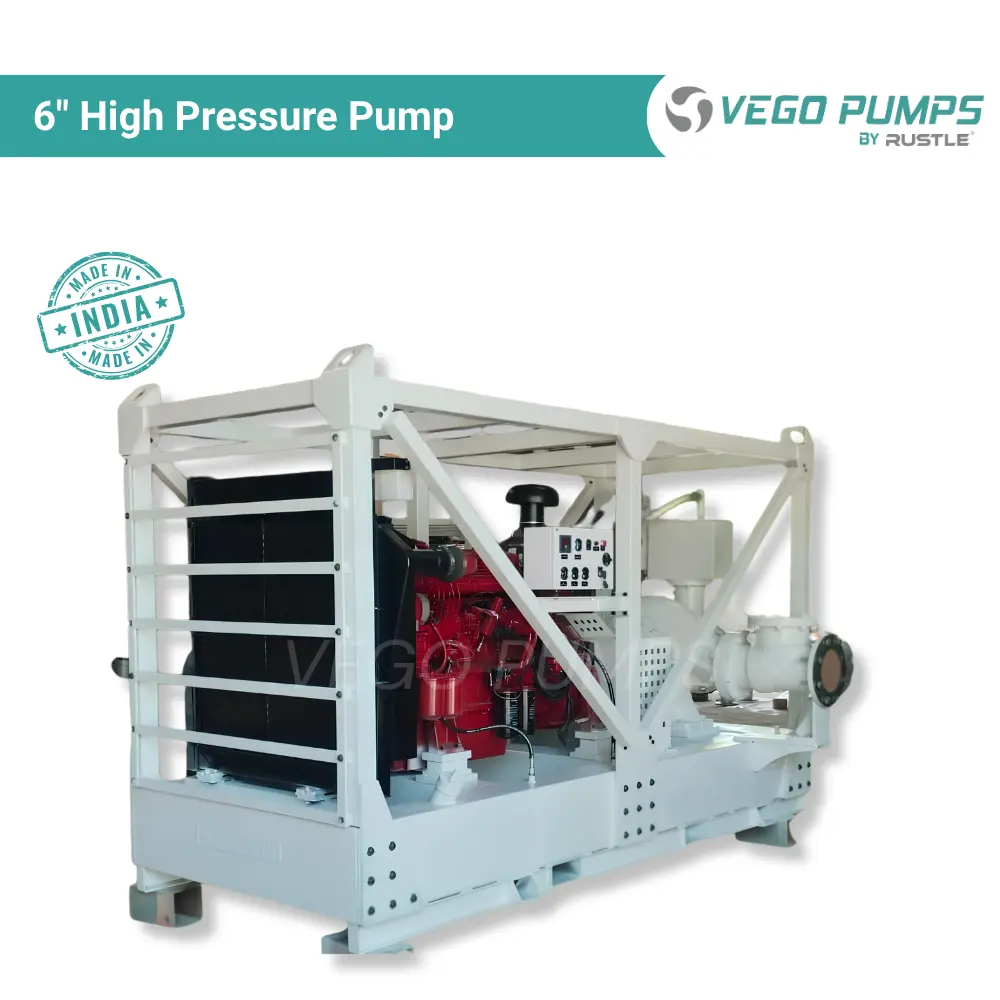
6 Inch High Pressure Pumps
The VEGO 6 Inch High Pressure Pump is built for exactly that: long-distance pipeline transport, mine dewatering, and any application where generating real pressure is the whole point.
| Specification | Detail |
|---|---|
| Pump size | 6 inch (150mm) suction and discharge |
| Pump type | Self-priming, auto priming centrifugal — high pressure (DP-H) |
| Drive options | Diesel engine (Deutz standard, alternatives on request) / Electric motor |
| Impeller material | Stainless steel or hardened steel (configurable) |
| Priming system | Fully automatic, with optional clutch-operated vacuum pump |
| Primary use case | Pipeline pumping, mine dewatering, long-distance water transport |
| Operation | Suitable for continuous 24/7 duty cycles |
WOW,Very wonderful
The content is really great