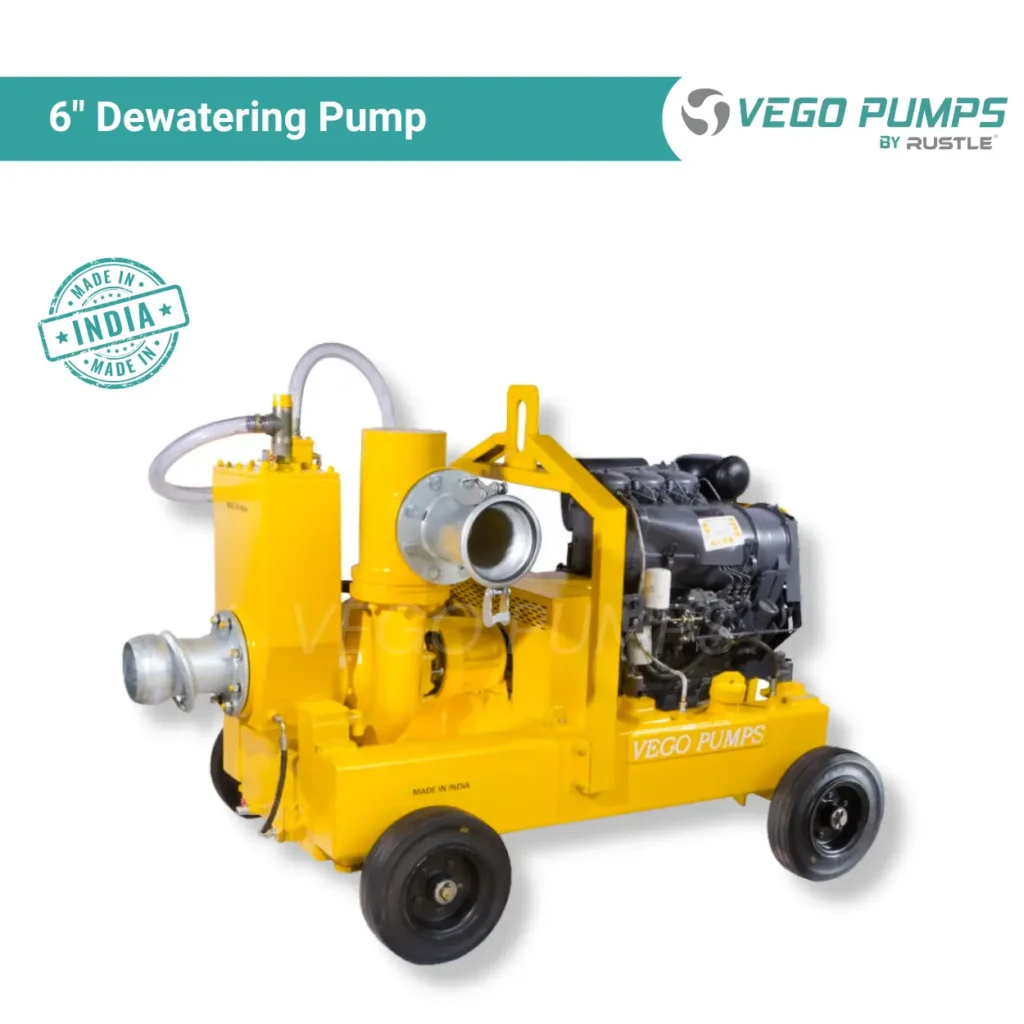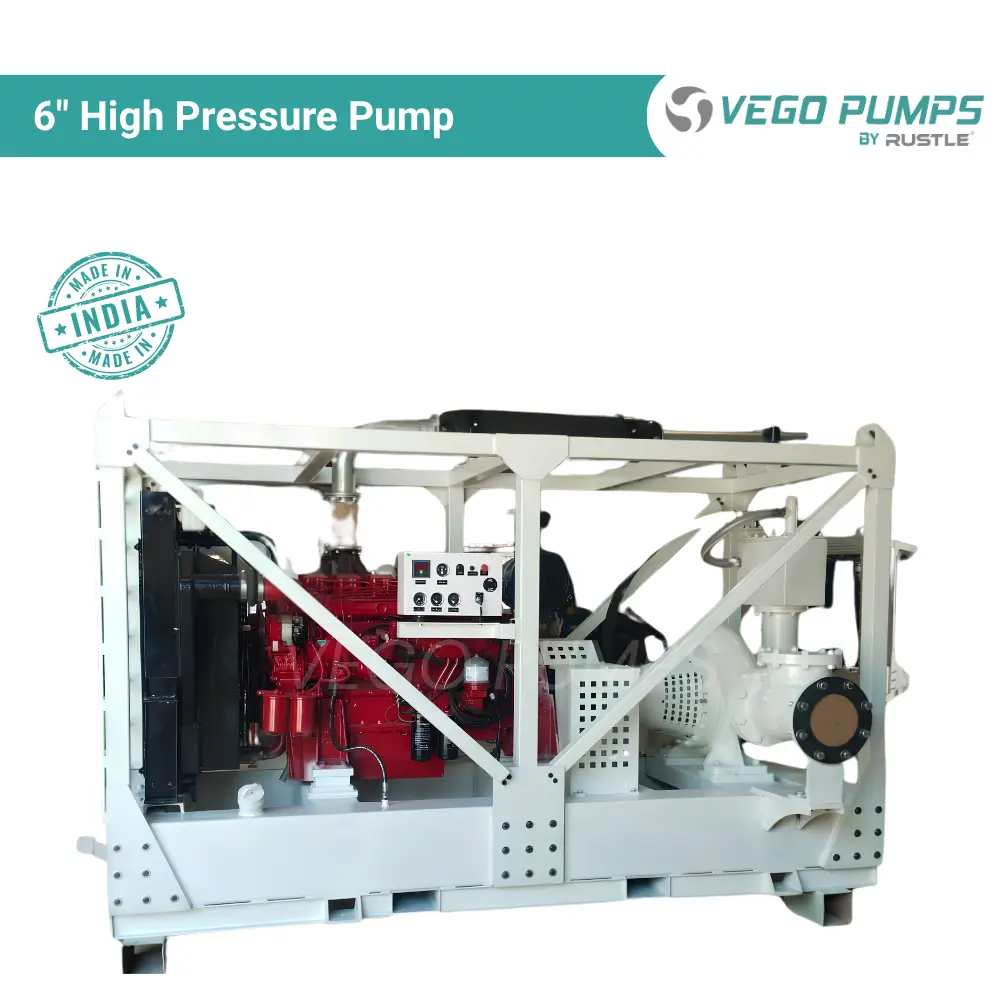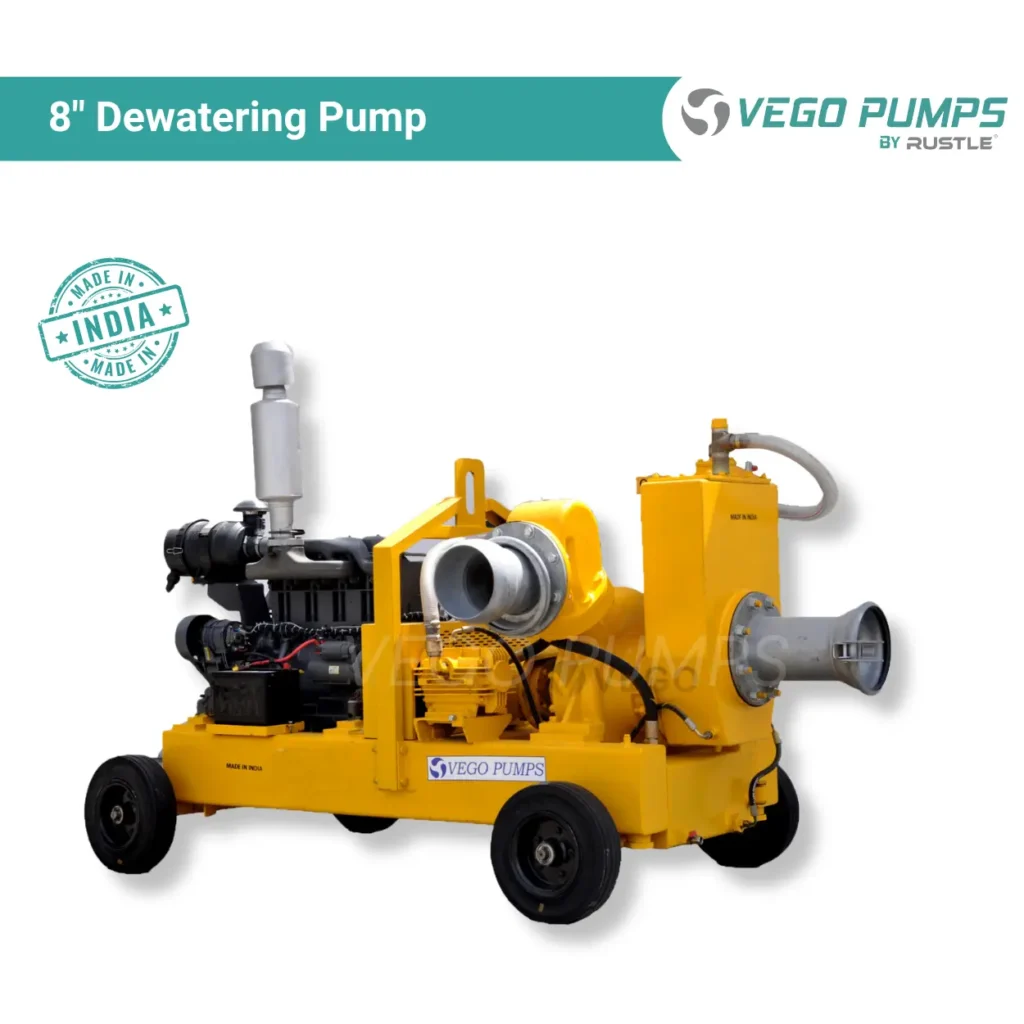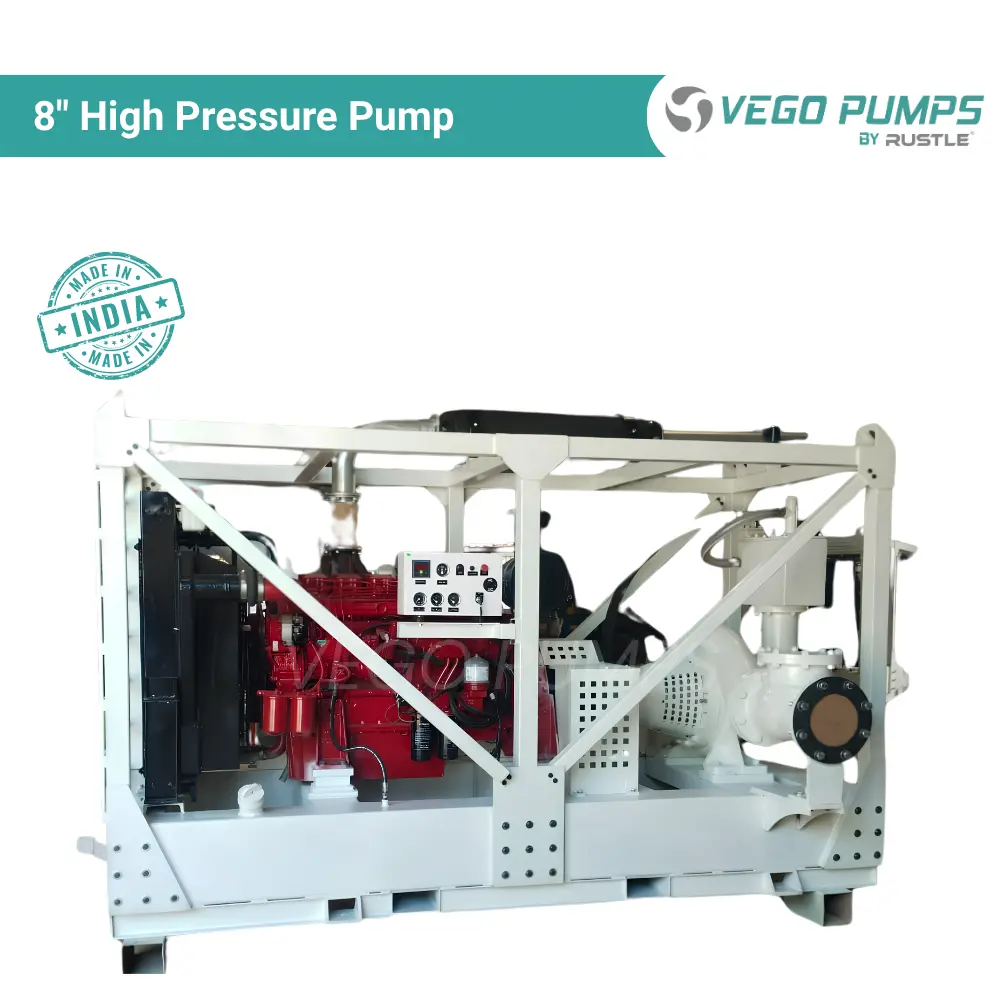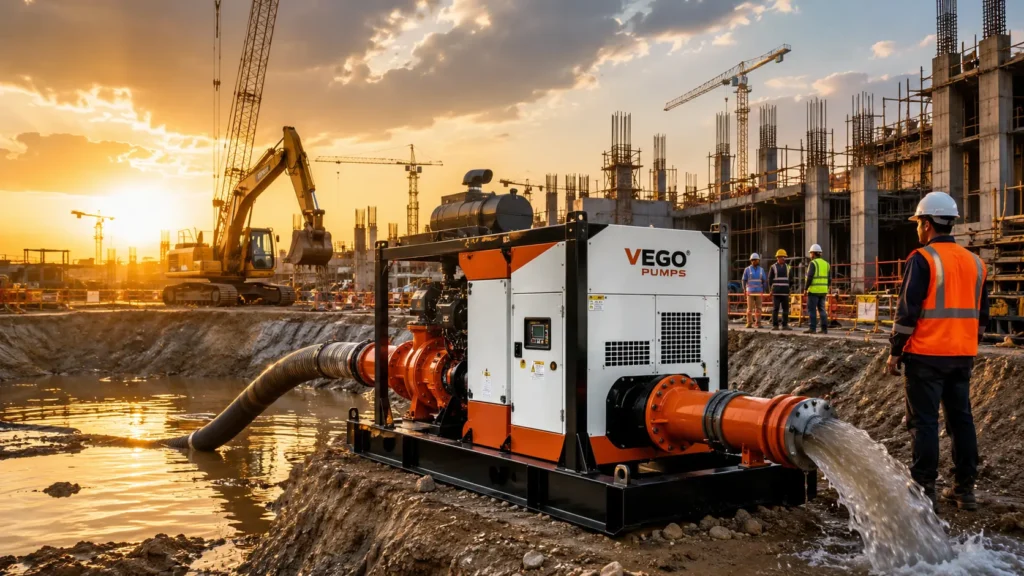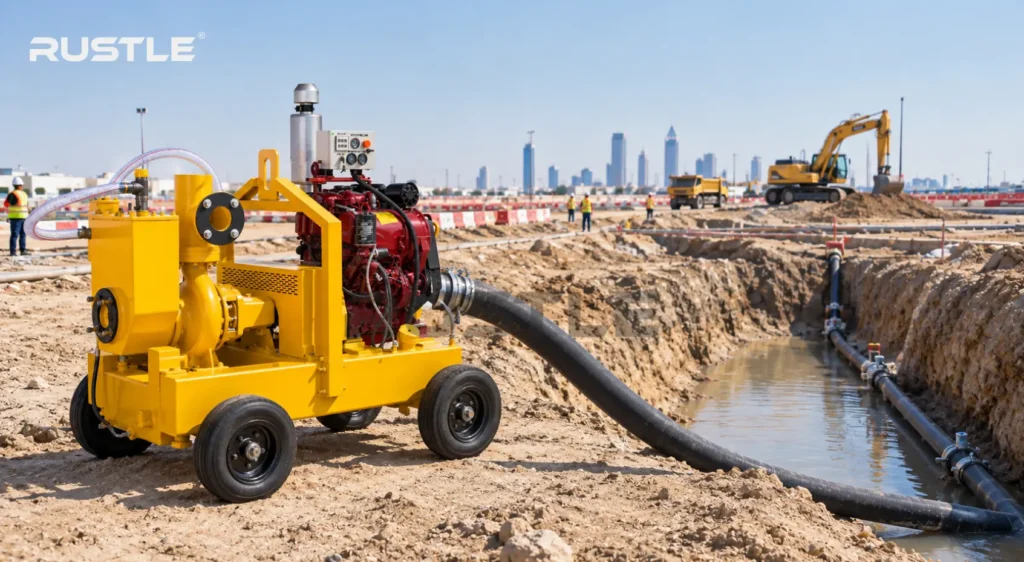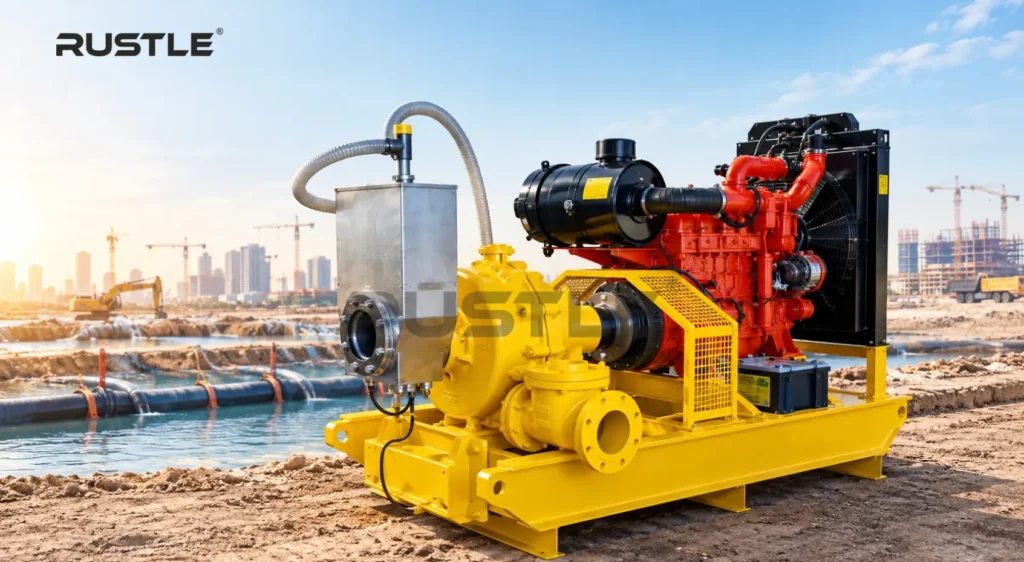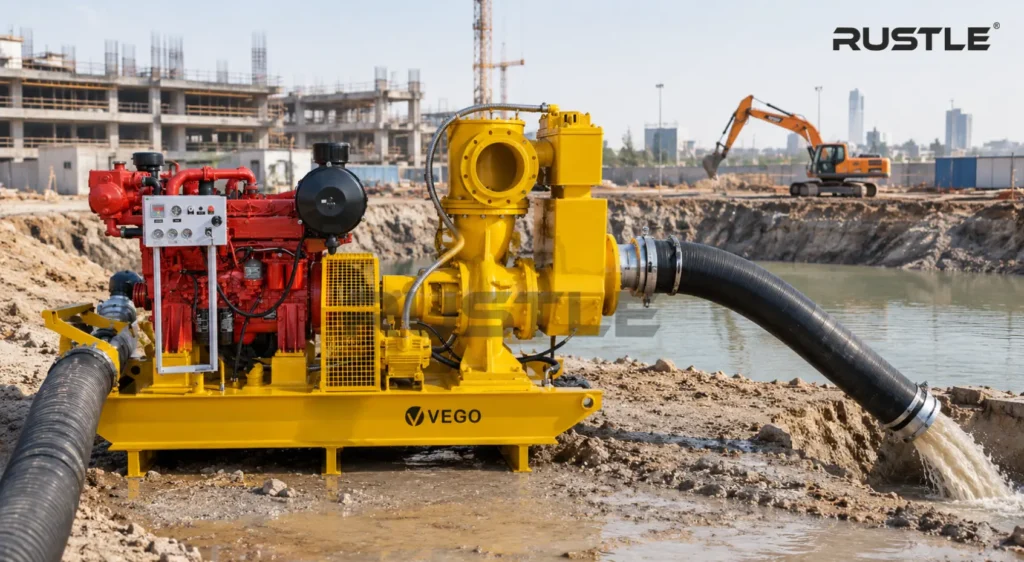
Water accumulation can bring a construction project to a standstill, flood a mine working area, or disrupt industrial operations. When water must be removed quickly and consistently, choosing the right pumping system becomes an important engineering decision.
Self-priming dewatering pumps are widely used for draining excavations, managing groundwater, removing floodwater, and transferring water containing suspended solids, provided the pump is designed for the liquid and site conditions.
Unlike a conventional centrifugal pump that may require the casing and suction line to be filled with liquid before starting, a self-priming pump is designed to remove air from its suction line and establish liquid flow after the required initial priming procedure.
For contractors, mining operators, municipal authorities, and industrial procurement teams, this can simplify installation and reduce operational interruptions. However, performance depends on more than the pump itself. Suction lift, total dynamic head, pipe diameter, liquid characteristics, engine or motor capacity, and maintenance practices all influence the result.
In this guide, VEGO Pumps by Rustle explains how self-priming dewatering pumps work, their main benefits, applications, limitations, maintenance requirements, and the factors to consider before purchasing a pump for projects in India, Saudi Arabia, the UAE, Qatar, Oman, Kuwait, Bahrain, and African markets.
What Are Self-Priming Dewatering Pumps?
Self-priming dewatering pumps are generally surface-mounted centrifugal pumps engineered to evacuate air from the suction line and establish pumping without requiring the operator to manually refill the entire suction line at every normal restart, provided the pump retains the required priming liquid or uses a suitable priming mechanism.
The pump is typically installed on a dry, accessible surface near the water source. A suction hose or pipe extends into the excavation, pit, sump, or other collection point, while the discharge line directs the extracted water to an approved drainage point or treatment system.
Depending on the design, self-priming may be achieved through a liquid-retaining casing, a recirculation arrangement, a vacuum-assisted priming system, or another engineered mechanism. These systems are not identical, so the manufacturer’s operating instructions must be followed.
How Does a Self-Priming Dewatering Pump Work?
The operating process can be understood in five stages:
- Initial priming: The pump casing is filled with the specified amount of liquid if the design requires it. Vacuum-assisted systems follow their own priming procedure.
- Air removal: The pump separates air from the liquid or evacuates air from the suction line through its priming mechanism.
- Water intake: As pressure conditions develop, atmospheric pressure helps push water from the source into the suction line.
- Centrifugal pumping: The impeller transfers energy to the liquid, creating flow through the discharge connection.
- Continuous operation: The pump maintains the required flow while operating within its design limits and receiving a suitable supply of liquid.
Important engineering note: Self-priming does not mean that a pump can run indefinitely without water, lift water from any depth, or automatically recover from every air leak. Maximum suction lift, priming time, dry-running capability, and restart procedures depend on the specific design.
Key Benefits of Self-Priming Dewatering Pumps
1. Faster and simpler site operation
On construction sites and mining projects, the water level may change throughout the day. A correctly selected self-priming system can simplify routine starts and restarts because operators do not need to manually fill the entire suction line every time under normal operating conditions.
This is particularly useful when equipment must be moved between drainage points or operated during changing site conditions.
2. Surface-mounted installation
A surface-mounted pump can be positioned on a stable platform close to the water source, keeping the main pump assembly accessible for inspection and servicing.
This can reduce the need to place the pump itself inside a wet pit or excavation. Nevertheless, workers may still need to inspect or position suction equipment, so confined-space and excavation safety procedures remain essential.
3. Suitable options for demanding water conditions
Selected self-priming centrifugal pumps can handle dirty water containing suspended solids. Open or semi-open impellers, appropriate casing passages, and suitable wear components can help accommodate the intended liquid.
The maximum solids diameter, concentration, abrasiveness, and type of debris must be checked against the pump’s technical data.
A pump designed for ordinary groundwater should not automatically be assumed suitable for thick slurry, abrasive mine tailings, fibrous waste, or corrosive process liquids.
4. Flexible power and installation options
Depending on the model, buyers may choose diesel-engine or electric-motor-driven equipment. Skid-mounted packages are useful for fixed or semi-permanent installations, while trailer-mounted units can support projects where the pump must be relocated frequently.
Diesel pumps may suit remote sites without reliable grid power. Electric pumps may offer operating-cost, noise, and emissions advantages where suitable electricity is available.
The best choice depends on operating hours, power availability, fuel costs, noise restrictions, emissions requirements, and the site’s safety conditions.
5. Support for emergency drainage
Flooding can affect basements, road construction, underpasses, industrial yards, and municipal drainage areas. A suitably sized self-priming dewatering pump can support emergency water removal when its flow, head, suction arrangement, and solids-handling capability match the situation.
For emergency planning, confirm the pump’s readiness, priming procedure, fuel or electrical supply, hose connections, and access to a safe discharge location before heavy rainfall occurs.
6. Easier routine access to service points
With a surface-mounted installation, operators can often access the engine or motor, filters, casing, seals, and other service points more conveniently than with equipment located deep inside a sump.
Actual maintenance time depends on the design. Before purchase, ask about inspection access, wear-part replacement, spare-parts availability, and the recommended service intervals.
Important Features to Look for in a Self-Priming Pump
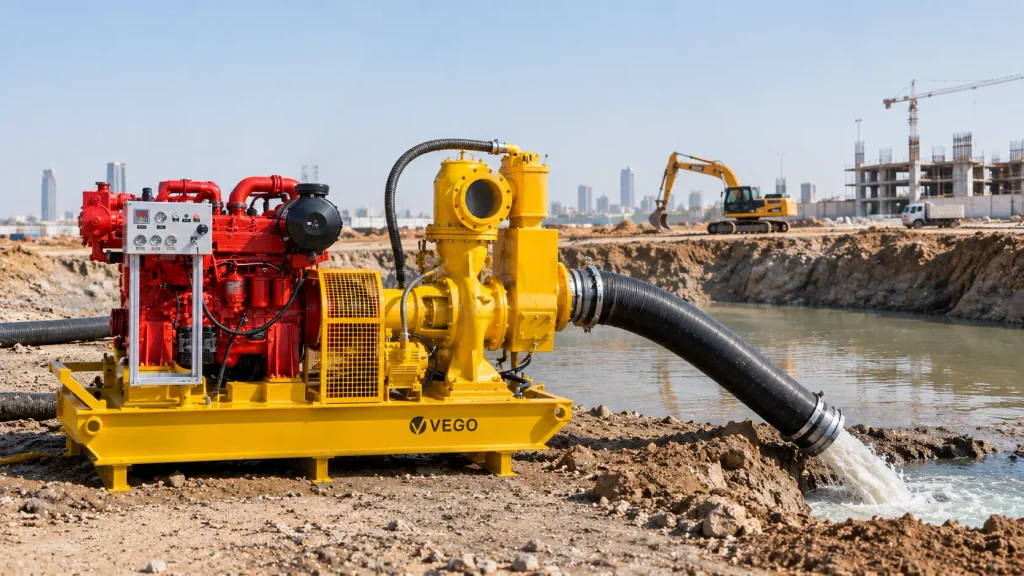
Not every pump marketed for dewatering has the same capabilities. Review the following features against the application.
| Feature | Why it matters | What to verify |
|---|---|---|
| Self-priming or vacuum-assisted system | Establishes suction by removing air | Priming method, lift limit, priming time |
| Impeller design | Influences efficiency and solids passage | Open, semi-open, or other design; allowable solids |
| Flow capacity | Determines how quickly water can be removed | Required flow at the operating head |
| Total dynamic head | Represents the complete pumping resistance | Static lift, pipe friction, fittings and outlet pressure |
| Diesel or electric drive | Determines the available power source | Duty rating, fuel use, electrical supply and controls |
| Mechanical seal | Helps prevent leakage around the shaft | Seal material, liquid compatibility and service needs |
| Casing and wetted materials | Affect durability and corrosion resistance | Liquid chemistry, abrasion and temperature |
| Skid or trailer mounting | Affects transport and installation | Lifting points, dimensions, weight and site access |
| Monitoring and protection | Helps operators identify abnormal conditions | Available alarms, sensors, controls and remote features |
| Serviceability | Affects downtime and maintenance effort | Access to wear parts, manuals and replacement components |
Suction lift and pipework
Suction lift is the vertical distance between the pump’s relevant suction reference point and the liquid surface. It is not the same as total dynamic head.
A longer suction line, undersized pipe, excessive bends, air leaks, clogged strainers, or high liquid temperature can make priming and operation more difficult. The theoretical atmospheric limit is not a practical design target: actual permissible lift depends on the pump, site elevation, liquid properties, losses, and operating conditions.
Keep the suction line as short and direct as practical, use an appropriate diameter, and follow the manufacturer’s limits for lift and hose arrangement.
Solids-handling capability
Construction runoff and mine water can contain sand, gravel, silt, or other debris. Ask the manufacturer to confirm the maximum allowable solids size and whether the stated rating applies to hard particles, soft solids, or a particular slurry concentration.
Large stones, long fibres, and abrasive particles can cause blockages or accelerate wear even when the nominal particle size appears acceptable.
Construction and material selection
A cast-iron casing may suit many general dewatering applications, while stainless steel or specialist alloys may be appropriate for particular corrosive liquids. Abrasive applications may require suitable wear-resistant components.
Material selection should be based on the actual liquid, pH, temperature, solids content, and expected operating life—not on material names alone.
Major Applications of Self-Priming Dewatering Pumps
1. Construction and infrastructure
Construction teams use dewatering pumps to remove water from:
- Building foundations and basement excavations.
- Road construction, bridge works, and underpasses.
- Trenches for water, drainage, and utility pipelines.
- Industrial building sites and infrastructure projects.
- Excavations affected by groundwater or rainfall.
Effective dewatering helps maintain workable site conditions and supports safer access. It does not replace excavation stability assessments, groundwater-control engineering, or suitable discharge management.
2. Mining and quarrying
Mining operations may require water removal from pits, access roads, sumps, and selected underground or surface facilities. Depending on the installation and pump specification, self-priming equipment can support water transfer and drainage where surface access is practical.
Mine water can be highly abrasive and may contain suspended minerals. Check the solids concentration, particle characteristics, corrosion risk, and duty cycle before specifying a pump.
3. Flood control and emergency response
Heavy rainfall can overwhelm local drainage systems and leave water in streets, basements, construction sites, and industrial compounds. Portable dewatering pumps can form part of a planned response alongside drainage channels, temporary barriers, and other emergency equipment.
For urban flood response, consider water depth, debris, access routes, electrical hazards, the discharge destination, and whether multiple pumps are required.
4. Oil and gas facilities
Self-priming pumps may be used for approved drainage and water-transfer duties at oil and gas sites. Applications involving flammable liquids, hazardous atmospheres, or classified areas require specifically suitable equipment, installation, and certification.
A standard diesel dewatering pump is not automatically suitable for hazardous-area operation. Verify the complete equipment package against the project’s applicable hazardous-area and site requirements.
5. Municipal and industrial water management
Selected models can support drainage, temporary bypass duties, wastewater handling, and water transfer in municipal or industrial environments. Sewage and sludge applications require careful selection because fibrous materials, solids concentration, and viscosity can differ significantly from ordinary dirty water.
Always check whether the proposed pump is approved for the actual liquid and duty.
6. Agriculture and irrigation infrastructure
Pumps may be used for draining low-lying areas, transferring water between collection points, and supporting temporary drainage around irrigation infrastructure. Suitability depends on flow requirements, suction conditions, water quality, and the elevation difference between source and discharge.
Self-Priming vs Submersible vs Conventional Centrifugal Pumps
Choosing between these pump types depends on where the pump can be installed, the liquid being handled, the required head, and the site’s operating conditions.
| Comparison | Self-priming surface pump | Submersible pump | Conventional centrifugal surface pump |
|---|---|---|---|
| Installation | Above the liquid | Pump operates in the liquid | Usually above the liquid |
| Priming | Designed to evacuate air using its priming system | Normally submerged during operation | Often requires the casing and suction line to be filled |
| Routine access | Generally convenient from the surface | May require lifting from the sump | Generally convenient from the surface |
| Air in suction line | Can remove air within design limits | No long surface suction line when correctly submerged | Can interrupt pumping and require repriming |
| Solids handling | Model-dependent | Model-dependent | Model-dependent |
| Best-fit situations | Surface-accessible drainage and portable dewatering | Deep sumps or locations where submerged installation is preferable | Flooded-suction installations or properly primed duties |
| Key limitation | Suction lift and priming limits | Electrical protection, cooling and lifting requirements vary | Air leakage and loss of prime can interrupt operation |
A submersible pump may be the better option where the water source is deep or surface suction lift is impractical. A conventional centrifugal pump may be economical when flooded suction is available. A self-priming model can be attractive when surface installation and repeated starts are important.
How to Select the Right Self-Priming Dewatering Pump
Correct selection starts with the duty point—not simply the pipe diameter or advertised maximum flow.
Step 1: Establish the required flow rate
Estimate the volume of water that must be removed and the acceptable drainage time.
For a simplified estimate:
Required flow rate = Water volume ÷ Target pumping time
For example, removing 300 m³ of water in 5 hours requires an average flow of 60 m³/hr, before allowing for incoming groundwater, rainfall, changing levels, downtime, and other losses.
This is only an initial estimate. The final design should consider continuing inflow and the actual pump performance at the required head.
Step 2: Calculate total dynamic head
Total dynamic head includes static elevation difference and the losses caused by the suction and discharge pipework, fittings, valves, and outlet conditions.
A simplified relationship is:
Total dynamic head = Static head + Friction losses + Other system losses
For pressurised or complex systems, the complete system calculation must account for the relevant pressure terms. Select a pump using its performance curve at the expected operating point rather than choosing solely by maximum flow or maximum head.
Step 3: Check suction conditions
Determine the maximum vertical suction lift, pipe length, pipe diameter, number of bends, water temperature, and site elevation.
Excessive suction lift or losses can prevent reliable priming and reduce performance. If the required suction conditions exceed the pump’s capabilities, consider relocating the pump, reducing losses, changing the pipework, or selecting a different pumping arrangement.
Step 4: Identify the liquid
Record whether the liquid is clean water, muddy water, sewage, slurry, or a chemically aggressive liquid. Document the particle size, concentration, abrasiveness, viscosity, pH, and temperature wherever possible.
These details help the manufacturer recommend suitable impeller geometry, clearances, seals, and materials.
Step 5: Select the power source and mounting
Consider:
- Diesel availability and fuel consumption.
- Grid power, generator capacity, and starting current.
- Required daily operating hours.
- Noise and emissions restrictions.
- Transport frequency and lifting arrangements.
- Enclosure, weather protection, and site security.
For remote GCC and African sites, logistics, spare-parts access, operator training, and fuel availability may influence the purchase as much as the initial equipment price.
Step 6: Compare lifecycle cost
A lower purchase price does not necessarily mean a lower operating cost. Compare the expected fuel or electricity use, scheduled maintenance, wear-part consumption, transportation, service access, and the financial impact of downtime.
Ask suppliers to provide the performance curve, duty-point confirmation, operating limits, maintenance schedule, and a clear list of included accessories.
Expert Tips for Better Dewatering Performance
- Position the pump on stable ground with sufficient ventilation and safe access.
- Keep suction hoses airtight and inspect seals, joints, and couplings.
- Use suitable strainers where required, without creating excessive suction restriction.
- Keep the suction line as short and direct as the site allows.
- Route discharge hoses to a suitable, permitted location and secure them against movement.
- Monitor water levels and changing inflow during heavy rainfall.
- Confirm that the selected impeller and casing can handle the expected solids.
- Maintain a record of operating hours, fuel consumption, pressure, flow, and service work.
- Keep critical spares available when equipment downtime would interrupt the project.
- Never bypass engine, electrical, pressure, or safety protections to force a pump to operate outside its intended limits.
Maintenance Checklist for Self-Priming Dewatering Pumps
Preventive maintenance is essential for reliable operation, particularly when a pump runs for long hours in dirty water or harsh outdoor conditions.
Before every start
- Inspect the casing, hoses, pipework, clamps, and connections.
- Check the specified priming-liquid level or priming-system readiness.
- Inspect the suction strainer and remove accumulated debris safely.
- Check engine oil, coolant where applicable, fuel, or electrical connections according to the manual.
- Confirm that the discharge line is secured and the outlet is clear.
- Verify that guards and safety devices are fitted.
During operation
- Observe flow, discharge pressure, noise, vibration, and leakage.
- Check for unusual engine behaviour, overheating, or loss of suction.
- Monitor liquid levels and ensure the pump remains within its permitted operating range.
- Watch for unexpected changes in flow that may indicate a blockage or air leak.
After operation
- Follow the shutdown and flushing procedure specified for the liquid handled.
- Drain or clean the equipment when required by the application and storage conditions.
- Inspect for wear, corrosion, and debris accumulation.
- Record operating hours and any faults observed.
Periodic servicing
Service intervals depend on the pump design, engine or motor, duty cycle, and liquid conditions. Follow the manufacturer’s schedule for oil, filters, seals, bearings, impellers, and other wear components.
Do not assume every self-priming pump is capable of continuous dry running. Dry-running limits must be confirmed for the exact model.
Common Buying and Operating Mistakes
Choosing by discharge size alone
A 6-inch, 8-inch, or 12-inch connection does not by itself establish the flow the pump will deliver. Flow changes with the total dynamic head and system resistance.
Better approach: Provide the required flow and head, then confirm the operating point on the performance curve.
Ignoring the suction lift
A pump may appear adequately sized but fail to prime because the suction lift is excessive or the line has air leaks.
Better approach: Check elevation, hose length, diameter, fittings, airtightness, and manufacturer limits.
Underestimating solids and abrasion
Water containing sand or gravel can wear components rapidly. Long fibres or unsuitable debris can block a passage even when the pump has a relatively large solids rating.
Better approach: Share a realistic description of the liquid and ask for a documented solids-handling limit.
Overlooking power and operating costs
A pump that meets the flow requirement may still be expensive to operate if the drive is poorly matched to the duty.
Better approach: Compare fuel or electrical consumption at the expected duty point, maintenance needs, and availability of power.
Neglecting spares and service support
Waiting for an imported seal, impeller, or engine component can create costly delays.
Better approach: Ask about recommended critical spares, service documentation, warranty coverage, lead times, and technical support before placing an order.
Discharging water without checking site requirements
Extracted water may contain sediment, oil, chemicals, or other contaminants. Direct discharge may be restricted or environmentally inappropriate.
Better approach: Check local discharge rules, sediment control, treatment needs, and the approved receiving point before pumping.
Self-Priming Dewatering Pumps: Trends for 2026–2028
Pump technology continues to develop, but the value of a new feature depends on whether it solves a real operating problem.
1. Remote monitoring and connected equipment
Sensors and connected controls can help operators monitor available parameters such as operating status, pressure, temperature, vibration, or fluid level, depending on the installed system.
For contractors operating across multiple sites, remote alerts and operating records may help identify abnormal conditions earlier and plan service work more efficiently.
2. Condition-based maintenance
Rather than relying exclusively on calendar intervals, maintenance teams can use operating hours and suitable condition data to help plan inspections and repairs. This approach requires reliable sensors, sensible alarm thresholds, and a maintenance process that responds to the information.
It complements rather than replaces mandatory inspections and manufacturer-prescribed servicing.
3. Fuel and energy management
Fuel use is influenced by the duty point, engine condition, pump efficiency, pipework, and operating practices. Better sizing and avoiding unnecessary throttling or excessive system resistance can improve operating economics.
Electric and hybrid solutions may become more attractive where power infrastructure, emissions policies, and operating patterns support them.
4. Improved serviceability
Accessible wear components, clear service documentation, and easier inspection can reduce maintenance effort. Buyers should evaluate the actual design and availability of parts rather than relying only on broad claims about low maintenance.
5. Application-specific pump packages
Construction, mining, flood control, and industrial wastewater operations have different requirements. More carefully configured packages—with appropriate mounting, controls, pipework, and monitoring options—can help match equipment to the site.
Looking ahead: Through 2027 and 2028, connected monitoring, energy management, and condition-based maintenance are useful areas to evaluate when specifying new equipment. These are development directions, not guarantees that every pump model or market will adopt them.
Choosing a Dewatering Pump Supplier in India, the Middle East, and Africa
A good supplier should understand the application rather than simply recommend a pump by size.
When evaluating a manufacturer or exporter, ask for:
- A model recommendation supported by the required flow and head.
- A pump performance curve and technical datasheet.
- Confirmation of priming method and maximum suction lift.
- Details of solids-handling capability and wetted materials.
- Engine or motor information and expected operating requirements.
- Installation, operation, and maintenance instructions.
- Availability of consumables and replacement parts.
- Delivery arrangements, warranty terms, and after-sales support.
- Applicable compliance documents and certifications for the destination and application.
For projects in Saudi Arabia, the UAE, Qatar, Oman, Kuwait, Bahrain, India, and African markets, also consider local site conditions, transportation, ambient temperatures, dust exposure, service access, and the availability of suitable power and fuel.
Explore VEGO Pumps by Rustle
VEGO Pumps by Rustle serves industrial and infrastructure pumping needs with dewatering pump options and application-specific configurations.
Depending on the required duty, pump size, and configuration, suitable equipment can support construction drainage, mining, groundwater management, and other water-removal applications.
For your project, the selection process should begin with the operating requirements rather than an assumption that one model suits every application.
Explore the following resources on the Rustle Dynamics website:
- Dewatering Pumps: https://rustledynamics.com/dewatering-pumps/
- All Dewatering Pumps: https://rustledynamics.com/all-dewatering-pumps/
- High-Pressure Pumps: https://rustledynamics.com/high-pressure-pumps/
- Solid Handling Pumps: https://rustledynamics.com/solid-handling-pumps/
- Genuine Pump Spares & Accessories: https://rustledynamics.com/genuine-pump-spares-accessories/
- Industries Served: https://rustledynamics.com/industries/
- Contact VEGO / Rustle: https://rustledynamics.com/contact-us/
Confirm that each destination is live and that the linked page matches the anchor text before publishing.
Conclusion: Select the Right Self-Priming Dewatering Pump for Your Project
Self-priming dewatering pumps can simplify surface-mounted drainage, reduce repeated manual priming, and support demanding water-removal operations when correctly specified. Their success depends on matching flow, total dynamic head, suction lift, solids-handling requirements, power supply, and material compatibility to the actual application.
For contractors, engineers, and procurement teams, the most reliable approach is to assess the complete pumping duty, review the performance curve, understand maintenance requirements, and choose a supplier that can provide appropriate technical documentation and support.
Planning a construction, mining, flood-control, or industrial dewatering project?
Contact VEGO Pumps by Rustle to discuss your pumping requirements. Share your required flow rate, total head, suction lift, liquid type, solids content, power source, and site location so the team can help identify a suitable configuration.
Website: https://rustledynamics.com/
Email: sales@rustledynamics.com
Phone: +91 99942 04834
Get in touch with VEGO Pumps by Rustle to discuss your project requirements and request a suitable pump recommendation.
Frequently Asked Questions
1. What is a self-priming dewatering pump?
A self-priming dewatering pump is generally a surface-mounted centrifugal pump designed to remove air from its suction line and establish liquid flow using an integrated priming arrangement.
2. How does a self-priming dewatering pump work?
Its priming system evacuates air from the suction line or separates air from the liquid, allowing water to enter the pump. The centrifugal impeller then transfers energy to the liquid and delivers it through the discharge line.
3. Do self-priming pumps need water before starting?
Many designs require an initial liquid charge in the casing. Others use a dedicated vacuum or priming arrangement. Follow the exact manufacturer’s procedure; self-priming does not automatically mean dry-start capability.
4. What are the main benefits of self-priming dewatering pumps?
Key benefits can include easier routine starting, surface-mounted installation, convenient access for servicing, portability in suitable configurations, and the ability to handle specified dirty-water applications.
5. Can a self-priming pump handle muddy water?
Selected models can handle muddy water containing suspended solids. Confirm the particle size, concentration, abrasiveness, impeller design, and material compatibility before selecting a pump.
6. What is the difference between a self-priming and a submersible dewatering pump?
A self-priming pump is normally installed above the water source and draws water through a suction line. A submersible pump operates in the liquid. The right choice depends on water depth, access, suction conditions, liquid characteristics, and the required duty.
7. How do I calculate the required dewatering pump capacity?
Estimate the volume of water to be removed and the available pumping time, then account for ongoing inflow and operating conditions. Verify that the selected pump can deliver the required flow at the calculated total dynamic head.
8. What is the maximum suction lift of a self-priming pump?
The limit varies by pump design, site elevation, water temperature, suction-line losses, and other conditions. Use the model’s published operating limits rather than assuming a universal suction-lift value.
9. Are diesel self-priming dewatering pumps suitable for construction sites?
They can be suitable where the required flow and head match the pump’s capability and diesel power is practical. Consider fuel consumption, ventilation, noise, emissions, and site safety requirements.
10. Can self-priming pumps be used for floodwater removal?
Yes, when the pump is correctly selected for the water conditions, required drainage rate, suction lift, discharge head, and debris content. Safe discharge and electrical or environmental hazards must also be considered.
11. How often should a self-priming dewatering pump be serviced?
Follow the manufacturer’s service schedule, adjusting inspections to the duty, operating hours, and liquid conditions. Check the priming system, filters, oil or electrical components, seals, hoses, and wear parts as applicable.
12. Can a self-priming pump run dry?
Do not assume so. Some specialised designs offer defined dry-running capability, while others can suffer seal or internal-component damage. Verify the limits for the exact model.
13. What information should I give a supplier before purchasing?
Provide the required flow rate, total dynamic head, suction lift, suction and discharge pipe sizes, liquid type, solids characteristics, operating hours, power source, installation arrangement, and destination country.
14. Where are self-priming dewatering pumps commonly used?
Common applications include construction excavations, mines and quarries, flood response, municipal drainage, selected industrial wastewater duties, and approved water-transfer applications at industrial facilities.
15. How can I request a suitable dewatering pump from VEGO Pumps by Rustle?
Visit https://rustledynamics.com/contact-us/ or email sales@rustledynamics.com. Include your operating conditions and technical requirements to help the team evaluate a suitable pump configuration.