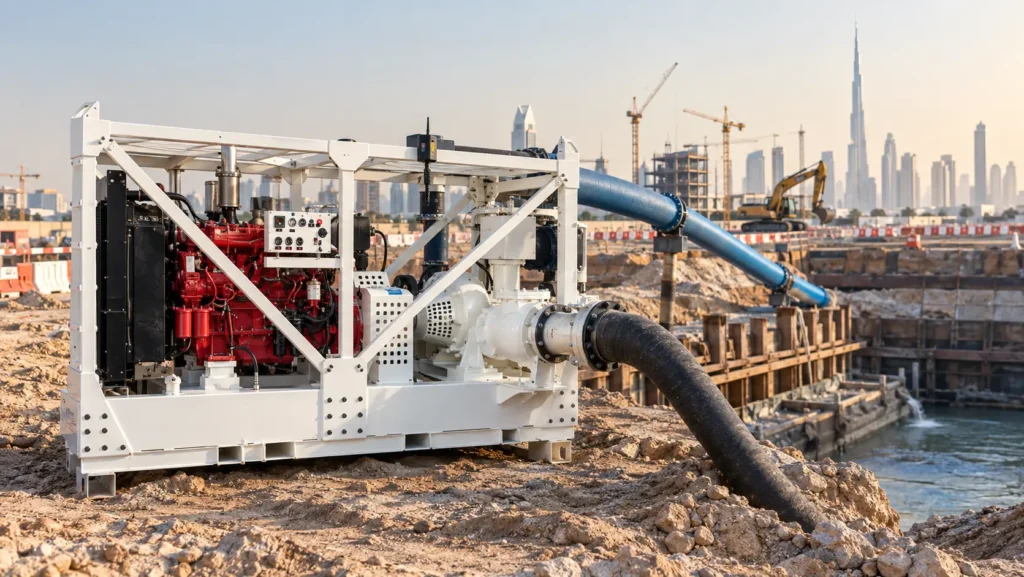
Water accumulation can create serious challenges at construction sites, mining operations, industrial facilities and infrastructure projects. Excess groundwater, rainwater, mud and wastewater can delay work, damage equipment and create unsafe working conditions. Choosing the right dewatering pump is essential for maintaining site productivity and managing unwanted water efficiently.
A dewatering pump is designed to remove accumulated water from different environments, including construction excavations, underground mines, drainage systems, flooded areas and industrial facilities. Depending on the application, these pumps are available in different capacities, discharge sizes, power configurations and construction materials.
For contractors, engineers and industrial procurement teams, understanding pump performance, flow rate, head, solid-handling capacity and operating conditions is important before selecting equipment.
In this guide, we explain how dewatering pumps work, their different types, industrial applications, important specifications and how to choose the right solution for your project.
What Is a Dewatering Pump?
A dewatering pump is an industrial pumping system used to remove unwanted water from a particular location and transfer it to a designated discharge point. These pumps are commonly used wherever water accumulation interferes with construction, mining, manufacturing, drainage or other industrial activities.
Unlike ordinary water transfer pumps, industrial dewatering pumps are selected according to demanding operating conditions. Some applications involve groundwater, muddy water, suspended solids, continuous operation or changing water levels.
Depending on the application, a dewatering pump can be powered by a diesel engine, electric motor or hydraulic system. Pump configurations include self-priming centrifugal pumps, submersible pumps and specialised slurry-handling equipment.
How Does a Dewatering Pump Work?
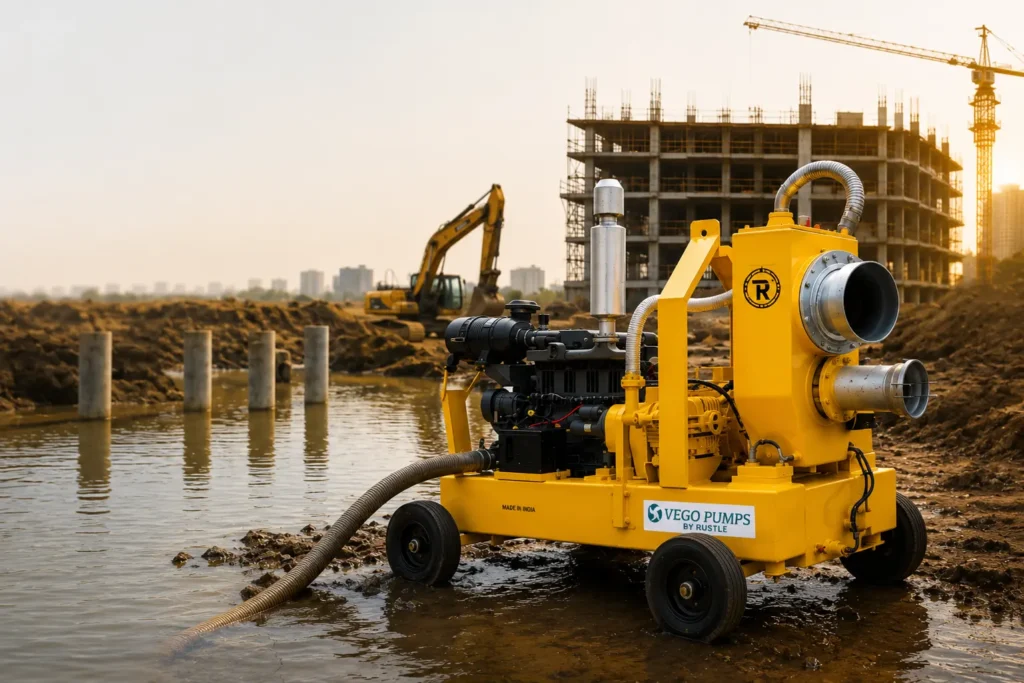
The working principle depends on the pump design.
In a centrifugal dewatering pump, an impeller rotates inside the pump casing. Water enters through the suction connection and is accelerated by the impeller. The pump casing converts this energy into pressure, allowing water to move through the discharge pipeline.
A self-priming dewatering pump uses a specially designed casing and priming arrangement to remove air from the suction line and establish pumping operation. This is particularly useful for applications where the pump is installed above the water level.
The performance of a pump depends on several factors:
- Impeller design and operating speed
- Suction and discharge pipe dimensions
- Total dynamic head
- Flow rate requirements
- Water characteristics and solid content
- Power source and operating conditions
Correct installation and pump selection are important for achieving reliable performance.
Different Types of Dewatering Pumps
Different projects require different pumping arrangements. The following are commonly used types of industrial dewatering pumps.
1. Diesel Dewatering Pumps
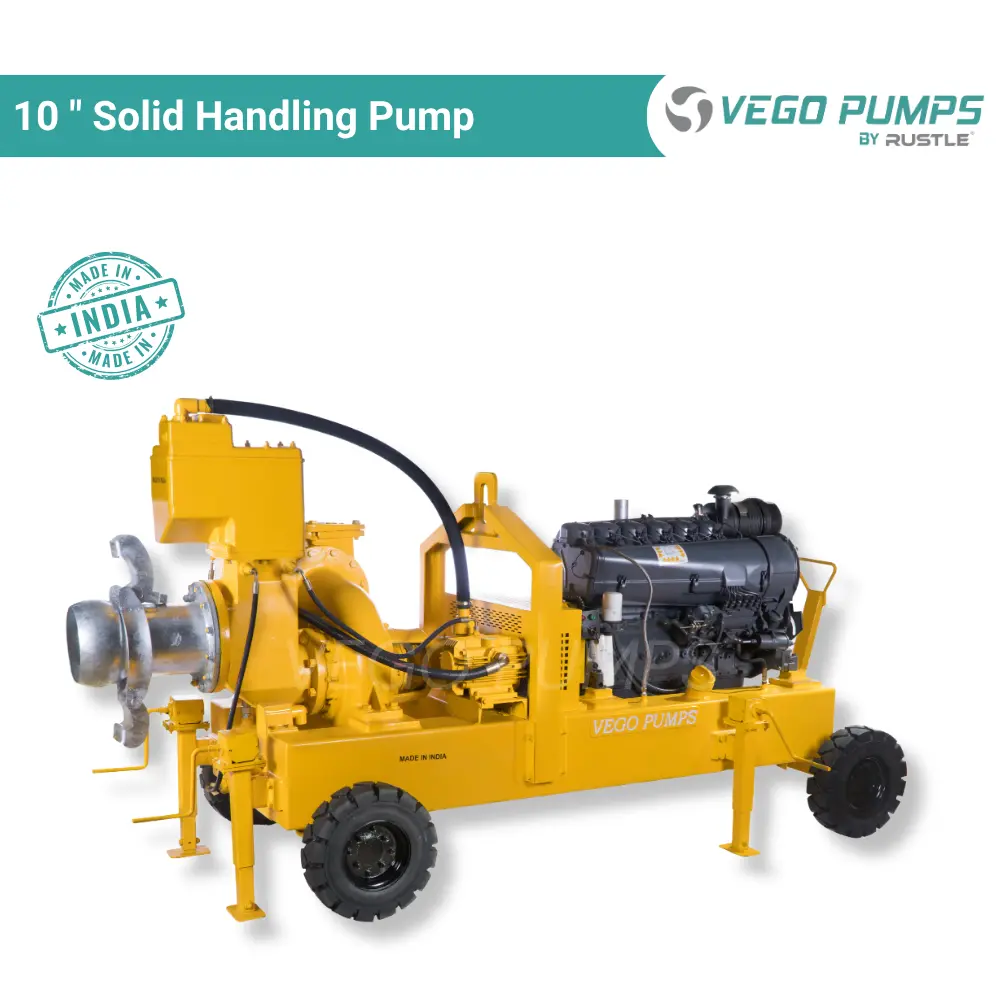
Diesel dewatering pumps are widely used in construction, mining, infrastructure and emergency drainage applications. They are suitable for locations where a reliable electrical supply is unavailable or where portable pumping equipment is required.
Key advantages include:
- Independent operation without a fixed electrical connection
- Suitability for remote construction and mining locations
- Portable skid-mounted or trailer-mounted configurations
- Options for high-volume water transfer
- Suitable configurations for continuous industrial operation
2. Electric Dewatering Pumps
Electric dewatering pumps use an electric motor to drive the pumping system. They are commonly used in industrial facilities, construction sites and permanent drainage installations where electricity is available.
Their benefits include convenient operation, compatibility with automation systems and the possibility of efficient operation when correctly matched to the duty point.
3. Self-Priming Dewatering Pumps
Self-priming pumps are designed to establish pumping operation by removing air from the suction arrangement. They are particularly useful for above-ground pump installations.
Applications include construction excavations, drainage operations, mining water removal and temporary floodwater management.
4. Submersible Dewatering Pumps
Submersible pumps operate while immersed in the water being pumped. They are commonly used in sumps, underground areas, pits and drainage applications where the pump needs to be positioned directly inside the water.
5. High-Pressure Dewatering Pumps
Some applications require water to be transferred over long distances or against higher elevation differences. High-pressure dewatering pumps are designed for these demanding operating conditions.
Pump selection should consider the required flow rate and total head rather than pressure alone.
6. Slurry and Solid-Handling Pumps
When the water contains sand, mud, suspended particles or other solids, a conventional clean-water pump may not be appropriate.
Slurry and solid-handling pumps are designed for more demanding liquid conditions. The maximum allowable solid size, material compatibility and impeller configuration must be checked against the actual application.
Major Industrial Applications of Dewatering Pumps
Industrial dewatering equipment supports a wide range of industries.
Construction and Infrastructure
Water accumulation in excavations, foundations, basements, tunnels and underground structures can interrupt construction activities.
Dewatering pumps help contractors remove groundwater and rainwater, maintain workable excavation conditions and support project progress.
Mining and Quarrying
Mining operations frequently experience groundwater ingress, rainwater accumulation and water collection in operational pits.
Mining dewatering pumps are selected according to water volume, pumping distance, elevation, suspended solids and operating environment.
Flood Control and Emergency Drainage
Heavy rainfall and flooding can cause water accumulation in roads, commercial properties, industrial facilities and low-lying areas.
High-capacity dewatering pumps can support emergency water removal when correctly sized for the required drainage conditions.
Oil and Gas Projects
Industrial facilities, pipelines and infrastructure projects may require temporary water removal and drainage management.
The equipment must be selected according to the liquid characteristics, site conditions and applicable safety requirements. Hazardous-area equipment should only be used when appropriately specified and certified.
Municipal and Wastewater Management
Municipal drainage systems, wastewater facilities and water management projects may require pumps for transferring accumulated water and handling wastewater.
The correct pump construction and solid-handling capability are important for reliable operation.
How to Choose the Right Dewatering Pump
Selecting a pump based only on its discharge size can result in poor performance. Engineers and procurement teams should evaluate the complete operating requirement.
1. Required Flow Rate
Flow rate refers to the volume of water the pump must transfer within a specific period.
It is commonly expressed in cubic metres per hour (m³/hr) or litres per second (L/s).
Estimate the water volume and the required drainage time before selecting the pump.
2. Total Dynamic Head
Total dynamic head represents the overall energy required to move water through the pumping system.
It includes static elevation difference and friction losses through pipes, fittings, valves and other components.
A pump must deliver the required flow rate at the actual operating head.
3. Discharge Size
Dewatering pumps are available in different discharge sizes depending on the model and application.
Common industrial configurations include 6-inch, 8-inch and 12-inch pumps.
The discharge size should be considered together with the required flow rate, pipe length and operating head.
4. Type of Water and Solid Content
Determine whether the pump will handle clean water, muddy water, sewage, sand or suspended solids.
Check the maximum solid-handling capability and wetted material specifications before finalising the pump.
5. Power Source
Consider whether the project requires a diesel-driven, electric or hydraulic pumping arrangement.
Diesel pumps can be useful for remote locations, while electric pumps may be suitable for sites with a reliable power supply.
6. Installation and Mobility
Consider whether the pump needs to be permanently installed or moved between locations.
Skid-mounted and trailer-mounted arrangements can provide flexibility for construction, mining and emergency drainage operations.
Important Dewatering Pump Specifications
Before purchasing an industrial dewatering pump, review the following technical parameters.
| Specification | Why it matters |
|---|---|
| Maximum flow rate | Determines water transfer capacity |
| Maximum head | Indicates pressure and elevation capability |
| Pump discharge size | Helps match pipeline requirements |
| Pump speed | Influences pump performance |
| Impeller design | Affects hydraulic performance and solids handling |
| Maximum solid size | Indicates allowable particle passage |
| Power source | Determines operating arrangement |
| Material of construction | Supports liquid compatibility and durability |
| Priming system | Determines how the pump establishes operation |
Always request a performance curve and confirm the actual operating duty point with the manufacturer.
Latest Developments in Industrial Dewatering Pumps
Industrial pumping requirements continue to evolve as construction, mining and infrastructure projects demand better operating efficiency and equipment reliability.
Some important developments influencing industrial dewatering include:
Energy-efficient pumping systems: Correct pump sizing, efficient hydraulic design and suitable motor selection can help reduce energy consumption.
Remote monitoring: Monitoring operating conditions such as pressure, flow, temperature and equipment status can help operators identify performance issues.
Automated pump operation: Automatic start-stop arrangements and level-based controls can help manage changing water levels in suitable installations.
Hybrid and alternative power options: Diesel-electric and alternative power configurations may be considered for projects with specific energy and site requirements.
Customised pumping systems: Project-specific skid mounting, trailer mounting, control panels and suction arrangements can help meet different site requirements.
These developments should be evaluated according to project requirements, operating costs and the actual features offered by the equipment manufacturer.
Dewatering Pump Requirements in Saudi Arabia and UAE
Construction, mining, industrial development and infrastructure projects across Saudi Arabia and the UAE create demand for reliable water management equipment.
In Saudi Arabia, major infrastructure development, excavation, industrial facilities and mining operations require pumping systems suitable for demanding site conditions. Projects around Riyadh, Jeddah, Dammam and developing industrial regions may have different water removal requirements.
In the UAE, construction, underground infrastructure, industrial facilities and drainage operations also require appropriately selected dewatering equipment. Contractors in Dubai, Abu Dhabi and other industrial regions should consider flow capacity, pumping head, water characteristics and operating conditions.
For Middle Eastern projects, equipment selection should account for high ambient temperatures, dust exposure, transportation requirements and the availability of maintenance support.
Why Choose VEGO Pumps by RUSTLE?
Choosing an experienced manufacturer is important when purchasing industrial dewatering equipment.
VEGO Pumps by RUSTLE provides industrial pumping solutions for construction, mining, infrastructure, flood control and other demanding applications.
Our dewatering pump range includes:
- 6-inch, 8-inch and 12-inch dewatering pump configurations
- Diesel-driven and electric-driven options
- Self-priming centrifugal pump solutions
- High-pressure pumping solutions
- Solid-handling and slurry pump options
- Skid-mounted and trailer-mounted arrangements
- Customised pumping solutions based on project requirements
Pump selection and configuration can be discussed according to the required flow rate, head, liquid characteristics and operating conditions.
Manufactured by Rustle Dynamics in Coimbatore, India, VEGO Pumps serves industrial customers in India and export markets, including the Middle East.
If you are looking for a dewatering pump for construction, mining, industrial drainage or floodwater removal, our team can help identify a suitable pumping configuration.
Explore our Industrial Dewatering Pumps and contact VEGO Pumps by RUSTLE for technical details and quotations.
Frequently Asked Questions About Dewatering Pumps
1. What is a dewatering pump used for?
A dewatering pump is used to remove accumulated groundwater, rainwater, muddy water and other unwanted liquids from construction sites, mines, excavations, industrial facilities and flooded areas.
2. Which type of dewatering pump is best for construction sites?
Diesel-driven self-priming centrifugal pumps are commonly considered for construction sites where mobility, high-volume water transfer and independent power operation are required. The correct model depends on the flow rate, head and water conditions.
3. What is the difference between a self-priming pump and a submersible pump?
A self-priming pump is generally installed outside the water and uses a priming arrangement to establish suction. A submersible pump operates while immersed in the liquid.
4. What size dewatering pump do I need?
Pump size depends on the required water volume, drainage time, total dynamic head, pipeline dimensions and solid content. A 6-inch, 8-inch or 12-inch discharge connection should be selected based on the actual duty requirement.
5. Are diesel dewatering pumps suitable for mining applications?
Yes. Suitable diesel-driven dewatering pumps are used in mining operations where high-volume water removal and independent power operation are important. The model must be selected according to site conditions and liquid characteristics.
6. Can dewatering pumps handle muddy water?
Some industrial dewatering pumps can handle muddy water and suspended solids. However, the maximum solid size and liquid compatibility must be confirmed for the selected model.
7. Where can I buy industrial dewatering pumps in India?
You can contact VEGO Pumps by RUSTLE, an industrial pump manufacturer based in Coimbatore, India, for 6-inch to 12-inch dewatering pump configurations and customised pumping solutions.
8. Does VEGO Pumps supply dewatering pumps for Middle East projects?
VEGO Pumps by RUSTLE serves export markets, including the Middle East. Contact the sales team to discuss your project requirements, specifications and availability.
Conclusion
Selecting the right dewatering pump is an important part of effective water management in construction, mining, infrastructure and industrial operations.
Before purchasing, evaluate flow rate, total dynamic head, discharge size, liquid characteristics, power source and installation requirements. A correctly selected pump can support reliable operation, reduce unnecessary downtime and improve site productivity.
VEGO Pumps by RUSTLE offers industrial dewatering pump solutions in 6-inch to 12-inch configurations, along with customised options for different applications.
Looking for a reliable industrial dewatering pump? Contact RUSTLE / VEGO Pumps to discuss your project requirements and request a quotation.