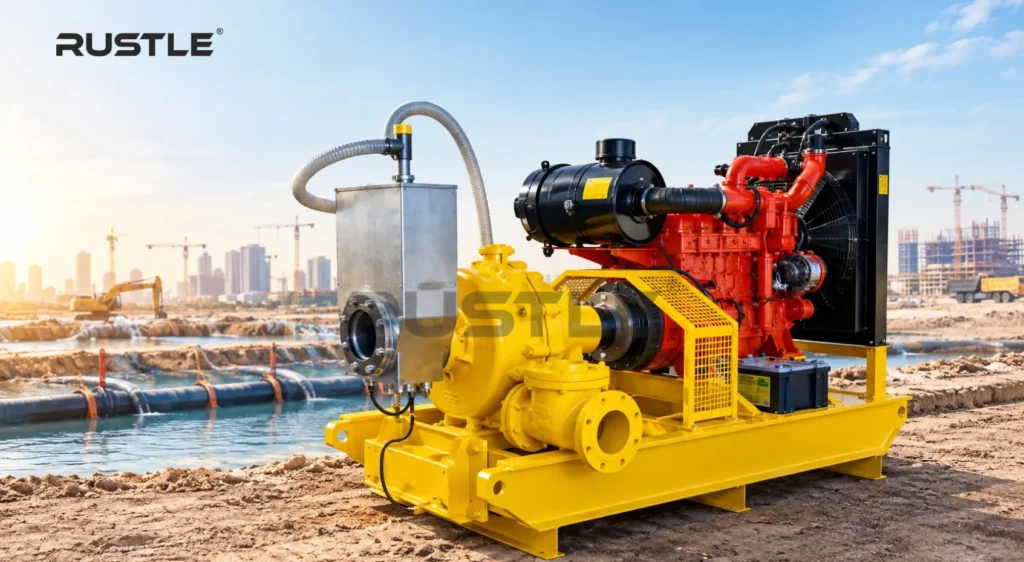
how to choose the right dewatering pump?
Choosing a dewatering pump is not simply a matter of selecting a 4-inch, 6-inch, 8-inch or larger pump. The correct pump must match the required flow rate, total head, water conditions, solids content, suction conditions, power availability, operating hours and site environment.
For contractors, mining operators, infrastructure companies and procurement teams, selecting the wrong pump can result in slow excavation, excessive fuel consumption, frequent clogging, premature component wear and costly project delays.
A properly selected dewatering system does the opposite. It keeps excavations workable, controls groundwater, reduces downtime and gives the project team predictable water-removal performance.
For projects in Saudi Arabia, UAE, Qatar, Oman, Kuwait, Bahrain, Africa and India, these considerations are particularly important because dewatering equipment may need to operate in high-temperature environments, remote locations, demanding construction conditions, mines, infrastructure projects and areas with variable water quality.
VEGO Pumps by Rustle manufactures industrial dewatering equipment in India for demanding construction, mining, infrastructure and industrial applications. Its published product range includes 6-inch and 8-inch auto-priming dewatering pumps, high-pressure pumps, solid-handling pumps and submersible pumps.
Why Correct Dewatering Pump Selection Matters
A dewatering pump is part of a complete hydraulic system. The pump must overcome both the required elevation and the resistance created by the discharge piping, bends, valves and other components.
A pump that delivers excellent flow at low head may perform poorly when connected to a long discharge pipeline.
Similarly, a high-head pump may be unnecessary if the application only requires moving water a short distance.
The first question should therefore be:
What are the actual hydraulic requirements of the project?
The key parameters are:
- Required flow rate
- Total dynamic head
- Suction lift
- Discharge distance
- Pipe diameter
- Water temperature
- Water quality
- Solids concentration
- Maximum solids size
- Daily operating hours
- Required duty cycle
- Available electrical power or diesel fuel
- Site mobility requirements
- Environmental and safety requirements
1. Calculate the Required Flow Rate
The first major selection factor is flow rate.
Flow is normally specified in:
- m³/hr
- L/min
- L/s
- GPM
For example, a contractor may determine that an excavation needs approximately 250 m³/hr of pumping capacity under normal operating conditions.
However, simply choosing a pump with a maximum capacity of 250 m³/hr is not enough.
The pump must be capable of delivering the required flow at the actual operating head.
This is why engineers should always review the pump performance curve rather than relying only on the maximum flow figure.
Practical engineering tip
Allow a reasonable engineering margin for changing site conditions, but avoid excessive oversizing.
An oversized pump can increase:
- Fuel consumption
- Capital cost
- Pipe velocity
- Hydraulic losses
- Wear
- Operating cost
The objective is not the biggest pump.
The objective is the right pump at the required duty point.
2. Determine Total Dynamic Head
Total dynamic head, or TDH, is one of the most commonly misunderstood pump-selection parameters.
It includes more than the vertical elevation.
A simplified calculation considers:
TDH = Static Head + Friction Losses + Pressure Requirement
Static head is the vertical difference between the pumping water level and the discharge point.
Friction losses depend on:
- Pipe length
- Pipe diameter
- Pipe material
- Flow velocity
- Number of elbows
- Valves
- Couplings
- Other fittings
Example
Imagine a construction site where:
- Water must be lifted 15 m
- Discharge pipeline extends another 150 m
- Several bends and valves are installed
- Required flow is 300 m³/hr
A pump capable of 300 m³/hr at zero head is not necessarily suitable.
The engineer needs the pump curve showing approximately 300 m³/hr at the calculated operating head.
This is one of the most important differences between selecting equipment from a catalogue and selecting equipment from an engineering duty point.
3. Choose the Correct Pump Type
Different water conditions require different pump technologies.
| Application | Typical Pump Choice | Main Consideration |
|---|---|---|
| Construction excavation | Auto-priming centrifugal | High-volume continuous drainage |
| Groundwater control | Auto-priming / wellpoint system | Reliable priming |
| Floodwater removal | High-capacity dewatering pump | Rapid deployment |
| Deep flooded pit | Submersible pump | Pump operates in water |
| Sludge and solids | Solid-handling pump | Large solids passage |
| Abrasive slurry | Slurry/wear-resistant pump | Abrasion resistance |
| Long-distance transfer | High-pressure pump | Higher head requirement |
| Sewer bypass | Self-priming/solid-handling pump | Solids and reliable priming |
Rustle’s product range follows this application-based approach, with separate dewatering, high-pressure, solid-handling and submersible pump categories.
4. Decide Between Diesel and Electric Drive
The power source should be selected according to the project environment rather than personal preference.
Diesel-driven dewatering pumps
Diesel pumps can be advantageous when:
- Grid power is unavailable
- The pump must be moved between locations
- The project is remote
- Emergency pumping is required
- Long-duration independent operation is required
Electric dewatering pumps
Electric pumps can be attractive where:
- Reliable electrical power is available
- Lower local emissions are important
- Noise reduction is required
- The pump will operate for long periods in a controlled environment
- Automation and electrical controls are preferred
Current industry research indicates continued growth in electric-driven pumping, alongside demand for portable diesel systems for temporary and remote applications.
RUSTLE’s published product information also indicates that its dewatering units can be supplied with diesel engines or electric motors depending on customer requirements.
5. Check Suction Lift and Priming Requirements
Priming is critical for many surface-mounted dewatering pumps.
A self-priming or auto-priming pump can remove air from the suction line and establish pumping without requiring repeated manual priming.
This is especially useful on:
- Construction sites
- Wellpoint systems
- Sewer bypass projects
- Temporary drainage systems
- Flood response operations
- Mining sites
- Rustle’s 6-inch and 8-inch dewatering models use automatic priming systems and are designed for applications including wellpoint dewatering, straight dewatering and sewer bypass.
Always verify the manufacturer’s specified maximum suction lift for the actual installation.
Do not assume that a pump’s nominal suction size automatically means it can lift water from any depth.
6. Consider Water Quality and Solids
Clear groundwater and solids-laden excavation water are not the same pumping application.
Before purchasing a pump, determine:
- Is the water clean?
- Does it contain sand?
- Is there silt?
- Are stones or debris present?
- What is the maximum particle size?
- Is the fluid abrasive?
- Is the water chemically aggressive?
If the water contains significant solids, a standard clean-water pump may experience rapid wear or blockage.
For heavier solids, a solid-handling pump may be more appropriate.
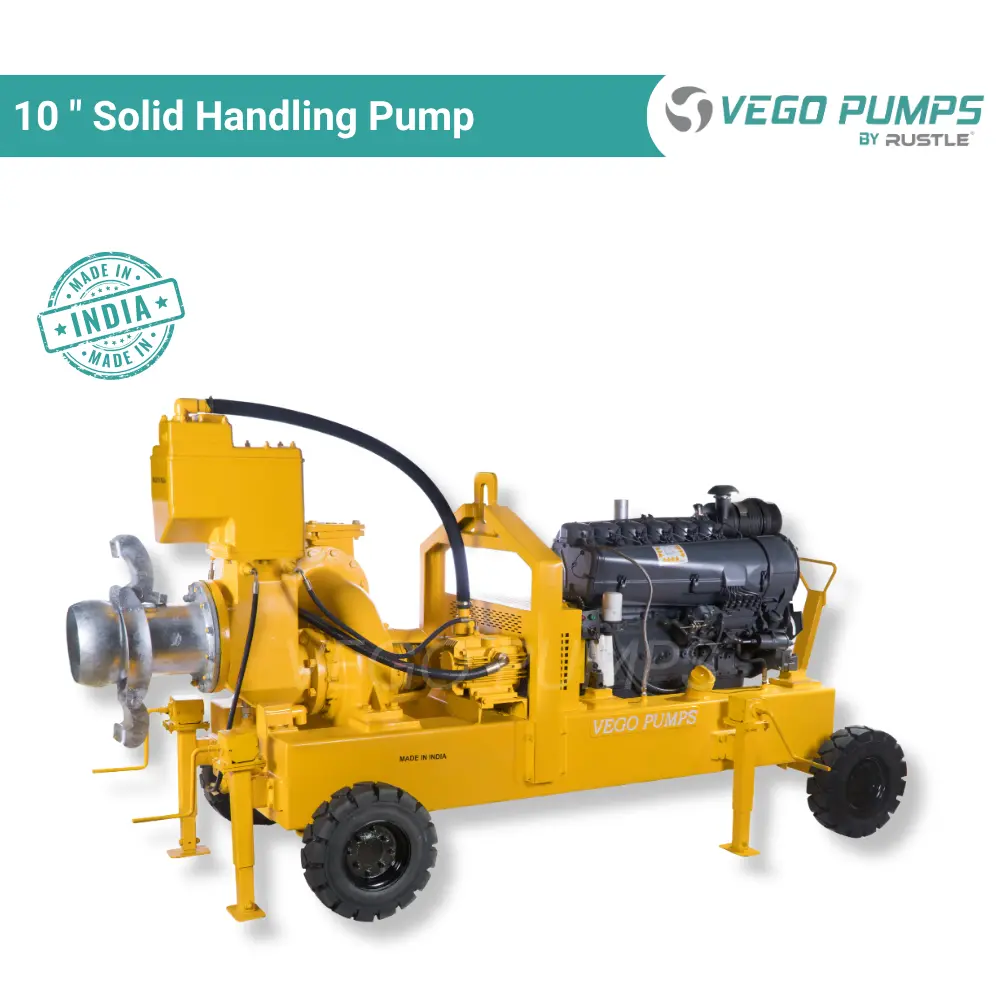
RUSTLE’s solid-handling range is designed for applications involving sludge, sewage and solids-laden liquids, with published models capable of handling large solids passages.
Expert tip
Do not specify a pump only from the average water condition.
Design around the worst realistic operating condition.
A pump that performs well in clean groundwater may struggle when heavy rain introduces silt, sand and debris into an excavation.
7. Select the Correct Pump Size
Pump diameter is important, but it should not be the only selection parameter.
For example, Rustle publishes the following specifications for two of its auto-priming dewatering models:
| Parameter | VEGO 6-Inch | VEGO 8-Inch |
|---|---|---|
| Suction | 6 in | 8 in |
| Delivery | 6 in | 8 in |
| Maximum published flow | 320 m³/hr | 640 m³/hr |
| Maximum published head | 38 m | 42 m |
| Drive | Diesel / electric options | Diesel / electric options |
| Mounting | Trailer / skid options | Trailer / skid options |
| Priming | Automatic | Automatic |
These are published maximum specifications, not a substitute for selecting the actual operating point from the performance curve.
For a project requiring 200 m³/hr at a particular head, for example, the engineer should compare the pump curves and determine which model provides that duty point efficiently.
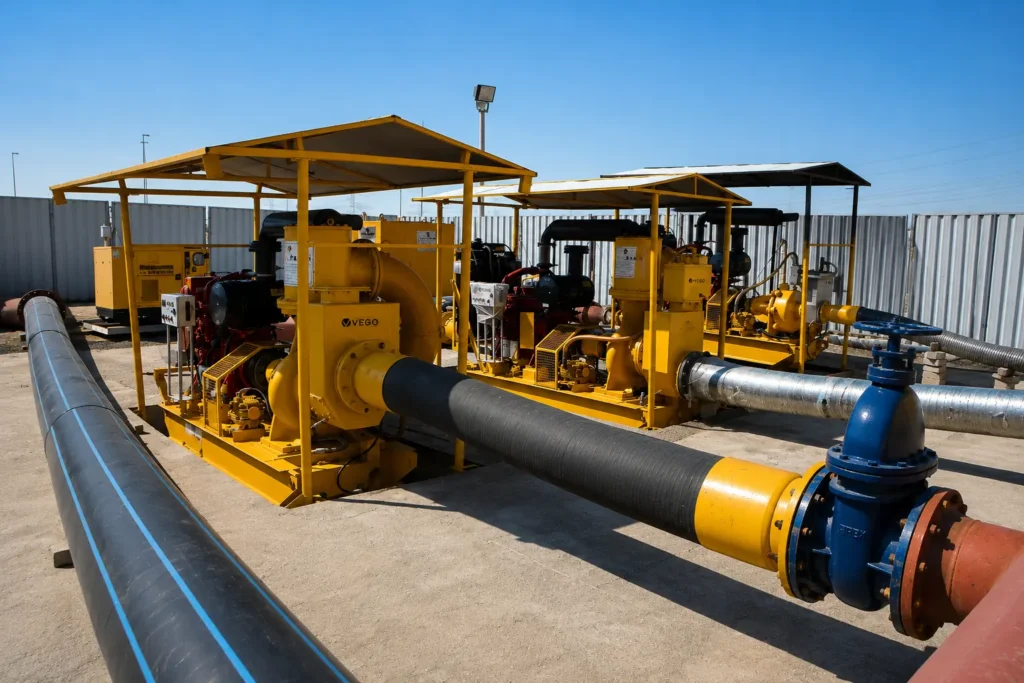
8. Consider Mobility and Site Conditions
A dewatering pump may need to move several times during a project.
For construction and infrastructure work, consider whether the unit should be:
- Skid mounted
- Trailer mounted
- Four-wheel site trailer mounted
- Pontoon mounted
- Permanently installed
- Easily lifted by crane or site equipment
Mobility can have a major impact on project productivity.
A technically suitable pump that takes hours to relocate may be less practical than a slightly different configuration that can be deployed quickly.
RUSTLE’s published dewatering models provide trailer and skid mounting options, while custom configurations can also be specified for particular project requirements.
9. Think About Maintenance Before Buying
A pump should not only be evaluated by its purchase price.
Procurement teams should also evaluate:
Total Cost of Ownership = Purchase Cost + Energy/Fuel + Maintenance + Spare Parts + Downtime
Ask the supplier:
- Are spare parts readily available?
- How quickly can wear parts be replaced?
- Is the pump easy to service at site?
- Are mechanical seals readily available?
- Are impellers and wear components replaceable?
- Is technical support available in the target region?
- What is the recommended maintenance interval?
RUSTLE states that it supplies spares for its pump products and wellpoint accessories, supporting maintenance and replacement requirements.
10. 2026–2028 Dewatering Pump Trends
The dewatering industry is moving beyond simply removing water.
Smarter monitoring
Remote monitoring can increasingly track:
- Pump running hours
- Water level
- Flow
- Pressure
- Engine condition
- Fuel consumption
- Vibration
- Temperature
- Fault conditions
This can help operators identify problems before they become major failures.
Energy efficiency
Energy and fuel consumption are becoming increasingly important procurement factors.
Instead of asking only:
“What is the pump price?”
professional buyers are increasingly asking:
“What will this pump cost us to operate for the next three years?”
Automation
Automatic start/stop based on water level can reduce unnecessary running time and support unattended pumping applications.
Rental and temporary pumping
Construction projects often have changing water requirements. Rental and temporary pumping solutions can therefore remain important where equipment needs change between project phases. Industry forecasts also identify rental fleets as an important part of the dewatering market.
More demanding mining applications
Mining operations increasingly require reliable water management as pits become deeper and operating conditions become more complex. Current market analysis identifies mining as a significant growth driver for high-capacity, wear-resistant dewatering equipment.
Common Dewatering Pump Selection Mistakes
Mistake 1: Selecting only by pipe diameter
An 8-inch pump is not automatically better than a 6-inch pump.
The duty point determines suitability.
Mistake 2: Ignoring total head
A pump may deliver impressive flow at low head but inadequate flow at the actual discharge condition.
Mistake 3: Ignoring solids
Sand, sludge and debris can rapidly increase wear or cause blockage.
Mistake 4: Oversizing the pump
Larger is not always better.
Oversizing can increase operating cost without improving project performance.
Mistake 5: Forgetting the discharge pipeline
A pump and pipeline must be designed as one hydraulic system.
Mistake 6: Buying based only on initial price
A cheaper pump can become expensive if spare parts, fuel consumption and downtime are high.
Mistake 7: Not planning for maintenance
A dewatering pump working continuously in a remote mine or construction site needs a realistic maintenance and spare-parts strategy.
Dewatering Pump Buying Checklist
Before sending a purchase enquiry, prepare these details:
- Required flow: ___ m³/hr
- Static head: ___ m
- Estimated total head: ___ m
- Suction lift: ___ m
- Discharge pipe diameter: ___
- Discharge pipeline length: ___ m
- Water type: ___
- Maximum solids size: ___ mm
- Approximate solids concentration: ___
- Operating hours/day: ___
- Diesel or electric: ___
- Trailer/skid/submersible: ___
- Ambient temperature: ___
- Project location: ___
- Required delivery date: ___
- Required quantity: ___
Providing these details to a pump manufacturer allows the engineering team to recommend a much more accurate configuration.
Choosing VEGO Pumps for Construction, Mining and Infrastructure
VEGO Pumps by Rustle provides industrial pumping equipment manufactured in Coimbatore, India.
The company’s published information describes manufacturing, inspection and testing capabilities, including pump inspection, casting NDT, impeller dynamic balancing, hydro testing and complete pump performance testing.
VEGO’s range includes:
- Auto-priming dewatering pumps
- High-pressure pumps
- Solid-handling pumps
- Submersible pumps
- Pump spares and accessories
The company’s published applications cover construction, mining, infrastructure, municipal drainage, industrial water handling and other demanding applications.
For buyers in Saudi Arabia, UAE, Qatar, Oman, Kuwait, Bahrain, Africa and India, application-specific pump selection is particularly important when project conditions vary between groundwater, excavation water, floodwater, slurry and long-distance water transfer.
Frequently Asked Questions
1. How do I choose the right dewatering pump?
Start with the required flow rate and total dynamic head. Then consider suction lift, water quality, solids, power source, operating hours, mobility and maintenance requirements.
2. What size dewatering pump do I need?
Pump size depends on the required flow and head, not simply the size of the excavation or discharge pipe. Use the manufacturer’s performance curve to select the correct operating point.
3. Is a diesel or electric dewatering pump better?
Neither is universally better. Diesel is useful where mobility and independent power are important, while electric pumps can be advantageous where reliable electrical power and lower local emissions are priorities.
4. What is a self-priming dewatering pump?
A self-priming pump is designed to remove air from the suction system and establish pumping without repeated manual priming.
5. Can a dewatering pump handle sand and sludge?
Some pumps can. If the water contains significant solids, specify a suitable solid-handling or slurry-capable pump rather than assuming a standard drainage pump will be adequate.
6. What is total dynamic head?
Total dynamic head represents the total resistance the pump must overcome, including elevation and hydraulic losses through the discharge system.
7. Why is pump performance at duty point important?
Maximum flow and maximum head are usually different points on a pump curve. The pump must provide the required flow at the actual system head.
8. Are auto-priming pumps suitable for construction sites?
Yes, auto-priming centrifugal pumps are widely used for construction dewatering, groundwater control, wellpoint systems and temporary drainage applications.
9. What should I consider for mining dewatering?
Consider continuous-duty requirements, abrasive water, solids, elevation, long discharge pipelines, pump mobility, wear protection and availability of spare parts.
10. How often should a dewatering pump be maintained?
Maintenance intervals depend on the pump, engine or motor, fluid condition and operating environment. Always follow the manufacturer’s maintenance schedule and inspect the pump more frequently under abrasive or continuous-duty conditions.
Conclusion: Choose the Pump for the Application, Not Just the Price
The right dewatering pump is the one that matches the actual hydraulic duty and site conditions.
Before purchasing, calculate the required flow and total head, understand the water and solids characteristics, select the appropriate pump technology, evaluate diesel versus electric drive, consider mobility and plan for maintenance and spare parts.
For contractors, engineers and procurement managers, this approach reduces the risk of underperforming equipment and helps control the long-term cost of water management.
VEGO Pumps by Rustle provides industrial dewatering, high-pressure, solid-handling and submersible pumping solutions for demanding applications across construction, mining, infrastructure and industrial sectors.
Need help selecting the right dewatering pump for your project?
Send VEGO Pumps your required flow, total head, suction lift, discharge distance, water condition, solids size and project location.
The VEGO technical team can help you identify the appropriate pump configuration for your application.
Get a project-specific dewatering pump recommendation from VEGO Pumps today.