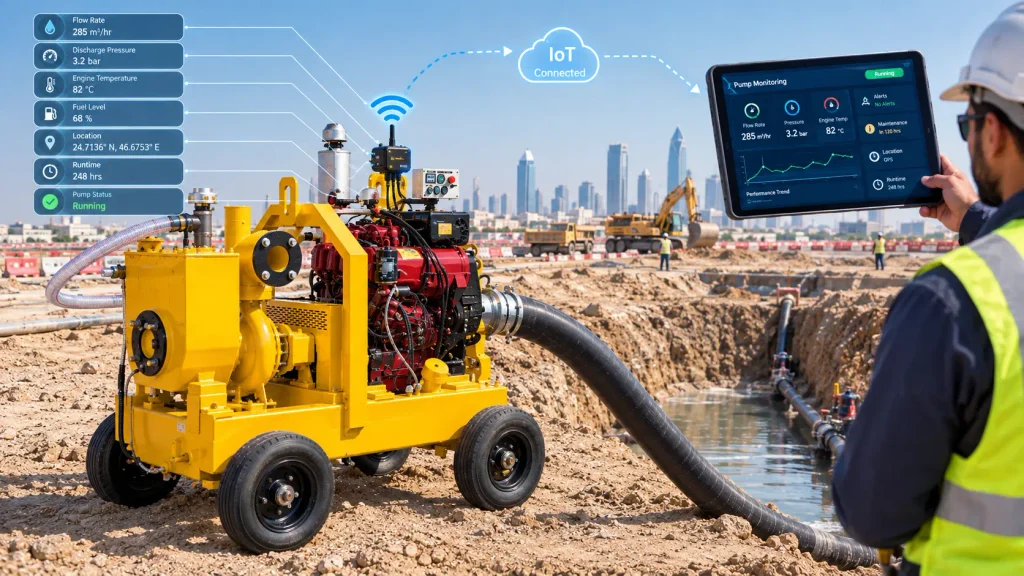
Industrial dewatering is changing. A pump is no longer expected only to move water from one point to another. For modern construction, mining, infrastructure and industrial projects, contractors increasingly need to know where the pump is, whether it is running correctly, how much water it is handling, when maintenance is due and whether a problem is developing.
That is where IoT technology and remote pump monitoring (IoT enabled dewatering pumps) are becoming important.
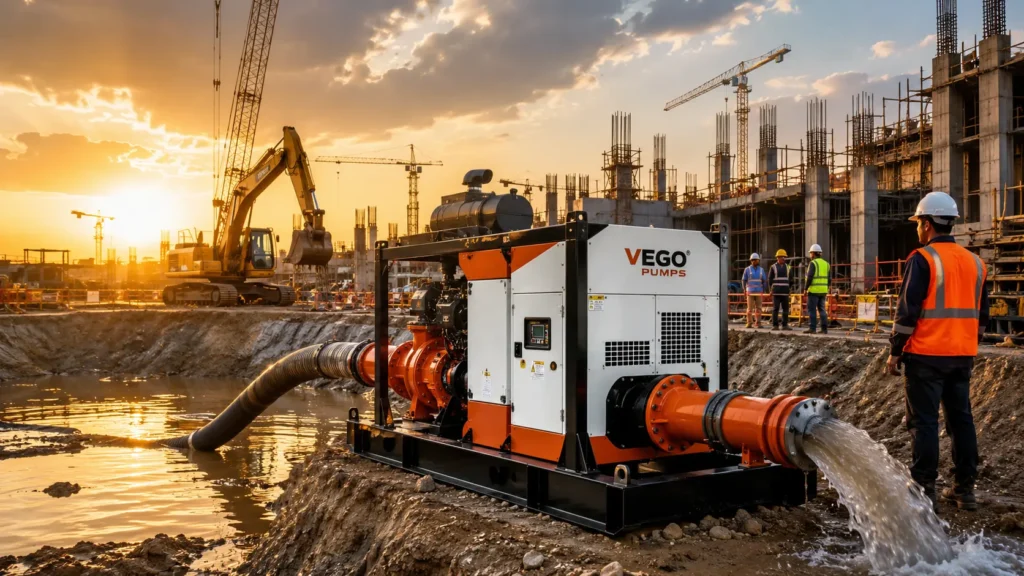
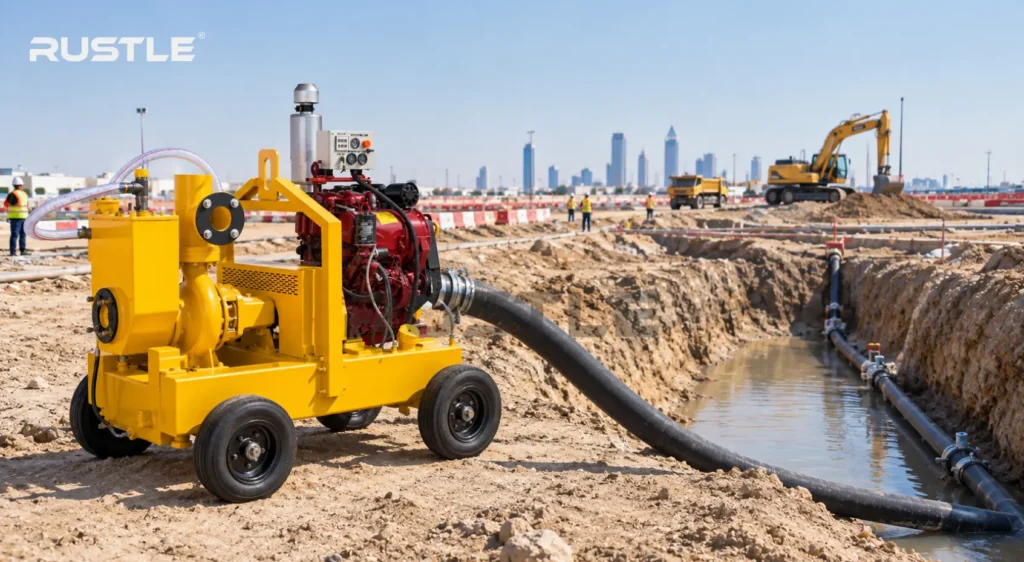
For projects across Saudi Arabia, UAE, Qatar, Oman, Kuwait, Bahrain, Africa and India, connected dewatering equipment can be particularly useful where pumps operate in remote locations, harsh environments or across multiple project sites.
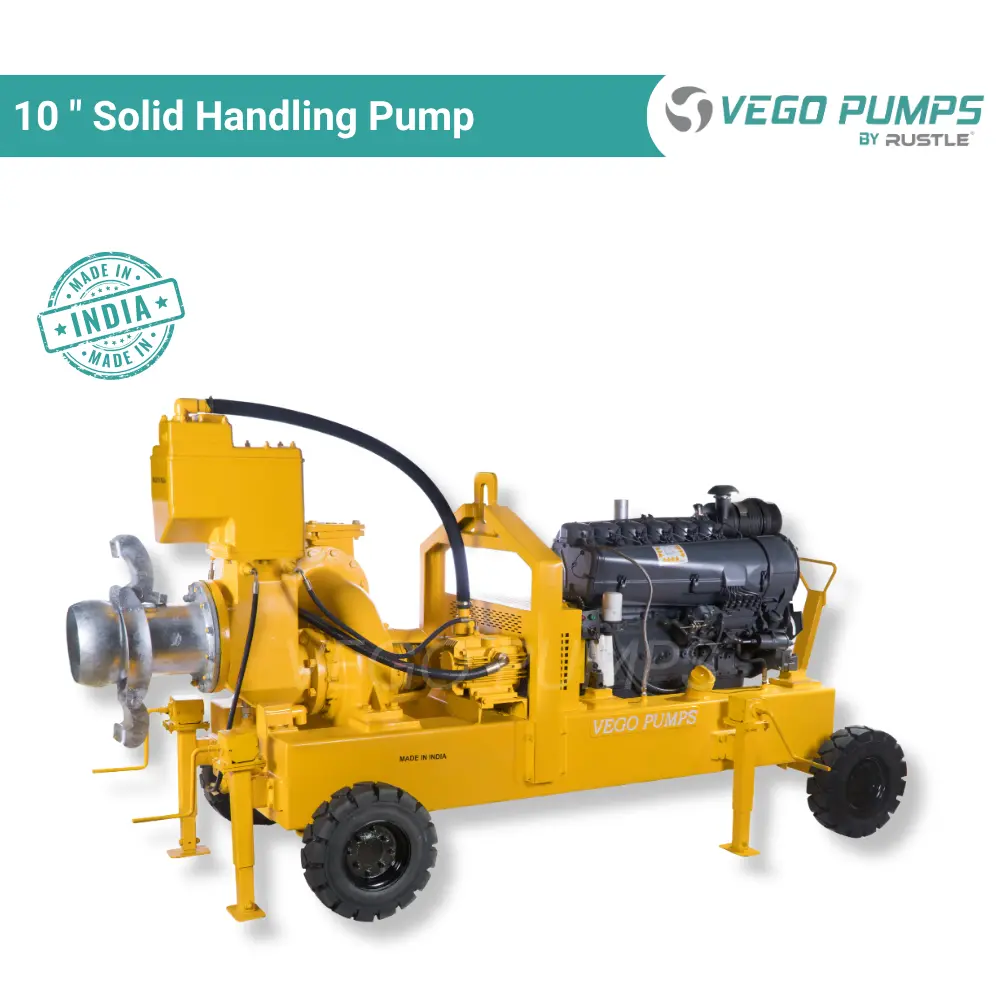
VEGO Pumps by RUSTLE manufactures industrial dewatering equipment in Coimbatore, India, with a product range covering auto-priming dewatering pumps, high-pressure pumps, solid-handling pumps and submersible pumps.
Important product-positioning note: RUSTLE’s current public product pages establish its dewatering-pump range and custom engineering capabilities, but do not currently document a specific branded VEGO IoT platform. Therefore, this article describes IoT-enabled/IoT-ready monitoring as a technology layer that can be integrated with VEGO dewatering equipment, rather than claiming a specific proprietary RUSTLE IoT platform that has not been publicly documented.
What Is an IoT-Enabled Dewatering Pump?
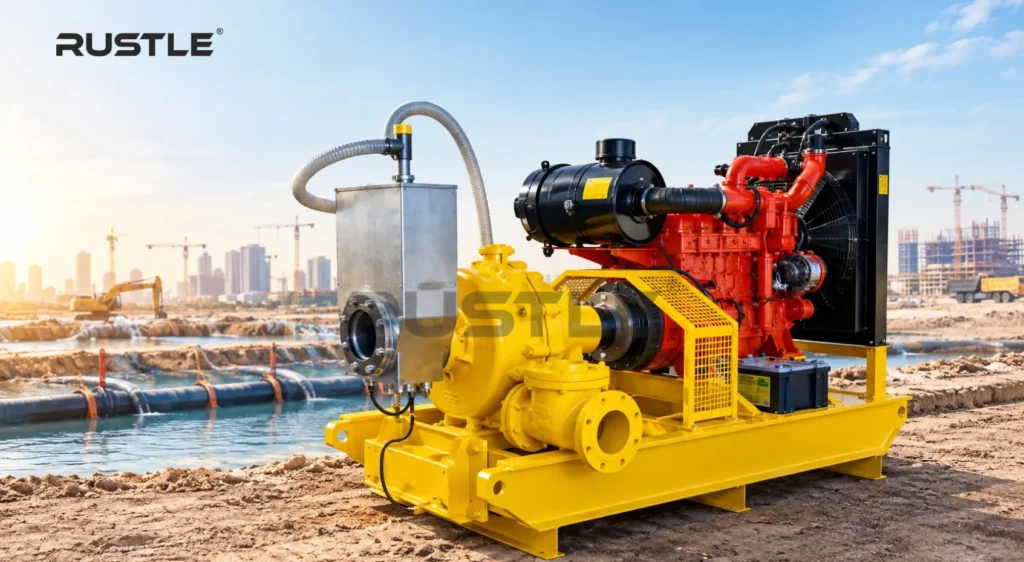
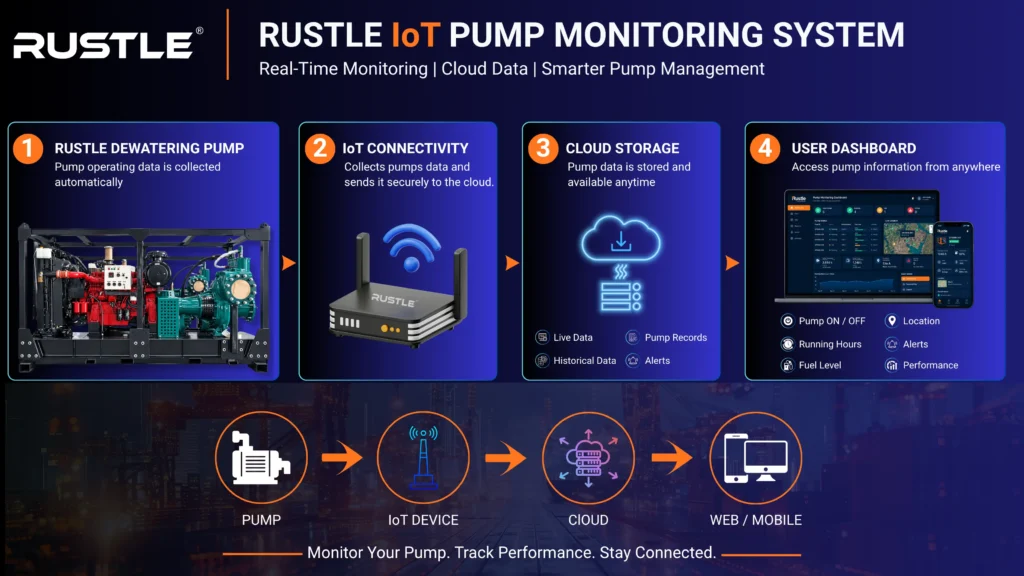
An IoT-enabled dewatering pump combines a conventional industrial pumping system with sensors, connectivity, data logging and remote monitoring.
Instead of relying entirely on an operator physically visiting the pump, selected operating information can be transmitted to a dashboard, mobile device or control system.
Depending on the monitoring configuration, useful parameters can include:
- Pump running status
- Operating hours
- Water level
- Flow rate
- Suction pressure
- Discharge pressure
- Engine or motor temperature
- Vibration
- Fuel level
- Fuel consumption
- Electrical current
- Fault or alarm status
- GPS/location
- Maintenance intervals
This direction is already visible across the pump industry. Xylem’s digital pumping solutions, for example, describe remote monitoring, alarms, diagnostics and mobile-asset tracking, while Kirloskar’s IoT solution describes real-time monitoring and predictive alerts.
Why IoT Matters for Industrial Dewatering
Traditional dewatering management often depends on site personnel checking pumps at scheduled intervals.
That approach can work for a small, easily accessible project.
But consider a contractor operating:
- 10 pumps across several excavation zones
- A remote mining site
- Multiple infrastructure projects
- Temporary flood-control pumps
- Pumps operating overnight
- Equipment spread over several kilometres
Physically checking every unit becomes time-consuming.
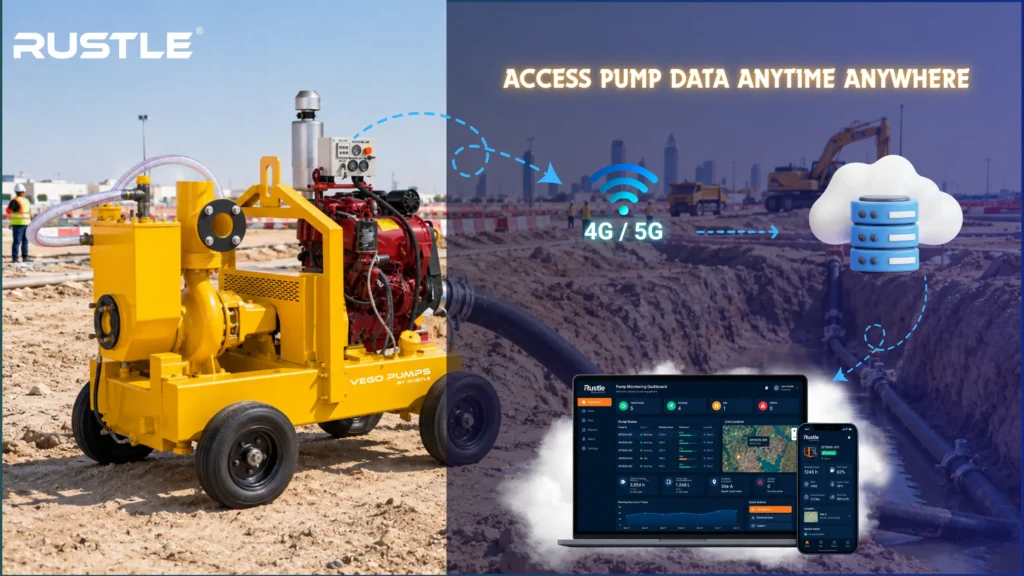
With remote monitoring, the project team can receive information about equipment status without constantly travelling to each pump.
Example
Suppose a pump normally operates at a stable discharge pressure.
Over several hours, the pressure begins changing while flow decreases.
Possible causes could include:
- Suction blockage
- Strainer restriction
- Air entering the suction line
- Impeller wear
- Discharge-line changes
- Increasing system resistance
The monitoring system does not replace engineering diagnosis, but it can draw attention to the abnormal operating condition earlier.
That is the real value of IoT: better visibility before a small problem becomes an expensive interruption.
How IoT Monitoring Works With a Dewatering Pump
A typical connected system can be understood in five layers.
| Layer | Function |
|---|---|
| Pump | Moves groundwater, stormwater, wastewater or other fluids |
| Sensors | Measure operating conditions |
| IoT controller | Collects and processes information |
| Connectivity | Sends data through cellular, Wi-Fi or other networks |
| Dashboard | Allows authorised users to view data and alerts |
The exact configuration depends on the pump, engine/motor, site conditions and monitoring objectives.
For a diesel-powered VEGO dewatering pump, for example, an IoT package could potentially monitor engine-related parameters alongside pump operating information.
For an electric system, monitoring could focus more heavily on electrical parameters, motor condition, pump performance and protection events.
Key Benefits of IoT-Enabled Dewatering Pumps
1. Remote Pump Monitoring
The most obvious benefit is visibility.
A project manager can potentially check whether a pump is:
Running → Stopped → In alarm → Due for maintenance
without making a physical inspection for every routine status check.
This becomes particularly useful for remote mining, infrastructure and emergency pumping operations.
Xylem’s field telemetry solutions demonstrate how remote monitoring can be used for mobile pumps, including remote control, parameter monitoring, location information, alarms and maintenance diagnostics.
2. Faster Response to Pump Problems
A conventional inspection might identify a problem hours after it begins.
A connected system can generate an alert when a monitored parameter crosses a defined threshold.
Potential alerts include:
- High temperature
- Low fuel
- Excessive vibration
- Abnormal pressure
- Pump stopped unexpectedly
- High water level
- Excessive operating hours
- Electrical fault
This is especially relevant where uncontrolled water can affect excavation productivity or site safety.
3. Predictive and Condition-Based Maintenance
Maintenance has traditionally been based on operating hours or fixed calendar intervals.
IoT creates the possibility of using actual operating information to support condition-based maintenance.
For example:
Normal vibration → increasing vibration → abnormal vibration → inspection
Instead of waiting for a component to fail, the maintenance team can investigate the trend.
This does not mean every IoT reading automatically predicts a failure. Sensor quality, thresholds, data history and engineering interpretation all matter.
4. Fuel and Energy Management
For diesel dewatering pumps, fuel consumption can be an important operating expense.
A monitoring system can record:
- Engine running hours
- Fuel level
- Fuel consumption
- Refuelling events
- Pump operating periods
For electric pumps, monitoring can instead focus on:
- Voltage
- Current
- Power consumption
- Operating hours
- Motor loading
This supports a shift from simply asking:
“How much did the pump cost?”
to:
“How much does it cost to keep this pump operating?”
That lifecycle perspective is increasingly important for industrial procurement.
5. Better Fleet Management
IoT becomes even more useful when a contractor operates several pumps.
Imagine a dashboard showing:
| Pump | Location | Status | Runtime | Alert |
|---|---|---|---|---|
| DP-01 | Excavation A | Running | 286 hr | Normal |
| DP-02 | Excavation B | Running | 341 hr | Service due |
| DP-03 | Mine Zone C | Stopped | 198 hr | Check required |
| DP-04 | Flood Zone D | Running | 92 hr | Normal |
Instead of managing equipment through separate phone calls and handwritten records, the project team can have a central operational view.
This approach is already appearing in commercial dewatering solutions. AMCO, for example, describes telemetry for diesel and electric dewatering pumps that can report parameters such as run hours, fuel, pressure, flow, location and alarms.
IoT Applications for VEGO Dewatering Pumps
VEGO’s published range includes 6-inch and 8-inch auto-priming dewatering pumps, high-pressure pumps, solid-handling pumps and submersible pumps. Its pumps can also be configured with diesel or electric drives depending on requirements.
An IoT monitoring layer can be particularly relevant to the following applications.
Construction
- Foundation excavation
- Basement construction
- Road projects
- Bridge construction
- Metro and tunnel projects
- Pipeline trenching
- Infrastructure development
Mining
- Open-pit mine dewatering
- Quarry drainage
- Underground water management
- Temporary pumping
- Remote pumping locations
Municipal and Flood Control
- Stormwater management
- Emergency drainage
- Floodwater removal
- Temporary bypass pumping
Industrial Applications
- Sump drainage
- Process-water transfer
- Plant maintenance
- Industrial wastewater applications
RUSTLE currently identifies construction, mining, infrastructure, municipal and industrial applications among its served sectors.
IoT vs Conventional Pump Monitoring
| Feature | Conventional Monitoring | IoT-Enabled Monitoring |
|---|---|---|
| Pump status | Physical inspection | Remote dashboard |
| Runtime | Manual recording | Automatic logging |
| Fault identification | Site visit | Automated alert possible |
| Fuel tracking | Manual | Sensor-based option |
| Location | Manual | GPS option |
| Maintenance | Calendar/runtime based | Runtime + condition data |
| Multi-pump management | Difficult | Centralised dashboard |
| Historical data | Limited | Data logging possible |
| Remote projects | More difficult | Better visibility |
| Emergency response | Manual | Alerts can improve response |
IoT does not eliminate the need for operators or maintenance technicians. It gives them better information to make decisions.
2026–2028 Trends in Smart Dewatering
The industry is moving toward connected equipment, lifecycle monitoring and more data-driven maintenance.
2026: Remote Visibility Becomes More Practical
Current industrial pumping solutions increasingly include:
- Remote monitoring
- Mobile dashboards
- Equipment alarms
- Runtime tracking
- Fuel monitoring
- Condition monitoring
- Digital maintenance records
The 2026 deployment of IoT monitoring across hundreds of portable dewatering pumps by Mumbai’s BMC also demonstrates that connected monitoring is moving beyond demonstration projects into real municipal water-management operations.
2027: More Condition-Based Maintenance
The next development is likely to be greater use of historical operating data.
Instead of simply reporting:
“Pump running.”
systems can increasingly help answer:
“Is the pump operating differently from its normal condition?”
This could support maintenance planning and reduce unnecessary physical inspections.
2028: Connected Pumping Systems
Longer term, the direction is toward systems combining:
Pump + Sensors + Controls + Connectivity + Analytics + Maintenance
Potential developments include:
- Automatic water-level control
- Remote start/stop
- Fleet dashboards
- Energy optimisation
- Predictive maintenance
- Digital service records
- Integration with site SCADA
- Automated operational reports
The technology should still be treated as a tool. Correct pump sizing, hydraulic design, installation and maintenance remain fundamental.
How to Select an IoT-Ready Dewatering Pump
Do not begin with the IoT dashboard.
Begin with the hydraulic duty.
Step 1: Determine Required Flow
Specify the required flow in:
- m³/hr
- L/min
- L/s
- GPM
Include expected peak inflow rather than designing only around normal conditions.
Step 2: Calculate Total Dynamic Head
Consider:
- Static lift
- Discharge elevation
- Pipe length
- Pipe diameter
- Valves
- Bends
- Fittings
- Friction losses
A pump’s maximum flow number alone is not sufficient for selection.
Step 3: Check Water Quality
Identify whether the water contains:
- Sand
- Silt
- Clay
- Gravel
- Sludge
- Abrasive particles
- Fibrous material
- Chemicals or corrosive components
For solids-laden water, select a pump specifically designed for the expected solids condition.
Step 4: Select the Power Source
| Site condition | Potential configuration |
|---|---|
| No reliable grid power | Diesel |
| Reliable electrical supply | Electric |
| Remote mobile project | Diesel/mobile package |
| Permanent installation | Electric may be practical |
| Critical application | Duty + standby arrangement |
| Changing project conditions | Mobile/skid/trailer system |
Step 5: Define the IoT Requirements
Before specifying an IoT system, decide what information is actually useful.
For example:
Basic: Runtime + location + pump status
Intermediate: Pressure + flow + fuel + alarms
Advanced: Vibration + temperature + energy + condition analytics
This prevents purchasing technology that produces data nobody actually uses.
Maintenance Tips for IoT-Enabled Dewatering Pumps
IoT is not a replacement for physical maintenance.
Daily or routine inspection
Check:
- Suction hose
- Discharge line
- Couplings
- Leaks
- Oil
- Coolant
- Fuel
- Battery
- Strainers
- Unusual vibration
- Unusual noise
Periodic maintenance
Inspect:
- Mechanical seals
- Bearings
- Impeller
- Wear components
- Priming system
- Vacuum pump
- Engine filters
- Electrical connections
- Sensors and communication hardware
Important expert tip
Never assume a sensor is correct simply because data appears on a dashboard.
Sensor calibration, wiring, connectivity and data quality should be checked as part of the maintenance program.
Common Mistakes When Implementing IoT Pump Monitoring
1. Monitoring everything
More data does not automatically mean better management.
Monitor the parameters that can influence operational decisions.
2. Ignoring hydraulic performance
A sophisticated dashboard cannot compensate for an incorrectly sized pump.
3. No alert strategy
If every small variation creates an alarm, operators can eventually ignore alerts.
Use sensible thresholds.
4. No connectivity plan
Remote sites may have inconsistent cellular or network coverage.
Connectivity must be considered during system design.
5. No maintenance response
An alert is useful only when someone has responsibility for responding to it.
6. Treating IoT as a substitute for engineering
IoT supports engineering decisions; it does not replace pump curves, hydraulic calculations, inspections or qualified technicians.
Why Consider VEGO Pumps by RUSTLE?
RUSTLE manufactures industrial equipment in Coimbatore, India, with in-house manufacturing, machining, fabrication, assembly and testing capabilities. Its published pump portfolio includes dewatering, high-pressure, solid-handling and submersible pumps.
VEGO’s 6-inch and 8-inch dewatering systems are designed for demanding applications including wellpoint dewatering and general water removal, with diesel and electric drive configurations available.
For connected pumping projects, the important discussion is therefore not simply:
“Can I add IoT?”
It should be:
“Which pump, sensors, controls and monitoring information will give my project the most useful operational visibility?”
That is the approach RUSTLE can take when configuring a dewatering solution for a specific application.
Expert Buying Checklist
Before contacting RUSTLE, prepare:
- Required flow rate
- Total dynamic head
- Suction lift
- Discharge pipe diameter
- Pipeline length
- Water type
- Maximum solids size
- Solids concentration
- Required operating hours
- Diesel or electric preference
- Trailer/skid/submersible requirement
- Ambient temperature
- Project location
- Number of pumps
- Standby requirement
- IoT monitoring requirements
- Required delivery date
The more accurate this information is, the more accurately the pump can be engineered around the actual duty.
Frequently Asked Questions
1. What is an IoT-enabled dewatering pump?
It is a dewatering pump equipped with sensors and connected monitoring technology that can transmit information such as operating status, runtime, pressure, flow, temperature, fuel or alarms to a remote monitoring system.
2. Can IoT technology be added to a diesel dewatering pump?
Yes. Depending on the pump and engine configuration, external sensors and telemetry equipment can be integrated to monitor selected operating parameters.
3. What parameters can IoT monitor on a dewatering pump?
Potential parameters include runtime, pressure, flow, water level, fuel level, temperature, vibration, electrical current, location and alarm status.
4. Can IoT prevent pump failure?
IoT cannot guarantee failure prevention. However, monitoring trends and abnormal operating conditions can help maintenance teams identify potential problems earlier.
5. Is IoT useful for construction dewatering?
Yes, particularly where pumps operate remotely, continuously, overnight or across multiple excavation areas.
6. Is IoT useful for mine dewatering?
It can be particularly valuable in mines because pumping equipment may be distributed across large or difficult-to-access areas.
7. Can an IoT system monitor multiple pumps?
Yes. A properly designed fleet-monitoring system can collect information from multiple connected pumps and present it through a central dashboard.
8. Does IoT replace regular pump maintenance?
No. Sensors and remote monitoring complement, rather than replace, physical inspection and scheduled maintenance.
9. Can IoT monitor diesel fuel consumption?
Depending on the telemetry configuration, fuel level and consumption can be monitored and logged.
10. Can electric dewatering pumps use IoT?
Yes. Electric pumps can be monitored for parameters such as runtime, current, voltage, temperature, pressure, flow and fault conditions, depending on the control and sensor system.
11. Are IoT dewatering pumps suitable for Saudi Arabia and the GCC?
Connected monitoring can be particularly useful for remote construction, mining and infrastructure projects across Saudi Arabia, UAE, Qatar, Oman, Kuwait and Bahrain. Equipment configuration should account for ambient conditions, connectivity, electrical requirements and project-specific regulations.
12. Can VEGO Pumps be configured for IoT monitoring?
IoT monitoring can be considered as a configurable technology layer for suitable VEGO pump installations. The exact sensors, telemetry hardware, communication method and monitored parameters should be confirmed with RUSTLE for the specific pump and project.
13. What should I provide to RUSTLE when requesting an IoT dewatering pump?
Provide flow rate, total head, suction lift, water characteristics, solids content, operating hours, power source, site location, number of pumps and the parameters you want to monitor.
Conclusion: Move From Pump Monitoring to Smart Dewatering
The future of industrial dewatering is not simply about installing a larger pump.
It is about creating a more visible, measurable and manageable pumping system.
IoT technology can give contractors, engineers and procurement teams better information about pump operation, maintenance requirements, fuel or energy use and equipment status. For remote construction, mining, infrastructure and flood-control projects, that visibility can be especially valuable.
But the foundation remains good engineering:
Correct flow + correct head + correct pump + correct installation + proper maintenance + useful monitoring.
RUSTLE can help evaluate these requirements and configure VEGO pumping equipment around the actual project duty.
Need a smart dewatering solution?
Send RUSTLE your flow rate, head, water condition, solids content, power source, project location and IoT monitoring requirements.
Talk to RUSTLE / VEGO Pumps for a project-specific dewatering solution and technical quotation.